Why Regular AML Training Is Essential for UAE Businesses
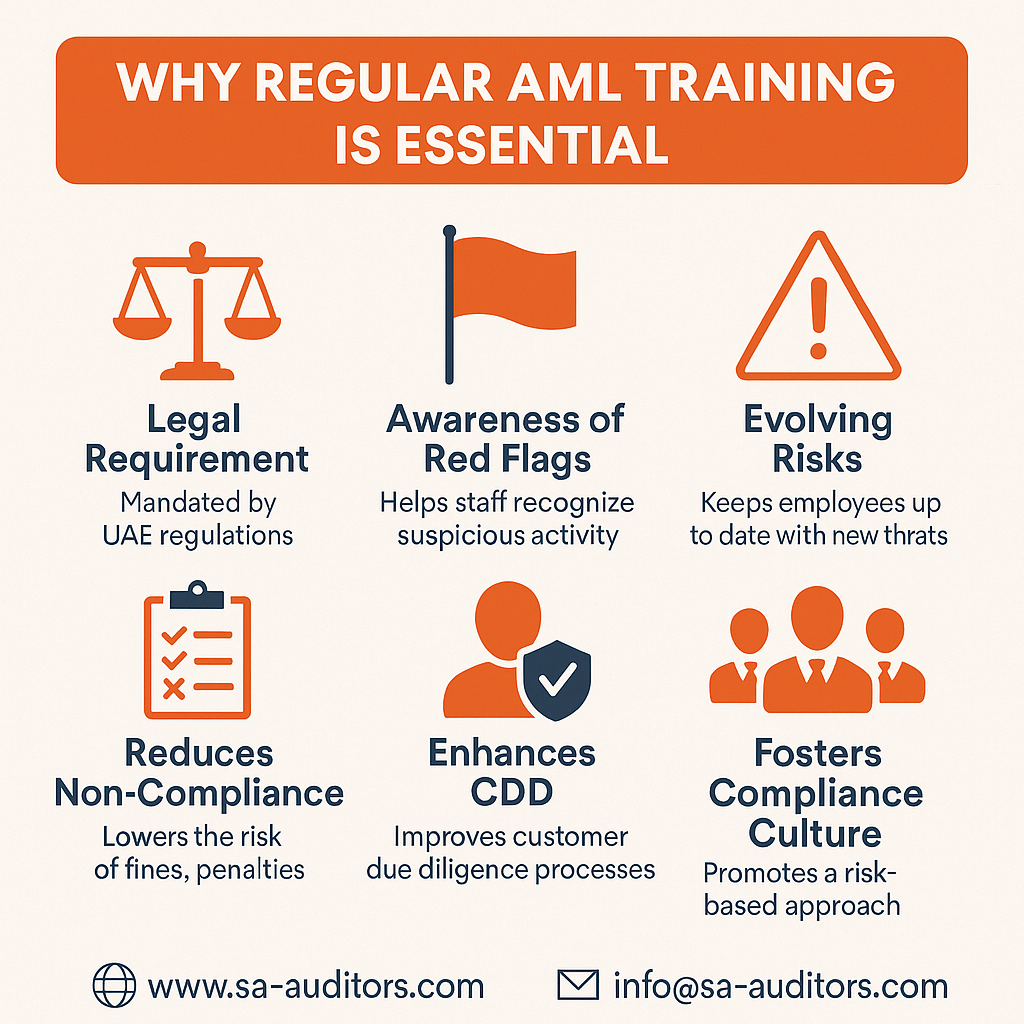
Introduction
The UAE has positioned itself as a global financial hub, attracting investors, businesses, and high-value transactions across multiple sectors. This growth, however, also increases the risk of money laundering (ML) and terrorist financing (TF). To counter these threats, the UAE follows FATF standards and enforces strict AML/CFT requirements under Federal Decree-Law No. 20 of 2018 and Cabinet Decision No. 10 of 2019.
One of the most critical compliance obligations for financial institutions and DNFBPs (Designated Non-Financial Businesses and Professions) is ensuring regular AML training for staff.
1. Legal and Regulatory Requirement
The Ministry of Economy and sector regulators mandate periodic AML training for employees.
Failure to train staff may lead to administrative penalties, fines, and even license suspension.
FATF emphasizes training as a key element of a robust compliance program.
2. Building Awareness of Red Flags
Employees often act as the first line of defense.
Regular training ensures they recognize suspicious patterns such as unusual customer behavior, large cash transactions, or dealings with high-risk jurisdictions.
Without continuous awareness, critical warning signs may be missed.
3. Keeping Up with Evolving Risks
Money laundering techniques are constantly changing — from trade-based laundering to cryptocurrency misuse.
Regular training updates staff on new red flags, typologies, and regulatory expectations.
It ensures businesses adapt to the latest FATF mutual evaluation findings and UAE FIU alerts.
4. Reducing the Risk of Non-Compliance
Non-compliance not only leads to heavy fines but also damages reputation.
Trained employees are better equipped to file quality Suspicious Transaction Reports (STRs), reducing over-reporting and under-reporting risks.
Strong training programs demonstrate a company’s commitment to a risk-based approach.
5. Enhancing Customer Due Diligence (CDD)
Training strengthens employees’ ability to perform KYC/CDD and Enhanced Due Diligence (EDD) checks.
Staff learn how to verify beneficial ownership, identify politically exposed persons (PEPs), and assess high-risk clients.
This reduces the likelihood of onboarding customers linked to illicit activities.
6. Fostering a Culture of Compliance
Regular training shifts compliance from being a box-ticking exercise to part of company culture.
Employees at all levels feel responsible for protecting the business against ML/TF risks.
A strong compliance culture also improves trust with banks, regulators, and stakeholders.
7. Tailored Training for Different Roles
Frontline Staff: Learn to identify red flags during onboarding or transactions.
Compliance Teams: Gain expertise in STR filing, regulatory updates, and monitoring tools.
Senior Management: Understand oversight responsibilities and how to allocate resources for AML controls.
8. Competitive Advantage
Businesses that maintain high AML standards attract stronger international partnerships.
Compliance assurance improves credibility with banks and regulators.
In today’s environment, strong AML compliance is a key differentiator in building long-term sustainability.
📩 For customized AML training programs and compliance support, contact us:
Sheikh Anwar Accounting & Auditing LLC
🌐 www.sa-auditors.com
📧 info@sa-auditors.com

