Why AML Is Not Just a Bank’s Responsibility
Introduction
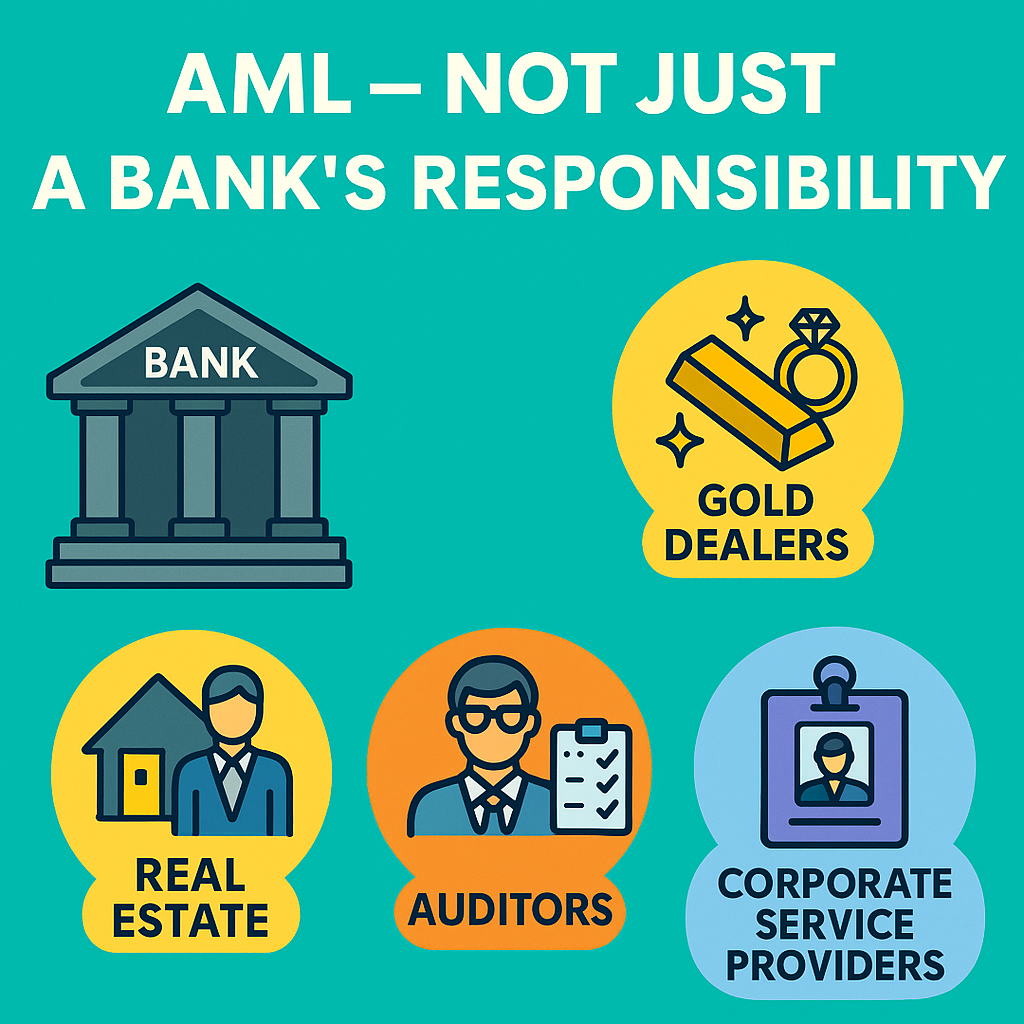
When people hear the term Anti-Money Laundering (AML), they often assume it is the sole responsibility of banks and financial institutions. While banks do play a major role, AML compliance extends far beyond the financial sector. In the UAE, a wide range of businesses—particularly those categorized as Designated Non-Financial Businesses and Professions (DNFBPs)—are equally responsible for implementing AML measures.
It explains why AML is not just for banks, highlights the sectors involved, and shows how businesses of all sizes must contribute to protecting the UAE’s financial system.
________________________________________
The Misconception: AML Is Only for Banks
Banks are often associated with AML because they handle most financial transactions, conduct Know Your Customer (KYC) checks, and report suspicious activity. However, criminals frequently use non-banking channels—such as real estate, gold trading, and corporate structures—to launder money.
Recognizing this, the UAE has placed AML obligations on a broader range of industries.
________________________________________
Who Else Must Comply with AML in the UAE?
1. Real Estate Sector
• Property transactions are attractive for laundering large sums of money.
• Developers, brokers, and agents must conduct Customer Due Diligence (CDD) and report cash transactions above AED 55,000.
2. Dealers in Precious Metals and Stones (DPMS)
• The gold and jewellery sector is highly vulnerable due to high-value, portable assets.
• Jewellers must verify customer identity, report suspicious transactions, and maintain records for at least five years.
3. Auditors and Accountants
• Criminals may exploit professional services to create complex structures for hiding illicit funds.
• Accountants and auditors must assess client risks, verify beneficial ownership, and report suspicious activities.
4. Corporate Service Providers
• Company formation and structuring can be used to obscure Ultimate Beneficial Owners (UBOs).
• Service providers must ensure transparency and disclose ownership information.
5. Other DNFBPs
• Lawyers, notaries, and trust companies also fall under AML obligations when handling financial or business transactions on behalf of clients.
________________________________________
Why AML Responsibilities Are Shared Beyond Banks
1. Criminals Exploit Weak Links
If only banks were regulated, money launderers would shift to unregulated sectors like real estate or jewellery. Expanding AML compliance ensures there are no weak points.
2. Economic Impact
The UAE’s open economy relies on global trade, investment, and tourism. AML compliance across all sectors strengthens the country’s reputation and protects its role as a trusted financial hub.
3. Regulatory Enforcement
The UAE’s Federal Decree-Law No. 20 of 2018 and Cabinet Decision No. 10 of 2019 explicitly extend AML obligations to DNFBPs. Non-compliance can lead to fines up to AED 5 million, license suspension, or even imprisonment.
4. International Alignment
As a member of the Financial Action Task Force (FATF), the UAE must show that AML compliance applies not only to banks but to all sectors vulnerable to financial crime.
________________________________________
Key AML Obligations for Non-Bank Businesses
• Customer Due Diligence (CDD) – Verify identities, UBOs, and assess risk profiles.
• Suspicious Transaction Reporting (STRs) – File reports with the FIU via goAML.
• Cash Transaction Reporting (CTRs) – Mandatory for cash payments above AED 55,000.
• Record Keeping – Maintain records for at least five years.
• Training & Awareness – Employees must be trained to detect and report suspicious activity.
• Appointing a Compliance Officer/MLRO – Required for DNFBPs to oversee AML obligations.
________________________________________
Conclusion
AML is not just a bank’s responsibility. In the UAE, all businesses in high-risk sectors—including real estate, gold trading, auditors, and corporate service providers—must implement AML frameworks. This shared responsibility ensures that the UAE maintains its global reputation as a safe and transparent place for trade and investment.
For businesses, AML compliance is not just about avoiding penalties—it is about building trust, protecting reputation, and contributing to the integrity of the financial system.
________________________________________
About Sheikh Anwar Accounting and Auditing LLC
At Sheikh Anwar Accounting and Auditing LLC, we provide AML compliance solutions for both financial and non-financial businesses. Our services include risk assessments, AML policy drafting, outsourced MLRO services, STR/CTR filing support, and employee training.
• 📍 Head Office: Dubai, UAE
• 🌐 Website: www.sa-auditors.com
• 📧 Email: info@sa-auditors.com