Who Are DNFBPs Under UAE AML Law?
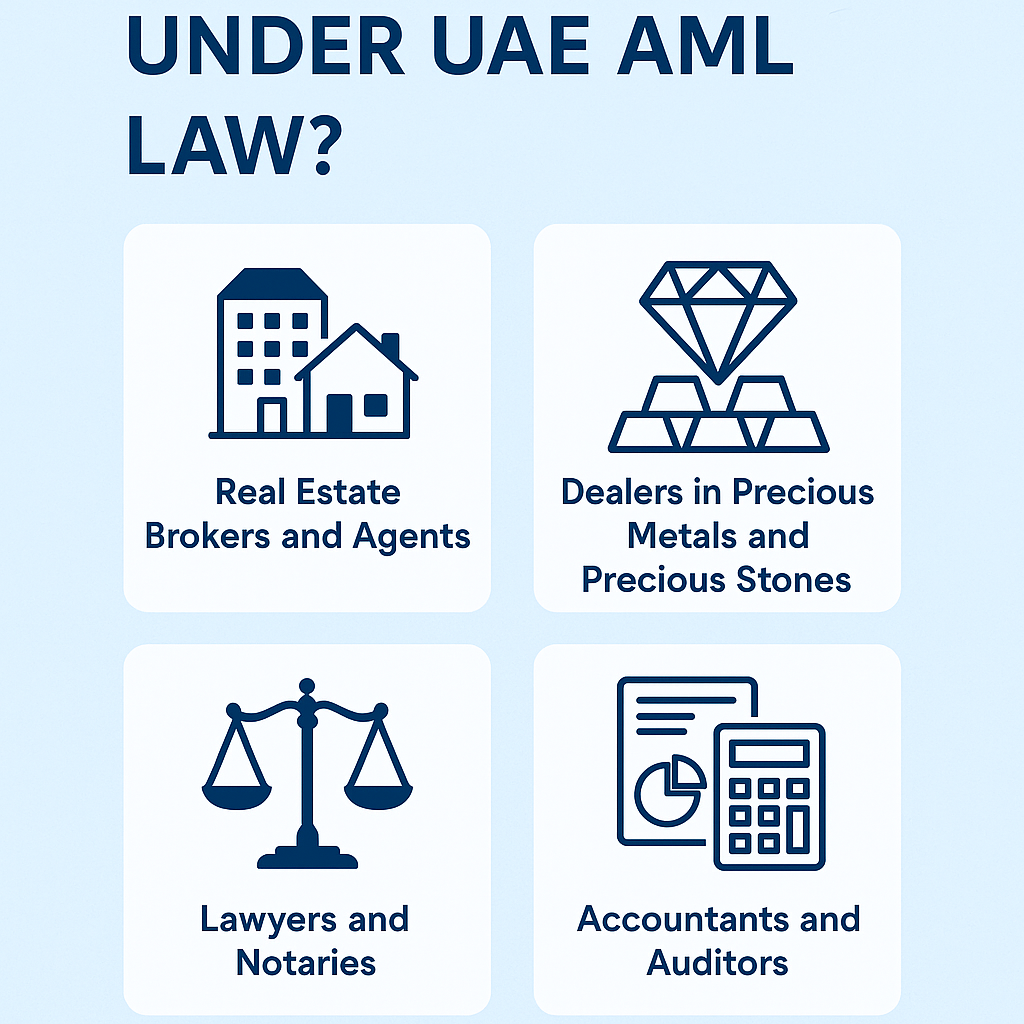
The United Arab Emirates (UAE) has developed a strong Anti-Money Laundering and Counter-Terrorism Financing (AML/CFT) framework in line with the Financial Action Task Force (FATF) recommendations. One of the most significant features of the UAE AML regime is the classification of certain non-financial businesses as Designated Non-Financial Businesses and Professions (DNFBPs).
Although these entities are not financial institutions, their activities can be exploited by criminals for money laundering (ML) and terrorist financing (TF), especially due to their exposure to large-value transactions, complex structures, and cross-border dealings.
At Sheikh Anwar Accounting and Auditing LLC, Dubai (MOE Registered Auditor – Entry No. 5817), we advise DNFBPs on how to implement AML compliance programs effectively, avoid penalties, and maintain market credibility.
________________________________________
1. What Are DNFBPs?
According to Federal Decree-Law No. 20 of 2018 on AML/CFT and Cabinet Decision No. 10 of 2019, DNFBPs are businesses and professions that, although not banks or financial institutions, are considered vulnerable to ML/TF risks.
This classification brings them under the same AML obligations as financial institutions, including customer due diligence (CDD), suspicious transaction reporting (STRs), and record-keeping.
________________________________________
2. Categories of DNFBPs in the UAE
The following are recognized as DNFBPs under UAE AML law:
a) Real Estate Brokers and Agents
• Involved in high-value property transactions.
• Vulnerable to cash payments, cross-border investors, and complex ownership structures.
b) Dealers in Precious Metals and Precious Stones (DPMS)
• Includes gold, diamond, and jewelry traders.
• High-risk due to cash-intensive transactions and potential misuse in trade-based money laundering (TBML).
c) Lawyers, Notaries, and Other Legal Professionals
• Often involved in company formation, trusts, and handling client assets.
• May unknowingly facilitate the concealment of beneficial ownership.
d) Independent Accountants and Auditors
• Prepare and review financial records, potentially spotting suspicious discrepancies.
• Risk arises from involvement in structuring transactions or handling client funds.
e) Corporate Service Providers / Company Formation Agents
• Assist in setting up businesses, trusts, or foundations.
• Risk of misuse through shell companies and complex ownership chains.
________________________________________
3. AML Obligations for DNFBPs
Under UAE AML law, DNFBPs must comply with the following obligations:
a) Customer Due Diligence (CDD)
• Verify customer identity using reliable documentation.
• Identify and confirm the Ultimate Beneficial Owner (UBO).
• Apply Enhanced Due Diligence (EDD) for high-risk clients such as Politically Exposed Persons (PEPs).
b) Record-Keeping
• Maintain client and transaction records for at least five years.
• Ensure accessibility for regulators and auditors.
c) Suspicious Transaction Reporting (STRs)
• File STRs and Suspicious Activity Reports (SARs) through the goAML portal of the UAE Financial Intelligence Unit (FIU).
d) Internal Controls
• Appoint a Money Laundering Reporting Officer (MLRO) or Compliance Officer.
• Establish written AML policies and internal monitoring systems.
• Train staff to detect red flags and comply with reporting requirements.
________________________________________
4. Penalties for Non-Compliance
The Ministry of Economy (MOE) supervises DNFBPs and conducts inspections. Penalties for non-compliance include:
• Fines ranging from AED 50,000 to AED 5 million.
• Suspension or cancellation of trade licenses.
• Public disclosure of violations, damaging reputation and investor trust.
Recent enforcement campaigns have imposed multi-million-dirham fines on DNFBPs in real estate, gold trading, and auditing for failing to meet AML obligations.
________________________________________
5. Why DNFBPs Should Take Compliance Seriously
DNFBPs are essential players in the UAE’s economy. Non-compliance not only leads to penalties but also risks damaging the UAE’s global reputation as a safe, transparent business hub. By building strong compliance systems, DNFBPs:
• Avoid fines and operational disruptions.
• Strengthen relationships with international partners.
• Contribute to the UAE’s global standing in fighting financial crime.
At Sheikh Anwar Accounting and Auditing LLC, we provide DNFBPs with practical solutions such as AML policy drafting, risk assessments, compliance training, and audit support.
________________________________________
Conclusion
DNFBPs—covering real estate brokers, dealers in precious metals, lawyers, accountants, and company service providers—are central to the UAE’s AML framework. By complying with Federal Decree-Law No. 20 of 2018 and Cabinet Decision No. 10 of 2019, they help protect the UAE’s economy from abuse while avoiding regulatory fines.
For businesses, AML compliance is not just a legal requirement—it is a mark of credibility and professionalism.
📌 Contact Us
Sheikh Anwar Accounting and Auditing LLC – Dubai, UAE
🌐 Website: www.sa-auditors.com
📧 Email: info@sa-auditors.com