When Should VAT Be Paid on Advance Receipts?
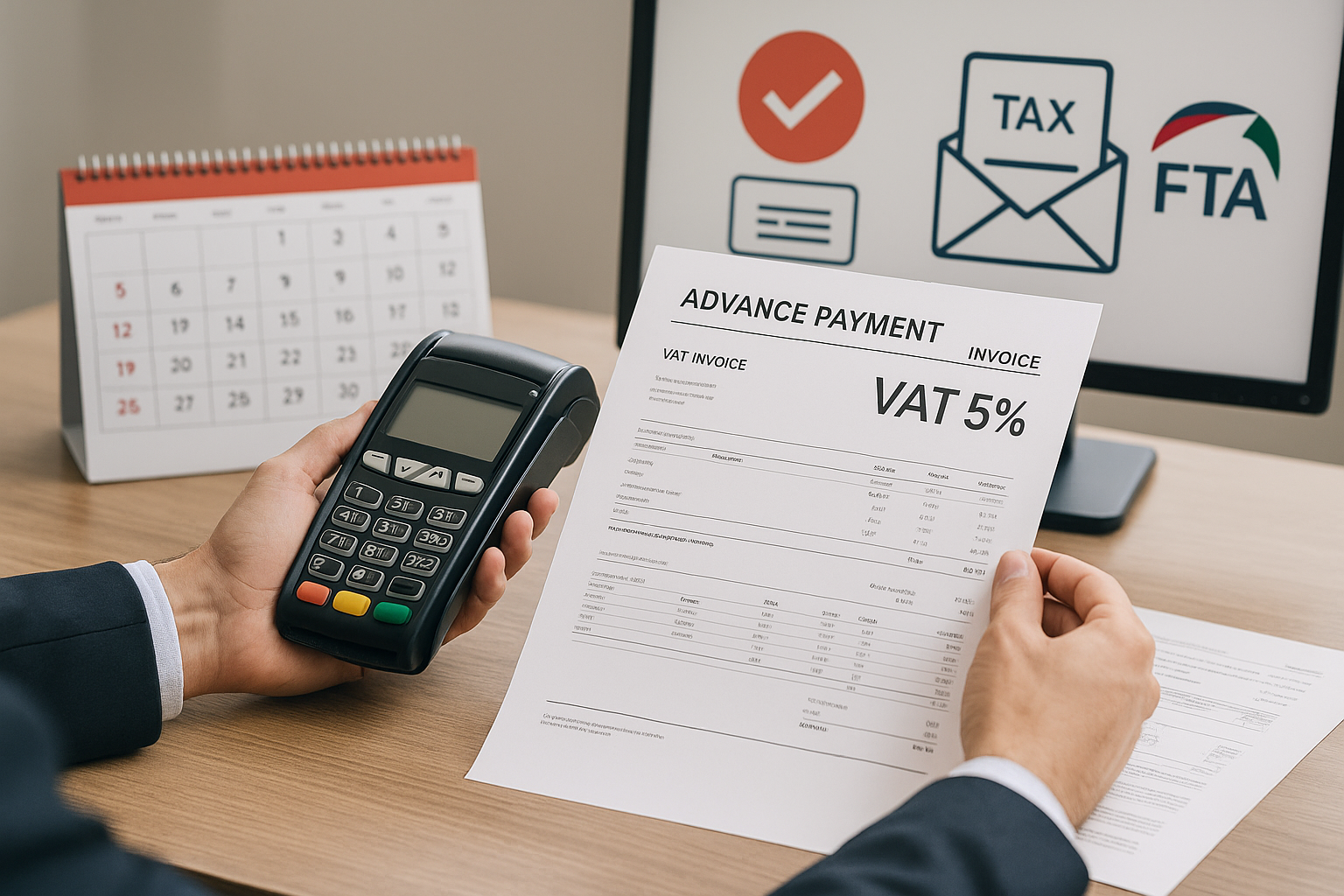
Under UAE VAT Law, businesses are often required to collect advance payments (or deposits) from customers before goods are delivered or services are rendered. But when exactly does VAT become due on such advances?
Here we explain the VAT implications of advance receipts, including the legal position, timing of payment, and best practices to avoid penalties.
________________________________________
✅ What Is an Advance Receipt?
An advance receipt is a partial or full payment received before the actual supply of goods or services. This includes:
• Booking deposits
• Advance payments for future supplies
• Prepaid service contracts
• Retainers or upfront charges
________________________________________
📜 Legal Basis
As per Article 25 of Federal Decree-Law No. 8 of 2017, the date of supply for VAT purposes (which determines when VAT is due) is triggered by the earliest of the following:
1. Date of issuance of the tax invoice
2. Date payment is received
3. Date of supply of goods/services (if earlier)
Thus, if a business receives an advance before delivering the goods or services, VAT becomes due at the time of receipt of the advance or issuance of invoice — whichever is earlier.
________________________________________
📅 When to Pay VAT on Advance Receipts?
Scenario VAT Payment Trigger
Advance received, no invoice issued VAT due on date payment is received
Invoice issued before payment VAT due on invoice date
Supply made before advance or invoice VAT due on date of actual supply
Example: If you receive AED 5,000 on 15 August 2024 as an advance and issue the invoice on 20 August 2024, the VAT is due on 15 August 2024.
________________________________________
🔄 VAT Treatment of Advance Payments
• Charge 5% VAT on the advance amount.
• Issue a tax invoice or receipt voucher showing VAT details.
• Reflect the VAT amount in your VAT Return for the period in which the advance was received.
________________________________________
⚠️ Special Cases to Note
1. Refundable Security Deposits
• If it's refundable and not meant for supply, no VAT is due at receipt.
• If later used for payment, VAT applies at that point.
2. Advance for Exempt or Zero-Rated Supplies
• No VAT due if the supply itself is exempt or zero-rated (e.g., export of goods, qualifying healthcare or education).
3. Long-Term Contracts
• Each advance installment must be treated as a separate supply and reported in the VAT return when received.
________________________________________
🧾 Documentation Requirements
• Issue a valid tax invoice or receipt voucher for the advance.
• Clearly state the VAT portion of the advance.
• Maintain audit-ready records linking advance receipts to future supplies.
________________________________________
💡 Best Practices for Businesses
• ✅ Always track advance receipts accurately in accounting software.
• ✅ Reconcile advances with final invoices at the time of supply.
• ✅ Train staff to issue proper tax invoices on time.
• ✅ Use invoice numbers that link advances to final settlements.
________________________________________
🛑 Common Mistakes to Avoid
• ❌ Delaying VAT payment until full invoice is issued
• ❌ Not including VAT in advance receipts
• ❌ Treating refundable deposits as taxable advances
• ❌ Missing advance payments in the VAT return
________________________________________
🔍 FTA Penalties for Non-Compliance
Failure to declare VAT on advance payments in the correct tax period may result in:
• Late payment penalties
• Incorrect VAT return penalties
• Audit issues during FTA reviews
________________________________________
💼 Need Help With VAT Compliance?
At Sheikh Anwar Accounting & Auditing LLC, we guide businesses across the UAE in handling VAT on advance payments, including:
• Tax invoice formats
• System setup for receipts
• Timely VAT return filing
📞 Contact us today to ensure you're VAT-compliant from Day One.
📧 info@sa-auditors.com
🌐 www.sa-auditors.com