What Triggers a VAT Audit in the UAE?
Introduction
The Federal Tax Authority (FTA) in the UAE conducts VAT audits to ensure that businesses are compliant with VAT laws under Federal Decree-Law No. 8 of 2017. While VAT audits can be random, most are triggered by specific red flags in your filings, patterns in your transactions, or other risk indicators identified by the FTA’s systems.
Understanding what triggers a VAT audit is crucial so that you can take proactive measures to stay compliant and avoid penalties.
________________________________________
🧾 What is a VAT Audit?
A VAT audit is a formal review by the FTA of your submitted VAT returns, invoices, and financial records to confirm:
• Proper collection and remittance of VAT
• Accuracy of input VAT claims
• Compliance with invoicing and recordkeeping rules
Audits can be desk-based (remote) or field-based (on-site visit).
________________________________________
⚠️ Common Triggers for a VAT Audit in the UAE
Here are the most common triggers that may prompt an FTA audit:
________________________________________
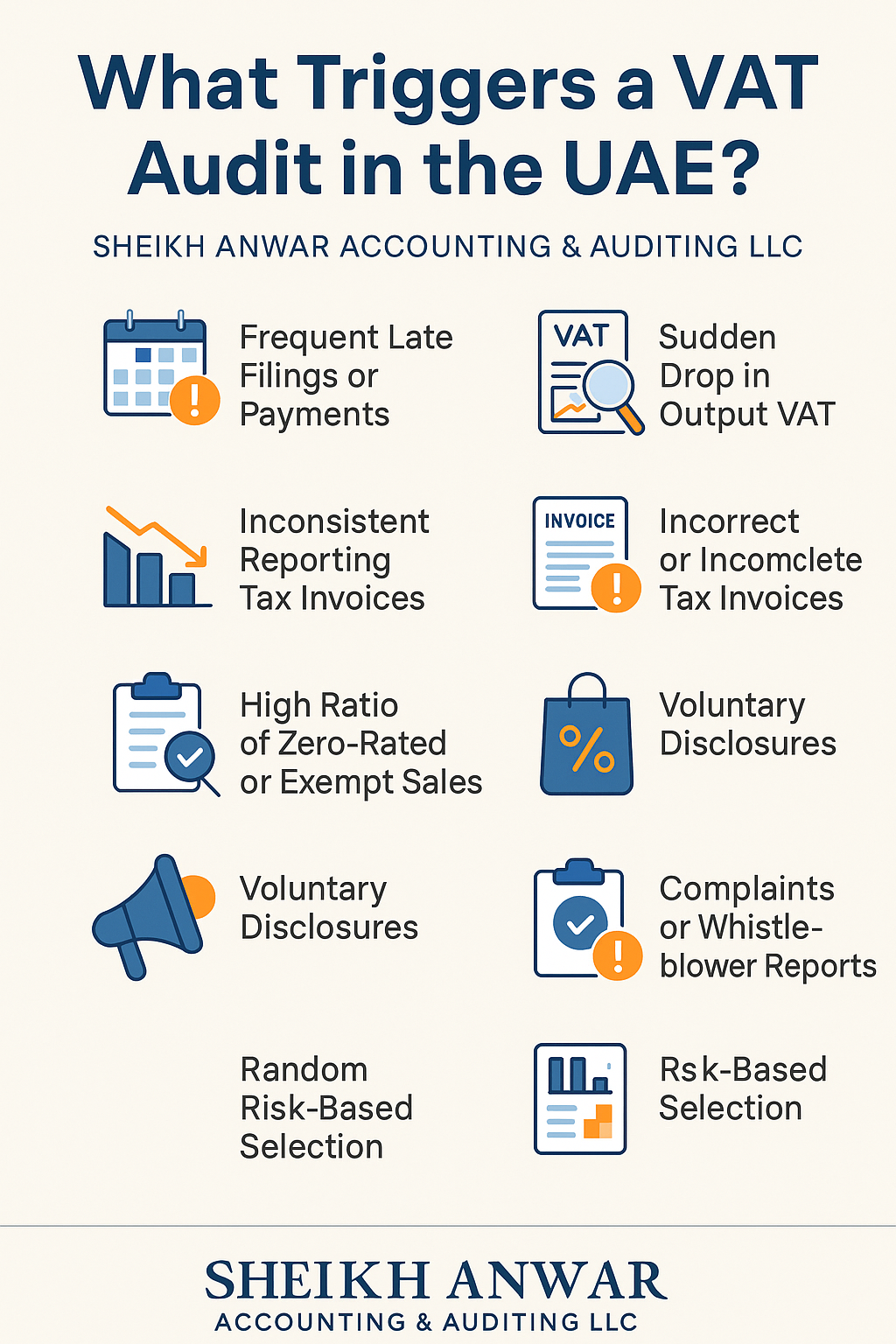
1. Frequent Late Filings or Payments
Consistent delays in submitting VAT returns or making payments raise red flags. The FTA may audit your business to ensure:
• No tax evasion is occurring
• Outstanding liabilities are being handled properly
________________________________________
2. Significant VAT Refund Claims
If you regularly claim high VAT refunds (especially as a percentage of sales), the FTA may want to verify:
• The legitimacy of the expenses
• Supporting invoices and contracts
• That no non-recoverable input VAT is being claimed
________________________________________
3. Sudden Drop in Output VAT
If your VAT payable drops suddenly without reasonable explanation (e.g., sales drop), this may lead to suspicion of:
• Underreported sales
• Unrecorded income
• Invoice manipulation
________________________________________
4. Inconsistent Reporting
Mismatch between:
• VAT returns and financial statements
• Customs declarations and import VAT
• Zero-rated/export sales and shipping documentation
Inconsistencies may suggest careless reporting or deliberate evasion.
________________________________________
5. Incorrect or Incomplete Tax Invoices
FTA often audits businesses that issue tax invoices missing:
• VAT Registration Number (TRN)
• VAT amount and rate
• Invoice sequence
• Buyer’s TRN for B2B supplies
Non-compliant invoicing is a major compliance violation.
________________________________________
6. High Ratio of Zero-Rated or Exempt Sales
If your business reports a large portion of sales as:
• Zero-rated exports
• Exempt supplies (e.g., healthcare, education)
You may be selected for audit to confirm:
• You’re not misclassifying taxable supplies
• You hold proper proof (export documents, contracts)
________________________________________
7. Voluntary Disclosures
Frequent filing of Form 211 (Voluntary Disclosure) may indicate ongoing issues in your internal VAT processes, prompting the FTA to investigate further.
________________________________________
8. Complaints or Whistleblower Reports
If a third party (supplier, customer, or employee) reports your business for VAT misconduct, this can result in an unplanned audit.
________________________________________
9. Random Risk-Based Selection
Even if you're fully compliant, your business may be selected randomly as part of the FTA’s risk profiling algorithm or compliance sampling.
________________________________________
📊 FTA’s Risk Analysis Tools
The FTA uses data analytics, AI, and interconnected systems (e.g., customs, Ministry of Economy, banks) to detect discrepancies and assess audit risk.
________________________________________
🧠 How to Reduce the Chances of an Audit
• File VAT returns and pay on time
• Ensure all invoices are VAT-compliant
• Match customs and import data with VAT returns
• Maintain proper audit trails for all transactions
• Conduct quarterly internal VAT reviews
• Work with a tax agent to monitor compliance
________________________________________
🧾 Documents to Keep Ready in Case of Audit
• Tax invoices (issued and received)
• VAT returns and payment proofs
• Sales and purchase ledgers
• Input VAT breakdown
• Export/import documentation
• Reconciliations with general ledger
📂 Retention period: 5 years (15 years for real estate businesses)
________________________________________
🤝 Need Help Preparing for a VAT Audit?
At Sheikh Anwar Accounting & Auditing LLC, we specialize in:
• VAT compliance checks
• Mock VAT audits
• Reconciliation and documentation support
• Audit representation before the FTA
📧 Contact: info@sa-auditors.com
🌐 Visit: www.sa-auditors.com
📞 +971-XX-XXXXXXX