What is Reverse Charge Mechanism in UAE VAT?
Introduction
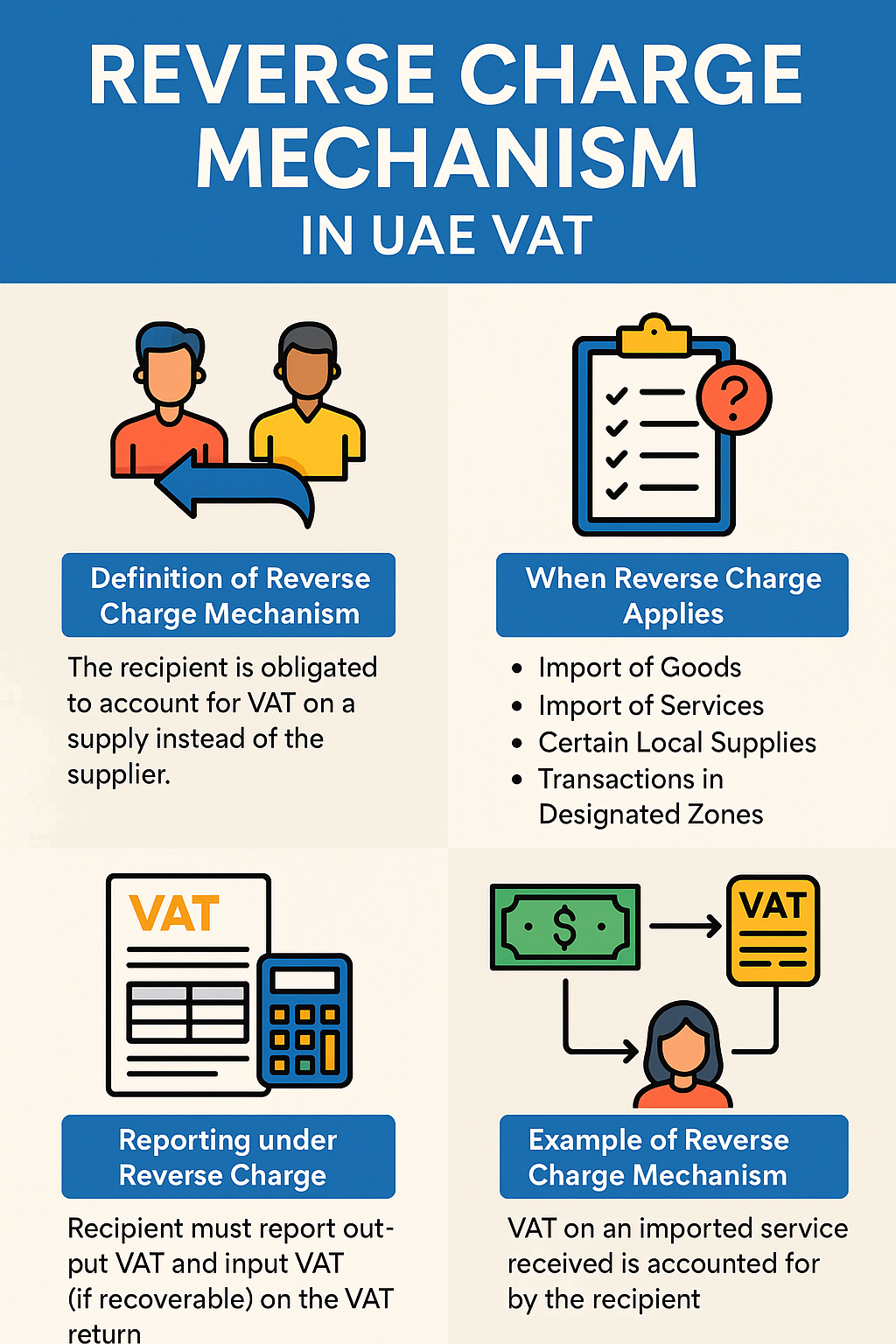
The Reverse Charge Mechanism (RCM) is a unique VAT concept that shifts the responsibility of tax payment from the supplier to the buyer. In the context of UAE VAT, the RCM is particularly important in scenarios involving cross-border transactions, certain domestic supplies, and transactions involving Designated Zones.
Understanding the reverse charge mechanism is critical for ensuring accurate VAT compliance and avoiding penalties from the Federal Tax Authority (FTA).
________________________________________
✅ Definition of Reverse Charge Mechanism (RCM)
In a normal VAT scenario, the supplier of goods or services is responsible for charging VAT, collecting it from the buyer, and remitting it to the FTA.
Under the reverse charge mechanism, the recipient (buyer) of goods or services is obligated to account for VAT on behalf of the supplier. The buyer reports both the input VAT and output VAT on the same transaction.
________________________________________
🧾 Legal Basis in UAE VAT Law
The reverse charge is governed under:
• Federal Decree-Law No. 8 of 2017 on VAT
• Cabinet Decision No. 52 of 2017 on Executive Regulations
• FTA Public Clarifications
________________________________________
📦 When Does Reverse Charge Apply in UAE?
1. Import of Goods into the UAE
When a VAT-registered business imports goods from outside the UAE, it must apply RCM.
• Example: A company in Dubai imports machinery from Germany.
• Outcome: The importer accounts for VAT on the import using RCM.
2. Import of Services
When services are provided by a non-resident supplier to a UAE-based business, the business must apply reverse charge.
• Example: Marketing services bought from a UK-based agency.
3. Supply of Certain Goods within UAE
Certain local supplies of crude oil, hydrocarbons, and gold & diamonds between VAT-registered entities fall under RCM if agreed in writing.
4. Transactions in Designated Zones
When goods are moved between a Designated Zone and the Mainland, RCM may apply depending on the nature of the transaction.
________________________________________
💼 Who Is Responsible for Reporting VAT under RCM?
The recipient of goods/services must:
• Calculate VAT on the value of the transaction
• Report this as output VAT in Box 3 of the VAT return
• Claim it as input VAT (if eligible) in Box 10 or 11 of the same VAT return
• Keep full documentation to support the RCM entry
________________________________________
🔄 How Reverse Charge Works in VAT Returns
Description Entry in VAT Return
Value of imported goods/services Box 6
Output VAT under RCM Box 3
Input VAT (if recoverable) Box 10 or 11
This self-accounting ensures that VAT is neutral if the business is entitled to full input recovery.
________________________________________
🧮 Example of RCM Accounting
Scenario:
• A UAE-based company imports software services from a US-based provider worth AED 10,000.
• VAT @ 5% = AED 500.
VAT Return Entries:
• Output VAT (Box 3): AED 500
• Input VAT (Box 10): AED 500 (if fully recoverable)
• Net VAT impact: Zero, but full compliance is required.
________________________________________
📚 Documentation Required for RCM
• Commercial invoice from foreign supplier
• Import declaration (for goods)
• Proof of payment
• RCM journal entries in accounting system
• VAT return reconciliation records
________________________________________
❌ Common Mistakes in RCM Accounting
• Failing to account for RCM on imported services
• Claiming input VAT without recording output VAT
• Incorrect reporting in VAT return boxes
• Not maintaining supporting documentation
________________________________________
⚖️ Penalties for Non-Compliance
As per Cabinet Decision No. 40 of 2017 on Administrative Penalties, failure to correctly apply the reverse charge mechanism can result in:
• AED 10,000 for incorrect tax return
• AED 1,000 - AED 5,000 for incomplete recordkeeping
• Additional penalties for repeated offenses
________________________________________
🎯 Final Thoughts
The Reverse Charge Mechanism is a vital part of UAE’s VAT system, especially in international and cross-border trade. Businesses must ensure proper understanding, application, and documentation of RCM to stay compliant and avoid costly penalties.
________________________________________
💼 Need VAT Filing or Audit Support?
Sheikh Anwar Accounting & Auditing LLC provides expert VAT advisory, VAT return filing, and training on RCM and FTA audits. Reach out to our team today to ensure full compliance with UAE VAT law.
🌐 Visit us: www.sa-auditors.com
📧 Email: info@sa-auditors.com
📱 WhatsApp: +971-XX-XXXXXXX