What is Exempt Income Under UAE Corporate Tax?
Introduction
The UAE Corporate Tax regime, effective from 1 June 2023 under Federal Decree-Law No. 47 of 2022, is designed to tax business profits while allowing certain types of income to be exempt.
Understanding Exempt Income is critical for accurate tax planning, as it directly reduces the taxable income on which the standard 9% Corporate Tax is levied.
It provides a complete breakdown of what qualifies as Exempt Income under UAE Corporate Tax, the conditions that apply, and how businesses can benefit.
________________________________________
🧾 Legal Reference
• Article 22 to 25 of the Corporate Tax Law
• Cabinet Decision No. 55 of 2023 (Participation Exemption criteria)
• Ministerial Decision No. 114 of 2023 (Application of exemptions)
________________________________________
✅ What is Exempt Income?
Exempt income refers to specific types of income that are excluded from the calculation of taxable income under UAE Corporate Tax, provided that certain conditions are met.
This means such income is not subject to the 9% Corporate Tax rate and does not impact the overall tax liability of a business.
________________________________________
🧾 List of Exempt Income Under UAE Corporate Tax
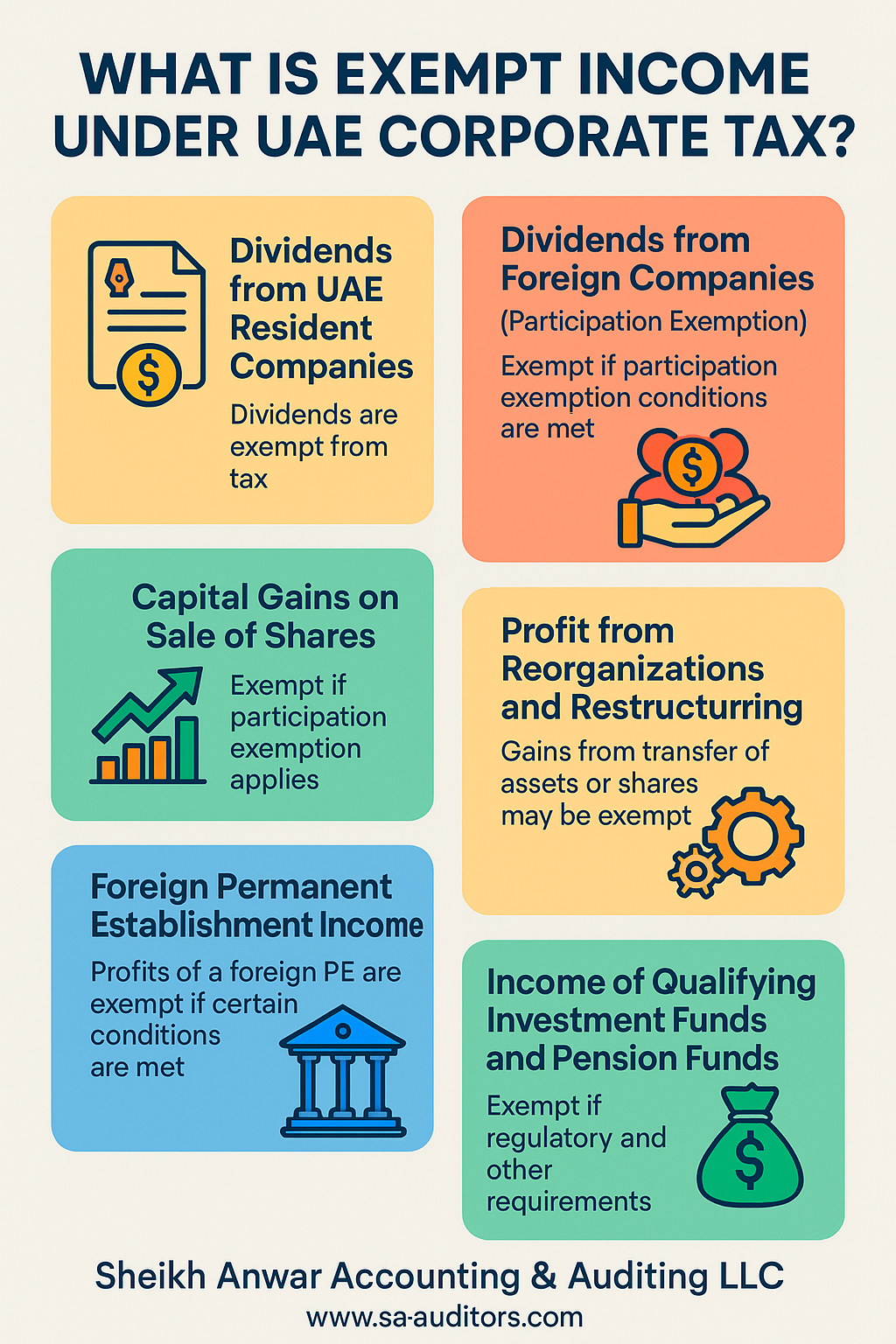
1. Dividends from UAE Resident Companies
• Dividends received from companies incorporated in the UAE are exempt from tax.
• No ownership threshold or holding period applies.
✅ Promotes group structuring and intra-group investments.
________________________________________
2. Dividends from Foreign Companies (Participation Exemption)
To be exempt, the Participation Exemption conditions must be met:
• Holding company must own ≥ 5% of shares in the foreign company
• Holding must be for ≥ 12 months or intention to hold that long
• Foreign company must be subject to at least 9% tax, or in a qualifying jurisdiction
• Must not be considered a portfolio investment
✅ Encourages UAE businesses to invest abroad without tax duplication.
________________________________________
3. Capital Gains on Sale of Shares
Capital gains on disposal of shares in a participating interest are exempt if:
• All conditions under Participation Exemption are satisfied
• Applies to both UAE and foreign shares
✅ Useful for holding companies and group restructuring.
________________________________________
4. Profit from Reorganizations and Restructuring
Gains arising from the transfer of business assets or shares during:
• Mergers
• Spin-offs
• Group restructurings
Can be exempt if:
• The transaction qualifies under Article 26 and 27 of the law
• There is no actual change in economic ownership
• Transfer is at book value
✅ Encourages corporate consolidation and reorganization.
________________________________________
5. Foreign Permanent Establishment (PE) Income
Profits attributable to a foreign PE of a UAE business are exempt if:
• The income is subject to tax in the foreign country
• The business elects to exclude foreign PE income from its UAE taxable income
• The foreign PE operates independently (with a business nexus abroad)
❗ Once elected, the exemption must be applied consistently.
________________________________________
6. Income of Qualifying Investment Funds and Pension Funds
Income earned by:
• Public and private pension funds
• Qualifying investment funds
May be exempt if:
• The fund is regulated and meets conditions issued by the Ministry of Finance
• Does not conduct commercial activities
✅ Encourages development of financial markets and retirement savings.
________________________________________
📋 Summary Table
Type of Income Exemption Status Key Conditions
Dividends from UAE companies ✅ Exempt None
Dividends from foreign companies ✅ Exempt Participation Exemption applies
Capital gains on shares ✅ Exempt Participation Exemption applies
Income from foreign Permanent Establishment ✅ Optional Exemption Subject to foreign tax + consistent application
Gains from group restructuring ✅ Exempt Transfer at book value + no change in ownership
Pension/Investment Fund income ✅ Exempt Regulatory approval + non-commercial activity
________________________________________
⚠️ Important Notes
• Exempt income must be reported in the Corporate Tax return even though it's not taxed
• Documentation supporting exemption (e.g., holding %, tax paid abroad, ownership period) must be maintained
• Elective exemptions, such as for foreign PE income, require formal election in tax return and must be applied consistently
________________________________________
🧮 Example: How Exempt Income Reduces Taxable Income
Particulars Amount (AED)
Net accounting profit 1,000,000
Add back: Non-deductible expenses 50,000
Less: Dividend from foreign sub. (200,000)
Less: Capital gain on share sale (150,000)
Taxable Income 700,000
CT Payable @9% on (700,000 - 375,000) AED 29,250
________________________________________
✅ Best Practices
• Maintain shareholding records for Participation Exemption
• Track ownership period and subsidiary taxation status
• Review group restructuring plans with exemption eligibility in mind
• Retain audit trail and legal documents for exempt items
• Ensure consistency between EmaraTax filing and financial records
________________________________________
🧠 How Sheikh Anwar Accounting & Auditing LLC Can Help
We assist businesses with:
✅ Identifying and claiming exempt income correctly
✅ Structuring foreign and local investments for exemption eligibility
✅ Preparing documentation for audits and FTA inquiries
✅ Compliance with CT law and related Ministerial Decisions
✅ Filing accurate tax returns with proper adjustments for exempt income
________________________________________
📞 Contact Us
📍 Sheikh Anwar Accounting & Auditing LLC
🌐 www.sa-auditors.com
📧 info@sa-auditors.com
📞 +971-XX-XXX-XXXX