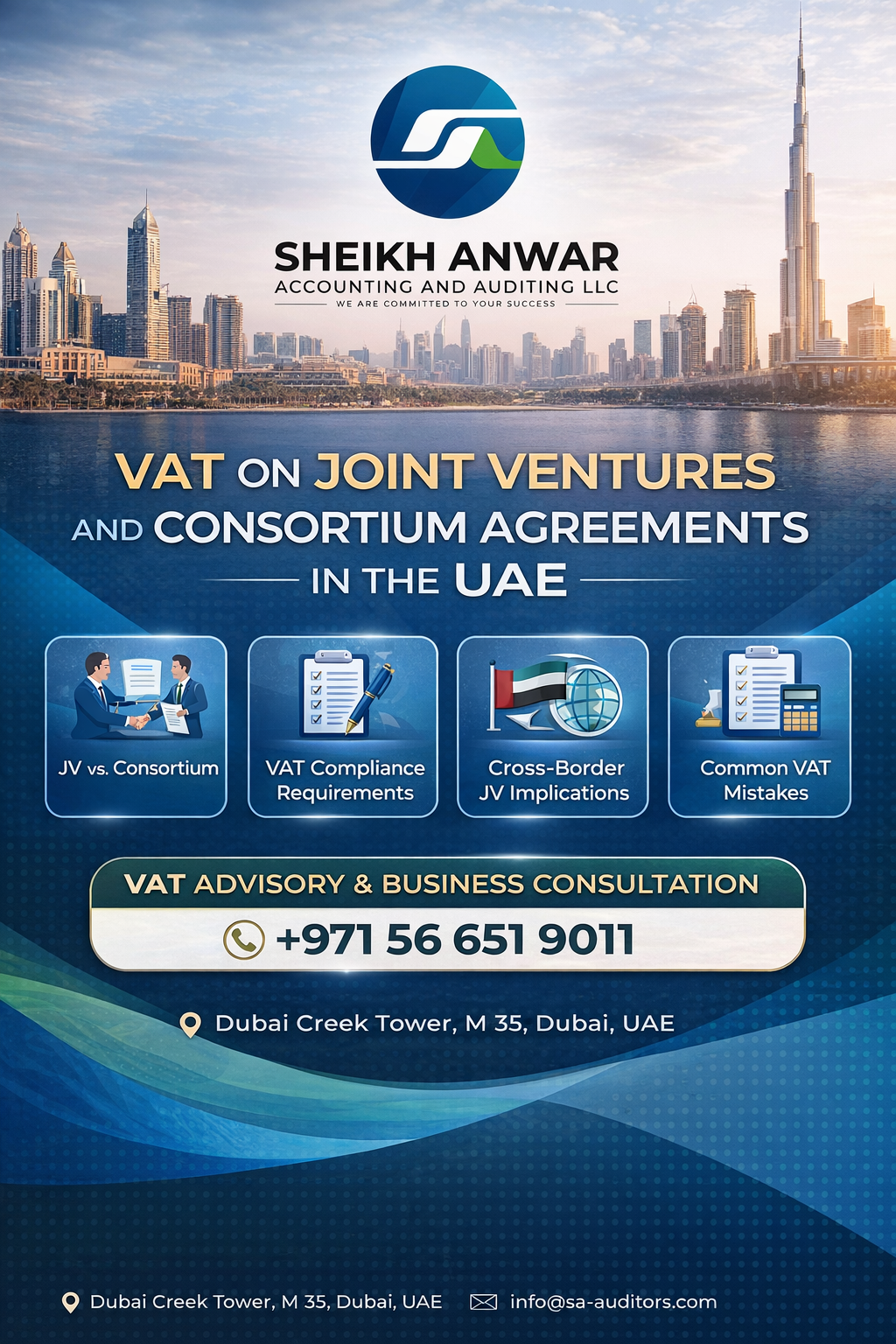
VAT on Joint Ventures and Consortium Agreements
📌 Introduction
Joint ventures (JVs) and consortium arrangements are widely used in the UAE, especially in sectors such as construction, infrastructure, oil & gas, and large-scale government projects. While these structures offer operational flexibility, their VAT treatment can be complex under the UAE VAT framework governed by the Federal Tax Authority.
Understanding the VAT implications is essential to ensure compliance and avoid costly errors.
________________________________________
🤝 What is a Joint Venture or Consortium?
• Joint Venture (JV): Two or more parties combine resources to undertake a specific project
• Consortium: A temporary alliance where members execute a contract collectively
These arrangements may or may not create a separate legal entity, which significantly impacts VAT treatment.
________________________________________
📊 VAT Treatment Based on Structure
1. Incorporated Joint Venture (Separate Legal Entity)
• JV is treated as a distinct taxable person
• Must register for VAT if threshold exceeded
• Supplies between JV and members are taxable at 5%
• JV files independent VAT returns
________________________________________
2. Unincorporated Joint Venture / Consortium
• No separate legal entity
• Each member is treated as separate taxable person
• VAT implications depend on contractual arrangement
Key Scenarios:
• Lead Partner Model:
Lead partner invoices client → charges VAT → distributes revenue
• Cost Sharing Arrangement:
Reimbursements may not attract VAT if conditions met
• Independent Supply by Members:
Each member invoices client separately with VAT
________________________________________
💼 VAT on Inter-Party Transactions
• Services between JV partners → subject to VAT (5%)
• Cost allocations → may be outside scope if pure reimbursement
• Profit share → generally not subject to VAT
________________________________________
🌍 Cross-Border Joint Ventures
• If foreign partners involved → Reverse Charge Mechanism (RCM) may apply
• UAE entity must account for VAT on imported services
• Export of services may qualify as zero-rated, subject to conditions
________________________________________
⚠️ Key Compliance Considerations
• Clear JV/consortium agreement defining roles and responsibilities
• Proper VAT registration status of each party
• Maintaining supporting documentation for cost-sharing
• Correct tax invoicing and accounting treatment
• Regular VAT return filing via the Federal Tax Authority portal
________________________________________
🚨 Common Mistakes to Avoid
• ❌ Assuming JV is always a separate taxable entity
• ❌ Incorrect VAT treatment of cost reimbursements
• ❌ Ignoring VAT on inter-party services
• ❌ Lack of clarity in agreements leading to disputes
________________________________________
🧠 Expert Insight
The VAT treatment of joint ventures and consortiums depends heavily on the contractual structure rather than just the business arrangement. A poorly drafted agreement can lead to incorrect VAT treatment and potential penalties.
________________________________________
🏢 About Us
Sheikh Anwar Accounting & Auditing LLC is a leading UAE-based firm providing:
• VAT Advisory & Structuring
• Corporate Tax & Compliance
• AML Compliance & Risk Assessment
• Audit & Assurance Services
We specialize in advising on complex structures like joint ventures and consortium agreements, ensuring full compliance with UAE VAT laws.
________________________________________
📞 Contact Us
🌐 Website: www.sa-auditors.com
📧 Email: info@sa-auditors.com
📱 Phone: +971 56 651 9011
📍 Address: Dubai Creek Tower, M 35, Dubai, UAE