VAT on International Transactions
Introduction
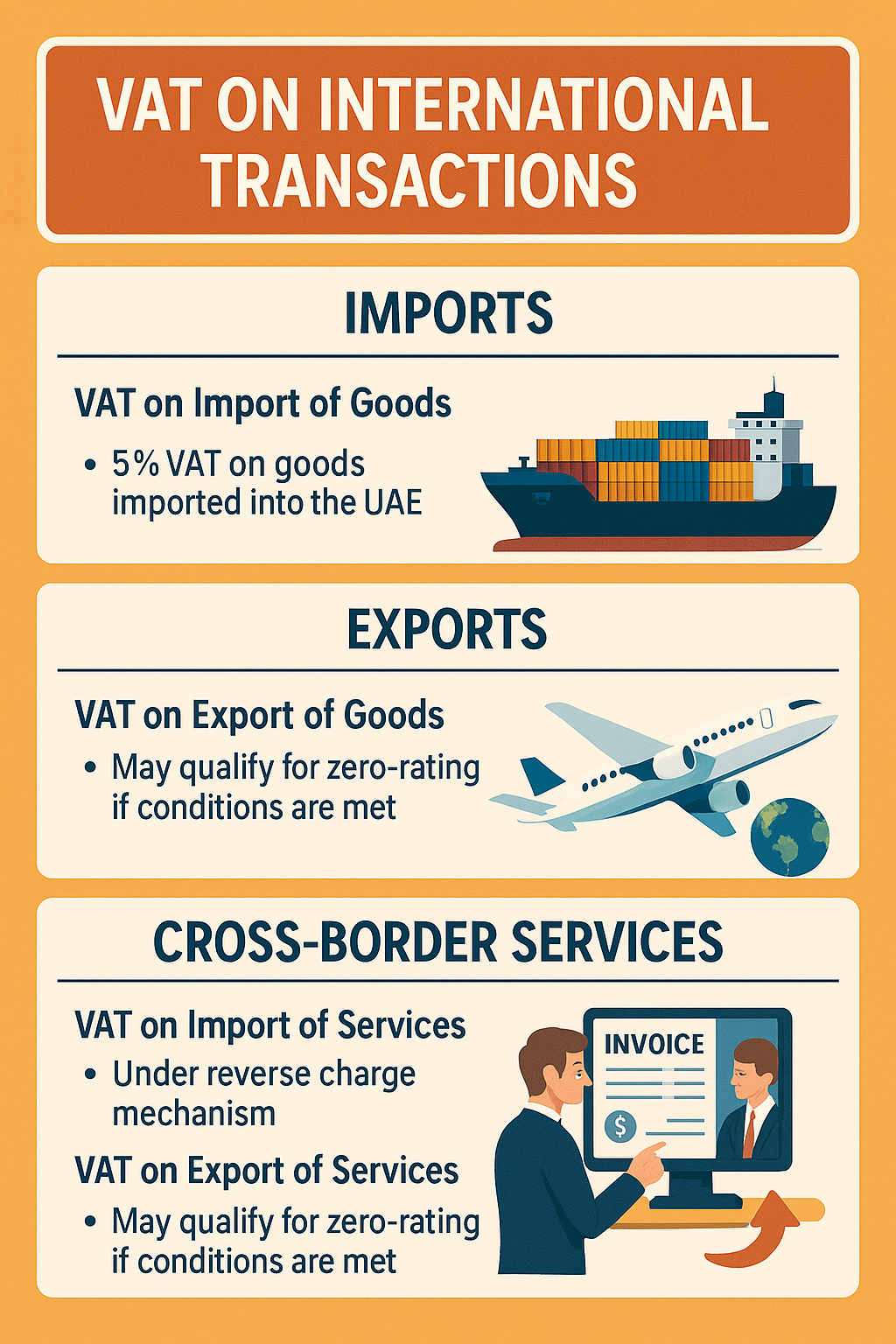
As a global trade hub, the UAE sees extensive cross-border transactions, including the import and export of goods and services. While Value Added Tax (VAT) is primarily a domestic consumption tax, it does apply to many international transactions—both for goods and services.
It clarifies how VAT is applied to imports, exports, and cross-border services under UAE VAT Law.
________________________________________
1. VAT on Import of Goods
When goods are imported into the UAE from outside the GCC:
• 5% VAT is payable at the customs point
• VAT is calculated on CIF value + customs duties
• Registered businesses can defer payment using the reverse charge mechanism (RCM)
✅ For VAT-registered businesses:
• No cash payment at customs
• Report the import VAT in Box 6 (value) and Box 3 (VAT amount) of VAT return
❌ For unregistered individuals:
• Pay VAT at time of import directly to customs
________________________________________
2. VAT on Export of Goods
Exports from the UAE to outside GCC countries may be zero-rated (0%), subject to these conditions:
Type of Export VAT Rate Conditions
Direct export 0% Goods physically leave UAE within 90 days, and export docs (bill of lading, customs declaration) are retained
Indirect export 0% Goods collected by non-resident buyer and shipped overseas; same documentation required
🚫 Failure to meet documentation conditions results in 5% VAT charge.
________________________________________
3. VAT on Import of Services
When a UAE-based VAT-registered business receives services from a non-resident supplier (e.g., foreign consultancy, software subscription):
• The business must self-account for VAT under the Reverse Charge Mechanism
• Report in Box 3 (output) and Box 10 (input) of VAT return
✅ No actual payment is made to FTA
✅ Input VAT can be recovered if the service is used for taxable business purposes
________________________________________
4. VAT on Export of Services
Professional services rendered by UAE businesses to clients outside the UAE or GCC may be zero-rated (0%) if all the following conditions are met:
• The recipient is outside the UAE
• The recipient is not VAT-registered in any GCC implementing state
• The benefit of the service is consumed outside the UAE
• Supplier keeps proper evidence (contracts, client location, payment receipt)
📌 Commonly zero-rated: IT services, consulting, marketing, design, accounting, etc.
________________________________________
5. GCC VAT Unified System Consideration
As of now (2025), only UAE and KSA have implemented VAT, but each state applies VAT independently. There is no full GCC VAT system integration yet.
• If services or goods are supplied to VAT-registered persons in another GCC state, normal VAT may apply (unless zero-rating conditions are met)
• Businesses should verify TRN and retain documentation to determine correct VAT treatment
________________________________________
6. Supplies Between Free Zones and Mainland
Designated Free Zones in the UAE may be treated differently:
Transaction VAT Treatment
From mainland to free zone 5% VAT applies
Between two designated free zones 0% VAT (if export criteria are met)
From free zone to outside UAE 0% VAT (as export)
Free zone to mainland 5% VAT applies
Always verify the “Designated Zone” status of the free zone involved.
________________________________________
7. Common Documentation Required for International VAT Treatment
To apply zero-rating on exports or services:
• Invoice stating customer’s address and TRN (if any)
• Delivery notes and shipping documents
• Customs export declaration
• Proof of payment from foreign client
• Email correspondence confirming service delivery location
Missing these may result in the FTA rejecting zero-rating claims during audit.
________________________________________
8. Common Errors in Cross-Border VAT Compliance
Mistake Risk
Failing to apply reverse charge on imported services Underreported VAT
Charging 0% VAT without export documentation Tax liability & penalties
Not segregating exports from local sales Overstated output VAT
Treating local free zone sales as exports Misclassified supply
Ignoring VAT on digital services received Reverse charge violation
________________________________________
📌 Conclusion
Cross-border transactions under UAE VAT law require careful classification between imports, exports, and services. While exports may be zero-rated and imports may qualify for reverse charge accounting, businesses must keep proper documentation and understand when 5% VAT still applies.
________________________________________
💼 Need Help With International VAT Transactions?
At Sheikh Anwar Accounting and Auditing LLC, we help:
• Classify your cross-border transactions
• Apply reverse charge mechanism properly
• Structure export invoices for 0% VAT
• Avoid penalties during VAT audits
📲 Contact us for a consultation on VAT and international trade.
📧 info@sa-auditors.com
🌐 www.sa-auditors.com
Popular Blogs