VAT Implications of Mergers and Acquisitions
Introduction
Mergers and Acquisitions (M&A) are strategic transactions that enable businesses to expand, restructure, or consolidate operations. While these transactions are primarily driven by commercial objectives, Value Added Tax (VAT) plays a critical role in determining the financial and compliance impact of such deals. Improper VAT treatment can lead to unexpected tax liabilities, penalties, and cash flow issues.
________________________________________
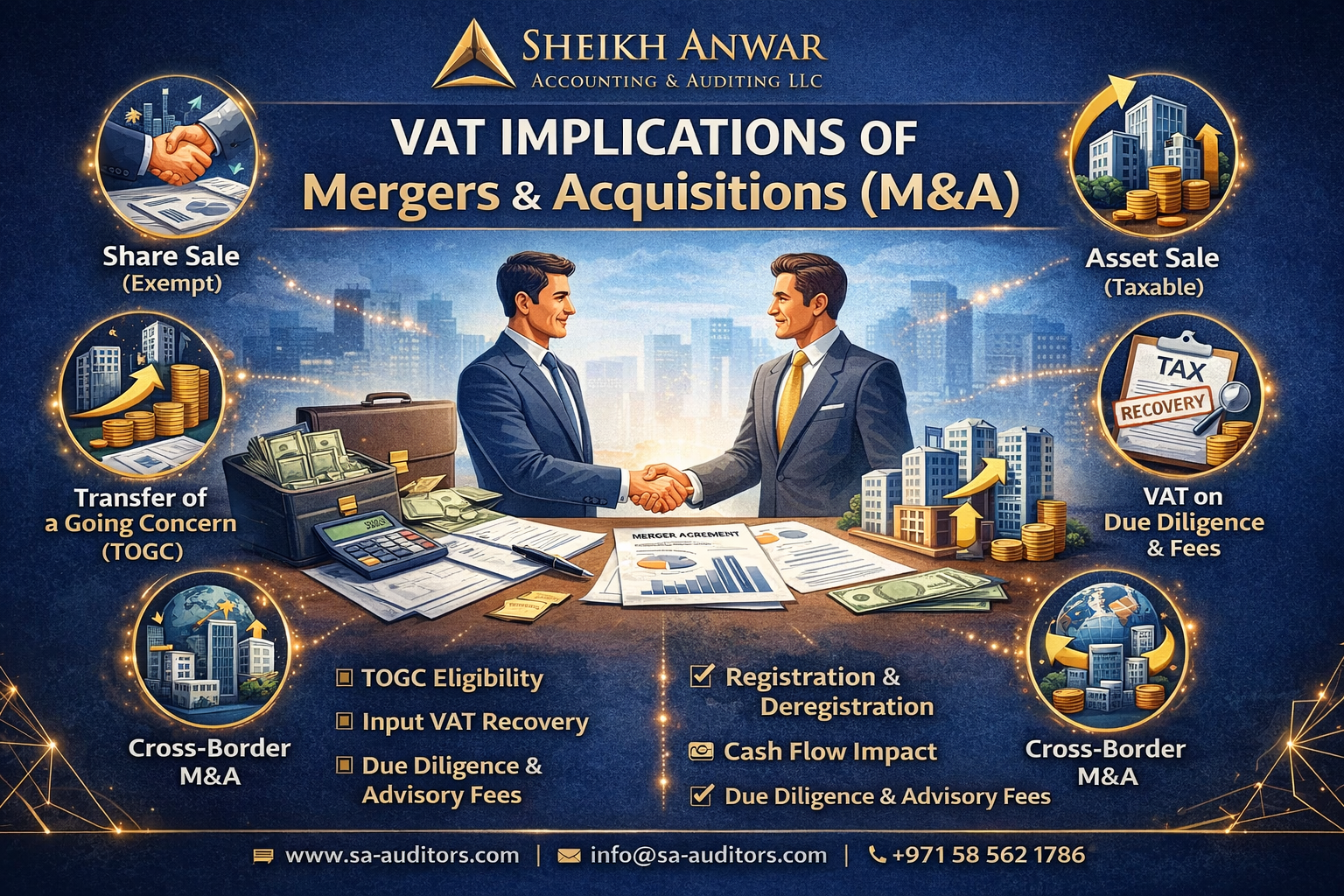
1. Nature of M&A Transactions and VAT Treatment
M&A transactions can take different forms, and VAT implications vary accordingly:
a) Share Sale
• Transfer of shares is generally treated as an exempt supply under VAT laws.
• No VAT is charged on the sale of shares.
• However, input VAT recovery may be restricted on expenses related to the transaction.
b) Asset Sale
• Transfer of business assets is typically treated as a taxable supply.
• VAT is applicable on the sale of assets unless specific relief applies.
• The buyer may recover input VAT subject to normal conditions.
________________________________________
2. Transfer of a Going Concern (TOGC)
One of the most important VAT concepts in M&A is the Transfer of a Going Concern (TOGC).
Key Conditions:
• The business (or part of it) must be transferred as a continuing operation
• The buyer must be VAT registered (or required to be registered)
• The buyer must intend to continue the same business activity
VAT Impact:
• If conditions are met, the transaction is treated as outside the scope of VAT
• This avoids immediate VAT liability and improves cash flow
👉 Proper structuring of M&A deals to qualify as TOGC is a critical tax planning tool.
________________________________________
3. VAT on Due Diligence and Professional Fees
During M&A transactions, businesses incur costs such as:
• Legal advisory
• Financial due diligence
• Tax consultancy
VAT Treatment:
• These services are subject to VAT
• Input VAT recovery depends on:
o Whether the transaction is taxable or exempt
o The nature of the business activities
⚠️ In share deals (exempt supplies), VAT recovery may be partially or fully restricted.
________________________________________
4. Input VAT Recovery Considerations
Input VAT recovery is one of the most complex areas in M&A.
Key Factors:
• Nature of transaction (taxable vs exempt)
• Use of acquired assets
• Apportionment methods (if mixed supplies exist)
Practical Impact:
• Businesses involved in exempt transactions may face irrecoverable VAT costs
• Proper structuring can significantly reduce this cost burden
________________________________________
5. VAT Registration and Deregistration
M&A transactions may trigger changes in VAT registration status:
• New entity formation → requires VAT registration
• Merger into existing entity → transfer of VAT obligations
• Business closure → VAT deregistration required
Important:
• Final VAT returns must be submitted
• Outstanding liabilities must be settled
________________________________________
6. Cross-Border M&A Considerations
For international transactions:
• Place of supply rules become critical
• Reverse charge mechanism may apply
• Different VAT jurisdictions may create complexity
👉 Proper planning is required to avoid double taxation or non-compliance.
________________________________________
7. Key Risks and Challenges
• Misclassification of transaction (asset vs share deal)
• Failure to qualify for TOGC
• Incorrect VAT recovery on advisory costs
• Non-compliance with registration/deregistration requirements
• Cash flow impact due to VAT liabilities
________________________________________
8. Practical Recommendations
✔️ Conduct a VAT impact assessment before executing the deal
✔️ Structure transactions to qualify for TOGC where possible
✔️ Review input VAT recovery eligibility
✔️ Maintain proper documentation for audit purposes
✔️ Seek professional advisory to ensure compliance
________________________________________
Conclusion
VAT plays a significant role in determining the true cost and structure of M&A transactions. Whether it is a share deal, asset acquisition, or business restructuring, understanding VAT implications is essential to avoid risks and optimize tax efficiency.
A well-planned M&A transaction, supported by expert VAT analysis, can enhance financial outcomes and ensure full regulatory compliance.
________________________________________
About Us
Sheikh Anwar Accounting & Auditing LLC
🌐 Website: www.sa-auditors.com
📧 Email: info@sa-auditors.com
📞 Phone: +971 58 562 1786
📍 Dubai, UAE