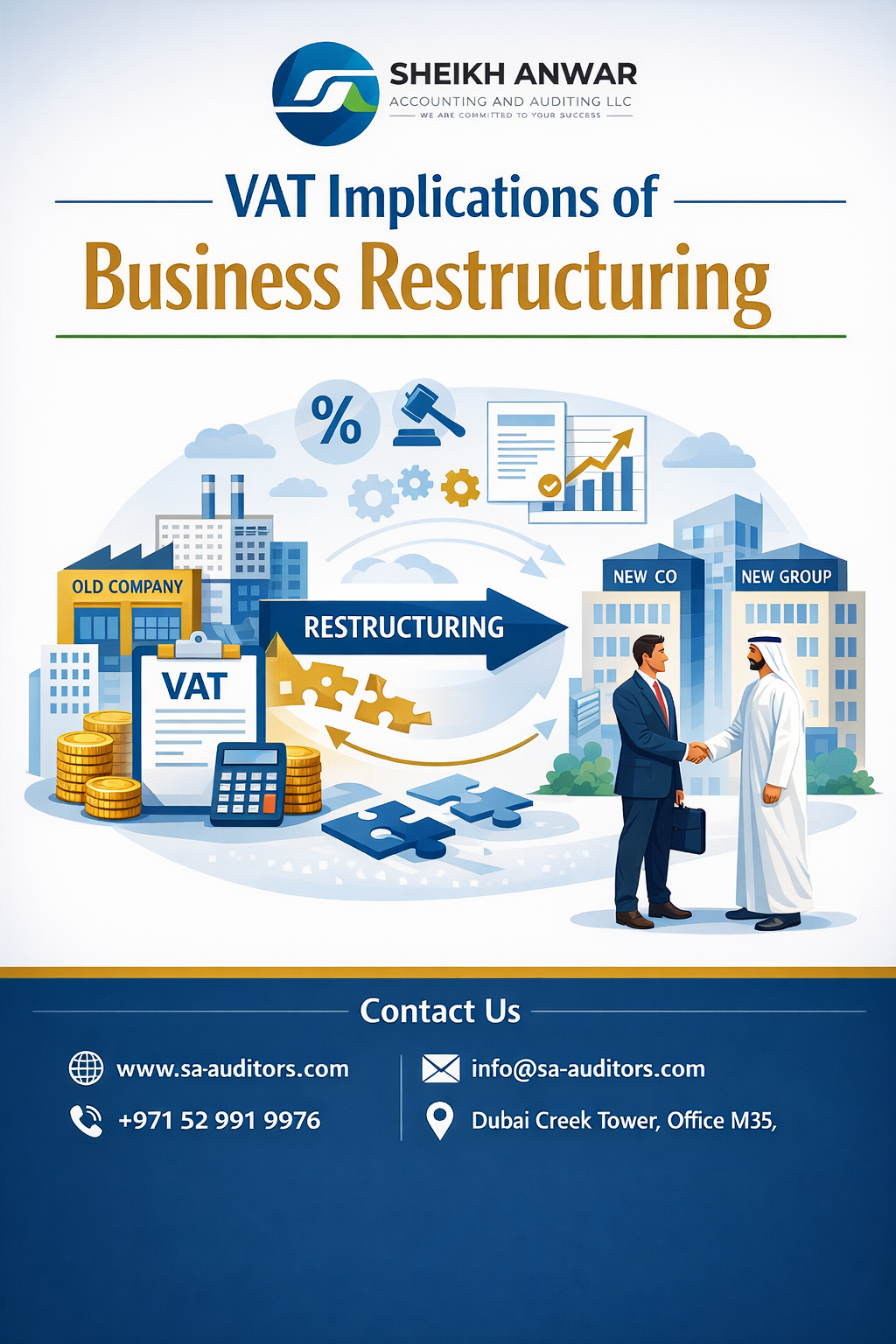
VAT Implications of Business Restructuring
Introduction
Business restructuring is a common strategic move undertaken by companies to improve efficiency, expand operations, or optimize tax and operational structures. In the UAE, such restructuring activities—including mergers, demergers, asset transfers, and internal reorganizations—have significant VAT implications that must be carefully assessed.
At Sheikh Anwar Accounting & Auditing LLC, we assist businesses in structuring transactions efficiently while ensuring full compliance with UAE VAT regulations and minimizing tax exposure.
________________________________________
What is Business Restructuring?
Business restructuring involves changes in the legal, operational, or financial structure of a business. Common forms include:
• Mergers and acquisitions
• Transfer of business or business units
• Internal group reorganizations
• Conversion of legal entities
• Asset transfers between related parties
• Sale of shares or business segments
Each of these transactions may have different VAT consequences.
________________________________________
General VAT Principle
Under UAE VAT law:
👉 VAT applies on the supply of goods and services
👉 A restructuring transaction may qualify as a taxable supply, unless specific relief applies
Therefore, businesses must evaluate whether VAT is applicable on each transaction.
________________________________________
Transfer of a Going Concern (TOGC) – Key Relief
One of the most important VAT reliefs available during restructuring is the Transfer of a Going Concern (TOGC).
What is TOGC?
TOGC allows the transfer of a business (or part of it) without charging VAT, provided certain conditions are met.
________________________________________
Conditions for TOGC
TOGC applies only if:
• The transfer involves a whole business or independent part of a business
• The recipient intends to continue the same business activity
• Both parties are VAT registered (or required to be registered)
• The transfer is not merely a sale of assets
________________________________________
Benefits of TOGC
✔ No VAT charged on transfer
✔ No cash flow impact
✔ Simplified transaction structure
________________________________________
When VAT Applies in Restructuring
If TOGC conditions are not met, VAT will apply as follows:
1. Asset Transfers
• Sale of individual assets → Subject to 5% VAT
________________________________________
2. Transfer Between Related Parties
• VAT applicable at standard rate
• Must consider market value rules
________________________________________
3. Share Transfers
• Generally VAT exempt (financial services)
• Input VAT recovery may be restricted
________________________________________
4. Liquidation or Closure
• May trigger deemed supply
• VAT applicable on remaining assets
________________________________________
Deemed Supply on Business Closure
When a business is closed or deregistered:
👉 VAT may apply on:
• Remaining inventory
• Fixed assets
• Goods where input VAT was previously recovered
This is often overlooked and can result in unexpected tax liabilities.
________________________________________
Market Value Rule for Related Parties
In restructuring involving related entities:
👉 If consideration is below market value, and
👉 The recipient cannot fully recover input VAT
👉 VAT must be calculated based on market value, not transaction value.
________________________________________
Input VAT Recovery During Restructuring
Input VAT recovery depends on:
• Nature of transaction (taxable vs exempt)
• Whether the activity continues post-transfer
• Whether costs relate to taxable supplies
👉 For example:
• Advisory/legal fees → Recoverable if linked to taxable activity
• Costs related to exempt transactions → Not recoverable
________________________________________
Common VAT Risks in Restructuring
Businesses often face the following issues:
• Incorrect application of TOGC relief
• Treating asset transfers as VAT-free incorrectly
• Ignoring deemed supply on deregistration
• Lack of documentation supporting business transfer
• Incorrect input VAT recovery
These risks can lead to significant penalties during FTA audits.
________________________________________
Best Practices for Businesses
✔ Conduct VAT impact assessment before restructuring
✔ Ensure TOGC conditions are fully met and documented
✔ Maintain detailed agreements and supporting documents
✔ Evaluate market value implications
✔ Plan VAT cash flow impact
✔ Seek professional advisory before execution
________________________________________
Conclusion
VAT implications of business restructuring in the UAE are complex and require careful planning. While reliefs such as TOGC can provide significant benefits, incorrect application can result in substantial tax exposure.
A proactive and well-structured approach will help businesses:
• Ensure compliance with UAE VAT laws
• Optimize tax outcomes
• Avoid penalties and audit risks
________________________________________
How Sheikh Anwar Accounting & Auditing LLC Can Help
We provide end-to-end advisory services for business restructuring, including:
• VAT impact analysis for restructuring transactions
• TOGC eligibility assessment and documentation
• Input VAT recovery review
• VAT registration/deregistration support
• FTA audit support and representation
________________________________________
📞 Contact Us Today
Sheikh Anwar Accounting & Auditing LLC
🌐 Website: www.sa-auditors.com
📧 Email: info@sa-auditors.com
📍 Address: Dubai Creek Tower, M35