VAT for Oil & Gas Companies in the UAE
Introduction
The Oil & Gas industry is a strategic pillar of the UAE economy, contributing significantly to national revenue and international trade. Since the introduction of Value Added Tax (VAT) in 2018, companies operating in the upstream, midstream, and downstream segments must comply with complex VAT regulations due to their diversified activities, government involvement, and cross-border operations.
Here we outlines key VAT considerations for Oil & Gas companies in the UAE.
________________________________________
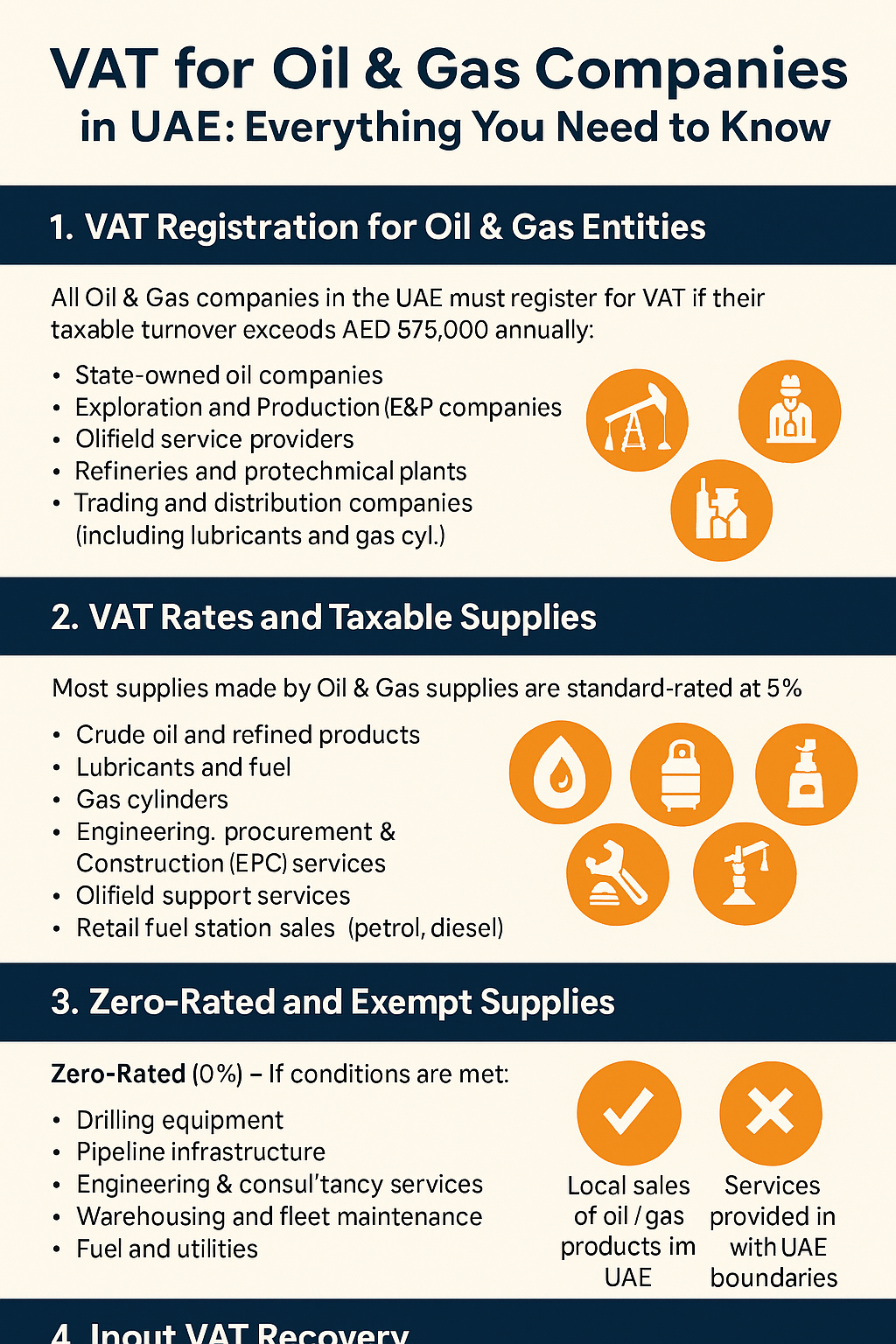
1. VAT Registration for Oil & Gas Entities
All Oil & Gas companies in the UAE must register for VAT if their taxable turnover exceeds AED 375,000 annually.
Entities that must register include:
• State-owned oil companies
• Exploration and production (E&P) companies
• Oilfield service providers
• Refineries and petrochemical plants
• Storage and logistics providers
• Trading and distribution companies (including lubricants and gas cylinders)
________________________________________
2. VAT Rates and Taxable Supplies
Most supplies made by Oil & Gas companies are standard-rated at 5%, including:
• Crude oil and refined products
• Lubricants and fuel
• Gas cylinders
• Engineering, procurement & construction (EPC) services
• Oilfield support services
• Retail fuel station sales (petrol, diesel)
________________________________________
3. Zero-Rated and Exempt Supplies
There are limited instances of zero-rated or exempt supplies in the Oil & Gas industry:
✅ Zero-Rated (0%) – If conditions are met:
• Export of oil or gas products outside the UAE
• International transport of petroleum products
• Export of services (e.g., consulting, if recipient is outside GCC and non-taxable)
❌ Not Zero-Rated:
• Local sales of oil and gas products in UAE
• Services provided within UAE boundaries
________________________________________
4. Input VAT Recovery
Oil & Gas businesses incur substantial input VAT on:
• Drilling equipment
• Pipeline infrastructure
• Engineering & consultancy services
• Warehousing and fleet maintenance
• Fuel and utilities
Input VAT is recoverable if used for taxable (standard- or zero-rated) activities.
However:
• Input VAT on exempt supplies (if any) is not recoverable
• Proportional recovery may be needed if the company engages in both taxable and exempt supplies
________________________________________
5. Reverse Charge Mechanism (RCM)
Oil & Gas companies frequently deal with foreign suppliers (e.g., equipment, consultancy, technology licenses). When services are imported:
• The UAE entity must self-account for VAT under reverse charge.
• Proper declaration in Boxes 3 and 10 of the VAT return is required.
Failure to apply RCM correctly can result in penalties.
________________________________________
6. VAT on Capital Projects and EPC Contracts
Large capital projects (e.g., refineries, pipelines) often involve complex EPC contracts. Key considerations:
• VAT applies on design, construction, installation, and commissioning
• Advance payments and milestone billing must be properly accounted for
• Retention amounts also require correct VAT timing
________________________________________
7. VAT on Fuel Sales and Retail Operations
Fuel stations must:
• Charge 5% VAT on petrol, diesel, lubricants, and car wash
• Issue tax invoices to corporate fleet customers
• Track input VAT on maintenance, fuel purchases, and operating costs
________________________________________
8. Key Compliance Risks for Oil & Gas Companies
Risk Impact
Misclassifying exports as standard-rated Overpaid VAT
Failing to apply reverse charge Under-reporting, penalties
Incorrect treatment of retention invoices Timing mismatches
Not documenting zero-rated exports properly Disallowed VAT recovery
Input VAT claimed on non-taxable activities Audit findings, reclaims
________________________________________
9. Documentation and Record-Keeping
Oil & Gas firms must retain:
• Import/export documentation (BLs, invoices, customs clearance)
• Contracts and tax invoices
• EPC project agreements with VAT clauses
• Input VAT calculations and apportionment working papers
Records must be kept for 5 years (15 years for real estate-related supplies).
________________________________________
📌 Conclusion
The VAT landscape for Oil & Gas companies in the UAE is complex, requiring deep industry understanding and strict compliance with FTA rules. From exploration to retail sales, VAT affects every stage of the supply chain.
________________________________________
💼 Need Professional VAT Support?
At Sheikh Anwar Accounting and Auditing LLC, we specialize in Oil & Gas VAT advisory including:
• VAT registration and returns
• Input tax optimization
• EPC contract reviews
• Zero-rating documentation
• FTA audit preparation
📲 Contact us today for expert Oil & Gas VAT guidance.
📧 info@sa-auditors.com
🌐 www.sa-auditors.com