Upcoming Changes in UAE VAT Law
Introduction
The UAE’s Value Added Tax (VAT) system has undergone significant transformation since its introduction in January 2018. With regional harmonization goals and digital governance at the forefront, the Federal Tax Authority (FTA) continues to enhance the VAT framework to improve compliance, reduce fraud, and align with international best practices.
As of mid-2025, several critical VAT updates and expected legal changes are on the horizon. Understanding these developments is crucial for business owners, CFOs, and tax professionals across the UAE.
________________________________________
🔍 Why Are VAT Laws Being Updated?
The changes are designed to:
• Strengthen enforcement and tax transparency.
• Address loopholes in VAT recovery and reporting.
• Incorporate new digital technologies (like EmaraTax).
• Prepare for GCC-wide VAT standardization.
• Reflect global trends in e-commerce and digital taxation.
________________________________________
📌 Major Upcoming Changes in UAE VAT Law
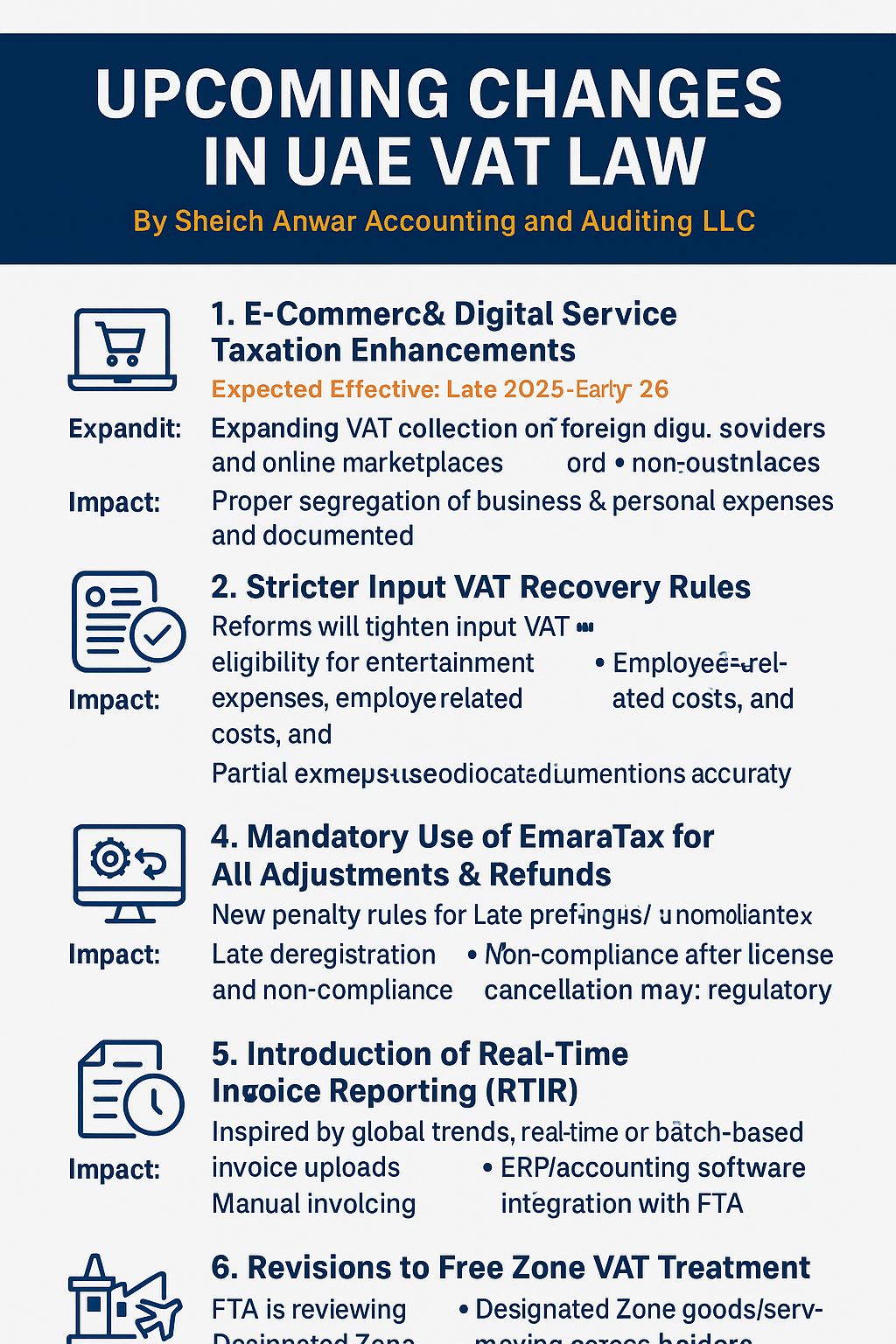
1. E-Commerce & Digital Service Taxation Enhancements
Expected Effective Date: Late 2025 – Early 2026
The FTA aims to expand VAT collection on:
• Foreign digital service providers (like software, e-learning, streaming).
• Online marketplaces acting as intermediaries.
Impact:
If you're selling via platforms like Noon, Amazon, or through your own website, you may be required to:
• Register for VAT even if not established in UAE.
• Collect and remit VAT on B2C sales.
• Comply with invoicing and record-keeping standards digitally.
________________________________________
2. Stricter Input VAT Recovery Rules
Upcoming reforms will tighten input VAT eligibility, especially on:
• Entertainment expenses,
• Employee-related costs (e.g., gifts, accommodation),
• Non-business use allocations.
Impact:
• Businesses must ensure proper segregation of business and personal expenses.
• Partial exemptions must be calculated and documented accurately.
________________________________________
3. Mandatory Use of EmaraTax for All Adjustments & Refunds
FTA is mandating the use of the EmaraTax platform for:
• VAT refund submissions (especially for exporters, real estate developers, and diplomats),
• Voluntary disclosures (Form 211),
• Penalty reconsideration requests.
Impact:
• Manual or PDF-based submissions will be discontinued.
• Authorised EmaraTax user credentials must be secured and updated regularly.
________________________________________
4. VAT Deregistration Penalty Reforms
New penalty rules are expected for:
• Late VAT deregistration after cessation of taxable activity,
• Non-compliance after trade license cancellation.
Impact:
• Firms must promptly deregister when turnover drops below AED 187,500 (voluntary threshold) or upon license cancellation.
• Fines may exceed AED 10,000 if non-compliance is prolonged.
________________________________________
5. Introduction of Real-Time Invoice Reporting (RTIR)
Inspired by global trends (e.g., India’s GST e-invoicing and EU's SAF-T), UAE may introduce:
• Live or batch-based invoice uploads to FTA’s portal.
• E-invoicing validations linked to TRN databases.
Impact:
• ERP and accounting software must be integrated with EmaraTax.
• Businesses using Excel/manual invoicing must upgrade.
________________________________________
6. Revisions to Free Zone VAT Treatment
FTA is reviewing:
• VAT treatment in Designated Zones for goods/services moving across borders.
• Clarification on mixed-use activities within free zones.
Impact:
• Re-assessment of supply chains for zero-rated, exempt, and standard-rated transactions.
• VAT grouping rules for free zone and mainland entities may tighten.
________________________________________
🧾 Other Areas Under Review
• VAT grouping eligibility & cross-liability exposure.
• Bare land and off-plan sales VAT implications.
• Financial services exemptions vs. taxable advisory services.
• Penalties reform for late payment, late filing, and voluntary disclosures.
________________________________________
🧠 How to Prepare for These Changes
At Sheikh Anwar Accounting and Auditing LLC, we recommend:
✅ VAT Readiness Checklist:
• Review your VAT return and disclosure history.
• Conduct a VAT health check audit for 2022–2024 returns.
• Assess your system readiness for e-invoicing and EmaraTax integration.
• Update internal staff training on new VAT documentation policies.
• Re-evaluate vendor and customer VAT treatment for cross-border transactions.
________________________________________
🛡️ Our Services
We provide:
• VAT impact assessment on your business operations.
• System compliance review and EmaraTax onboarding.
• Assistance with voluntary disclosure, reconsideration, and refund claims.
• Periodic VAT training for finance teams.
________________________________________
📍Final Thoughts
The evolving VAT landscape in the UAE demands proactive compliance. The upcoming changes may increase administrative responsibilities, but they also present opportunities to digitize and streamline operations.
Act now to stay ahead of regulatory changes.
Contact Sheikh Anwar Accounting and Auditing LLC for expert guidance and risk-free VAT operations.
📞 Phone: +971-XXX-XXXX
📧 Email: info@sa-auditors.com
🌐 Website: www.sa-auditors.com