UAE’s VAT Position in GCC VAT Framework
Introduction
When the United Arab Emirates (UAE) introduced Value Added Tax (VAT) on 1 January 2018, it did so as part of a larger regional initiative—the GCC Unified VAT Agreement. While the UAE has successfully implemented and enforced its domestic VAT laws, its alignment with the broader GCC VAT framework continues to evolve.
Here we explore the UAE’s VAT position within the Gulf Cooperation Council (GCC) VAT Framework, the extent of its compliance, and what it means for businesses operating in multiple GCC countries.
________________________________________
🌍 What is the GCC VAT Framework?
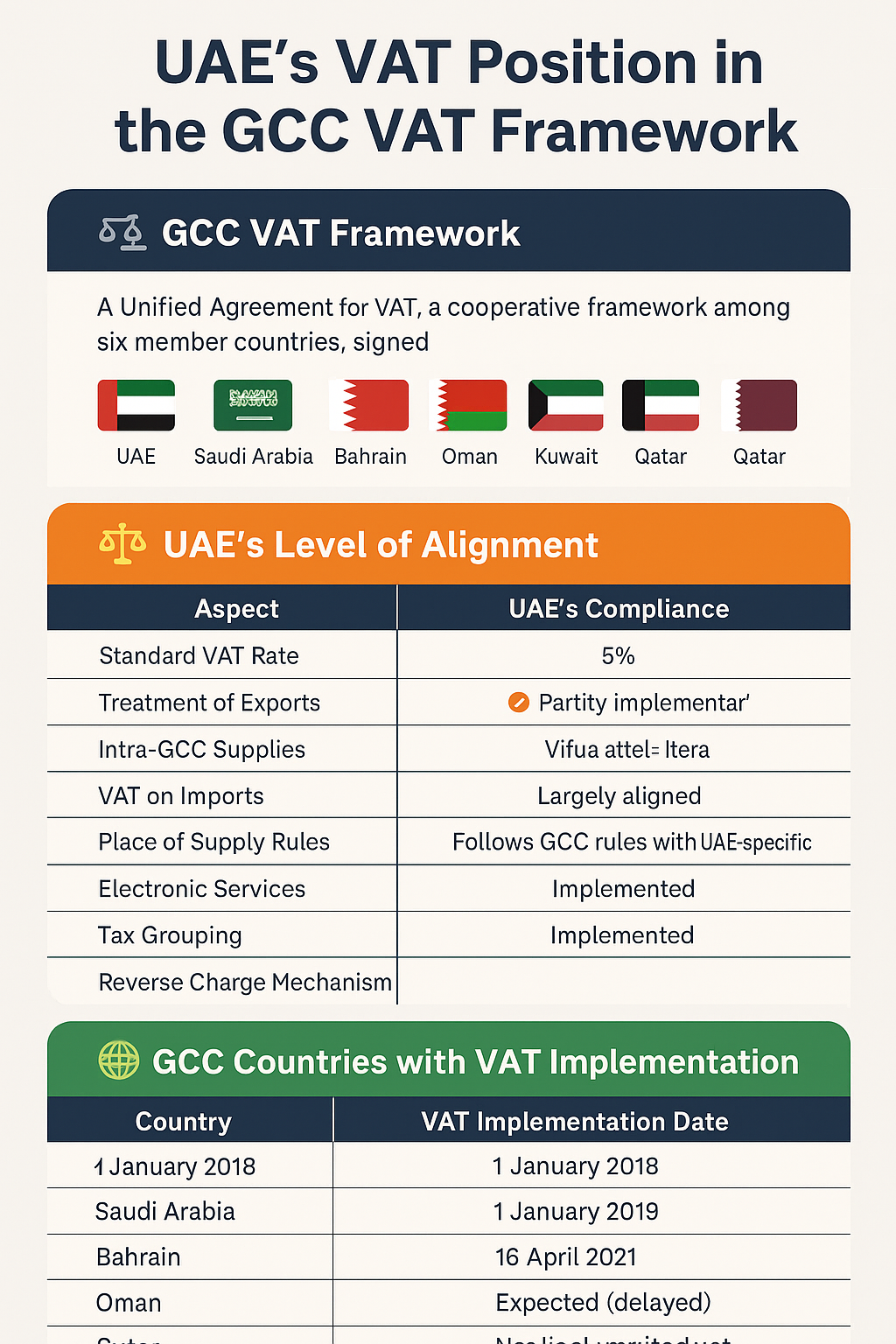
The GCC VAT Framework refers to the Unified Agreement for VAT signed in 2016 by all six GCC member states:
• United Arab Emirates
• Saudi Arabia
• Bahrain
• Oman
• Kuwait
• Qatar
This agreement sets out the foundational rules and principles for implementing VAT across the region in a harmonized manner.
________________________________________
📜 Key Objectives of the GCC VAT Framework
1. Harmonized Tax System across member states
2. Efficient intra-GCC trade with minimal VAT leakage
3. Consistency in tax treatment of goods and services
4. Revenue diversification beyond hydrocarbons
5. Clarity for cross-border businesses
________________________________________
🇦🇪 UAE’s Implementation of VAT
The UAE implemented VAT through:
• Federal Decree-Law No. 8 of 2017 on VAT
• Cabinet Decision No. 52 of 2017 on Executive Regulations
• Federal Tax Authority (FTA) as the enforcement body
While the UAE adopted most of the principles of the GCC VAT Framework, its actual VAT regime has a number of country-specific adaptations based on national priorities and economic strategy.
________________________________________
⚖️ UAE's Level of Alignment with GCC VAT Framework
Aspect UAE’s Compliance
Standard VAT Rate ✅ 5% (Aligned with GCC Framework)
Treatment of Exports ✅ Zero-rated (Aligned)
Intra-GCC Supplies ⚠️ Partially implemented
VAT on Imports ✅ Yes
Place of Supply Rules ✅ Largely aligned
Electronic Services ✅ Follows GCC rules with UAE-specific clarity
Tax Grouping ✅ Implemented
Reverse Charge Mechanism ✅ Applied for services & some goods
Note: Full mutual recognition of intra-GCC supplies is not yet fully operational because not all GCC countries have implemented VAT.
________________________________________
🌐 GCC Countries with VAT Implementation (as of 2025)
Country VAT Implementation Date
UAE 1 January 2018
Saudi Arabia 1 January 2018
Bahrain 1 January 2019
Oman 16 April 2021
Qatar Expected (delayed)
Kuwait Not implemented yet
Because of this staggered rollout, true GCC-wide harmonization is still pending.
________________________________________
🔍 Intra-GCC Trade: The UAE’s Current Approach
Pre-conditions for zero-rating intra-GCC exports:
As per the GCC VAT Agreement, goods and services supplied between VAT-implementing GCC states should be zero-rated, provided the recipient is VAT-registered in the destination country.
However, in UAE:
• Supplies to other GCC states are currently treated as exports, and zero-rated, only if goods leave UAE physically.
• Until all countries have operational VAT systems linked by a shared electronic GCC VAT System, intra-GCC B2B supplies are handled like exports.
VAT Treatment Depends On:
• Destination country’s VAT status
• Recipient’s VAT registration status
• Mode and proof of shipment
________________________________________
🧾 Input VAT Recovery and Refunds
The UAE offers:
• Full input VAT recovery for eligible business expenses
• Refund schemes for:
o GCC nationals with business presence in other member states
o Tourists from GCC and beyond
However, reciprocal refunds with other GCC states are limited until full system integration.
________________________________________
📈 Opportunities and Challenges for UAE Businesses
✅ Opportunities
• Advance compliance systems through EmaraTax
• Clear guidance via FTA Public Clarifications
• Strategic positioning as a regional trade hub
⚠️ Challenges
• Inconsistent VAT treatment across GCC
• Difficulty claiming input VAT refunds across borders
• Uncertainty in intra-GCC tax rules
________________________________________
📌 Conclusion
While the UAE is a pioneer in implementing VAT in line with the GCC VAT Framework, the full vision of a unified tax environment remains in progress. Businesses should continue to:
• Monitor developments in other GCC countries
• Structure cross-border transactions carefully
• Seek professional VAT advice for regional operations
________________________________________
🤝 How We Can Help
At Sheikh Anwar Accounting and Auditing LLC, we help clients:
• Navigate intra-GCC VAT compliance
• File VAT returns in UAE and analyze regional implications
• Structure transactions to minimize VAT risks
• Handle cross-border VAT refunds and disclosures
📧 Contact: info@sa-auditors.com
🌐 Visit: www.sa-auditors.com
________________________________________