UAE’s Removal from FATF Grey List – What It Means
Introduction
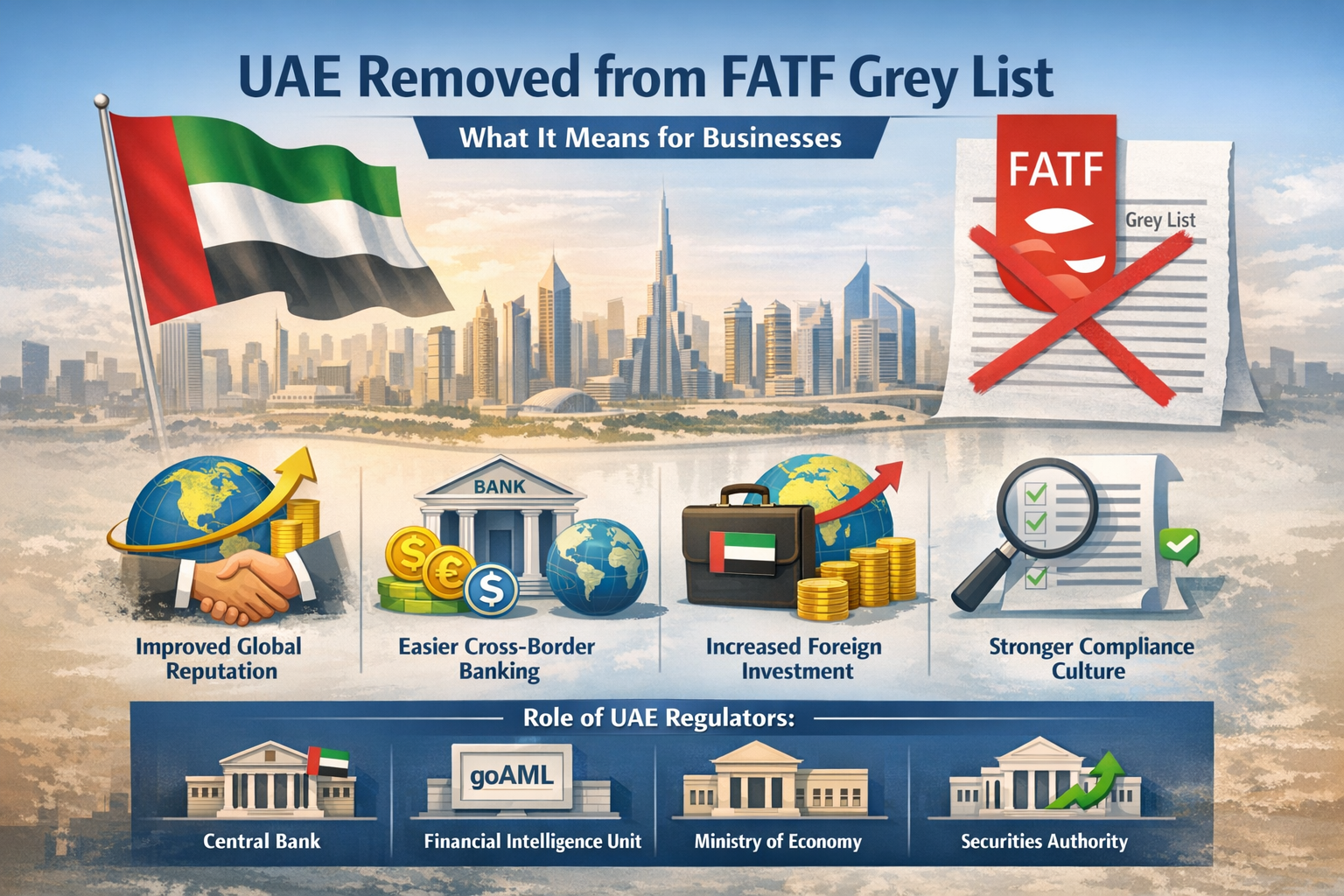
In a major milestone for the country’s regulatory and financial framework, the United Arab Emirates (UAE) was officially removed from the Financial Action Task Force (FATF) Grey List in February 2024.
This decision reflects the UAE’s strong commitment to strengthening its Anti-Money Laundering (AML) and Counter-Terrorism Financing (CTF) systems. Over the past few years, the UAE has significantly enhanced its regulatory framework, supervision mechanisms, and enforcement actions to align with international compliance standards.
For businesses operating in the UAE—particularly those in financial services, gold and precious metals trading, real estate, accounting, and corporate services—this development has important implications.
________________________________________
Understanding the FATF Grey List
The Financial Action Task Force is the global standard-setting body responsible for combating money laundering and terrorist financing.
Countries placed on the Grey List are jurisdictions under increased monitoring due to identified deficiencies in their AML/CFT framework. These countries must implement an action plan to strengthen their systems and address regulatory gaps.
The UAE was added to the Grey List in March 2022, mainly due to concerns related to:
• Monitoring of high-risk sectors
• Effectiveness of financial intelligence reporting
• Supervision of non-financial businesses
• Enforcement of AML compliance obligations
Since then, the UAE government has implemented significant reforms to meet FATF requirements.
________________________________________
Role of Competent Authorities (COM) in Strengthening AML Compliance
A key factor in the UAE’s removal from the Grey List was the strong coordination among the country’s competent authorities (COM) responsible for AML supervision and enforcement.
Several regulators oversee AML compliance across different sectors:
Financial Intelligence and National Coordination
• UAE Financial Intelligence Unit (FIU)
Responsible for receiving and analyzing suspicious transaction reports submitted through the goAML platform.
• Executive Office for Control and Non-Proliferation
Oversees implementation of Targeted Financial Sanctions (TFS) and compliance with UN sanctions.
• National Anti-Money Laundering and Combating Financing of Terrorism Committee
Coordinates AML/CFT policies across government agencies.
________________________________________
Financial Sector Regulators
Financial institutions in the UAE are supervised by:
• Central Bank of the UAE – regulates banks, exchange houses, and financial institutions.
• Securities and Commodities Authority – supervises capital markets and investment firms.
• Dubai Financial Services Authority – regulates financial services within the Dubai International Financial Centre.
• Financial Services Regulatory Authority – supervises financial institutions operating in the Abu Dhabi Global Market.
________________________________________
DNFBP Supervisory Authorities
Designated Non-Financial Businesses and Professions (DNFBPs) are supervised by:
• UAE Ministry of Economy – responsible for supervising Dealers in Precious Metals and Stones (DPMS), auditors, and corporate service providers.
• Dubai Land Department – supervises AML compliance for real estate brokers and developers.
• Various Free Zone Authorities such as DMCC, DAFZA, and SAIF Zone, which also monitor compliance within their jurisdictions.
These authorities conduct inspections, enforce compliance, and impose penalties for violations of AML regulations.
________________________________________
Key Reforms Implemented by the UAE
To address FATF recommendations, the UAE introduced several reforms:
1. Strengthened AML Legislation
The UAE enhanced its AML framework under Federal Decree Law No. 20 of 2018 and subsequent implementing regulations.
2. Increased Inspections and Enforcement
Authorities significantly increased compliance inspections across high-risk sectors such as:
• Gold and precious metals trading
• Real estate brokerage
• company service providers
• financial institutions
3. Improved Suspicious Transaction Reporting
Businesses are now required to actively submit reports through the goAML system, including:
• Suspicious Transaction Reports (STR)
• Suspicious Activity Reports (SAR)
• Sanctions reporting
4. Stronger International Cooperation
The UAE enhanced cooperation with global financial intelligence units and international regulators to combat illicit financial flows.
________________________________________
Benefits of UAE’s Removal from the Grey List
1. Improved Global Reputation
Removal from the Grey List enhances the UAE’s credibility as a transparent and compliant international financial hub.
2. Easier Cross-Border Banking
International banks often apply stricter due diligence measures to grey-listed jurisdictions. Removal from the list facilitates smoother financial transactions.
3. Increased Foreign Investment
The decision boosts investor confidence and strengthens the UAE’s position as a leading global business destination.
4. Stronger Compliance Culture
The reforms introduced during FATF monitoring have significantly improved corporate governance and compliance awareness across the country.
________________________________________
What This Means for UAE Businesses
Although the UAE has been removed from the Grey List, businesses must continue maintaining strong compliance practices.
Companies should ensure that they:
• Maintain AML policies and procedures
• Conduct Customer Due Diligence (CDD) and Enhanced Due Diligence (EDD)
• Perform risk assessments
• Report suspicious activities through goAML
• Provide regular AML training to employees
Regulators will continue conducting inspections to ensure that AML compliance standards remain high.
________________________________________
Importance for DNFBPs and Precious Metals Traders
Businesses classified as Designated Non-Financial Businesses and Professions (DNFBPs)—especially gold and jewellery traders—remain a key focus area for regulators.
Given the UAE’s role as a global trading hub for precious metals, authorities have increased monitoring of:
• gold trading companies
• bullion dealers
• jewellery traders
• scrap metal businesses
These sectors are expected to maintain robust compliance systems and risk monitoring frameworks.
________________________________________
Conclusion
The UAE’s removal from the **Financial Action Task Force Grey List represents a major achievement and highlights the country’s strong commitment to combating financial crime.
However, maintaining this status requires continuous cooperation between businesses, regulators, and competent authorities.
Organizations operating in the UAE must ensure that they maintain effective AML compliance frameworks and contribute to a transparent and secure financial system.
________________________________________
About Us
Sheikh Anwar Accounting and Auditing LLC provides specialized compliance and advisory services including:
• AML Risk Assessments
• AML Policy Preparation
• AML Audits
• goAML Registration & Reporting
• Corporate Tax & VAT Compliance
Visit: www.sa-auditors.com