UAE AML Journey: Past, Present & Future
Introduction
The United Arab Emirates (UAE) has transformed into a global hub for trade, finance, and investment. With this growth comes the challenge of preventing money laundering (ML) and terrorism financing (TF). Over the years, the UAE has taken significant steps to build a strong Anti-Money Laundering (AML) framework—aligning with global standards, strengthening enforcement, and preparing for future challenges in an increasingly digital economy.
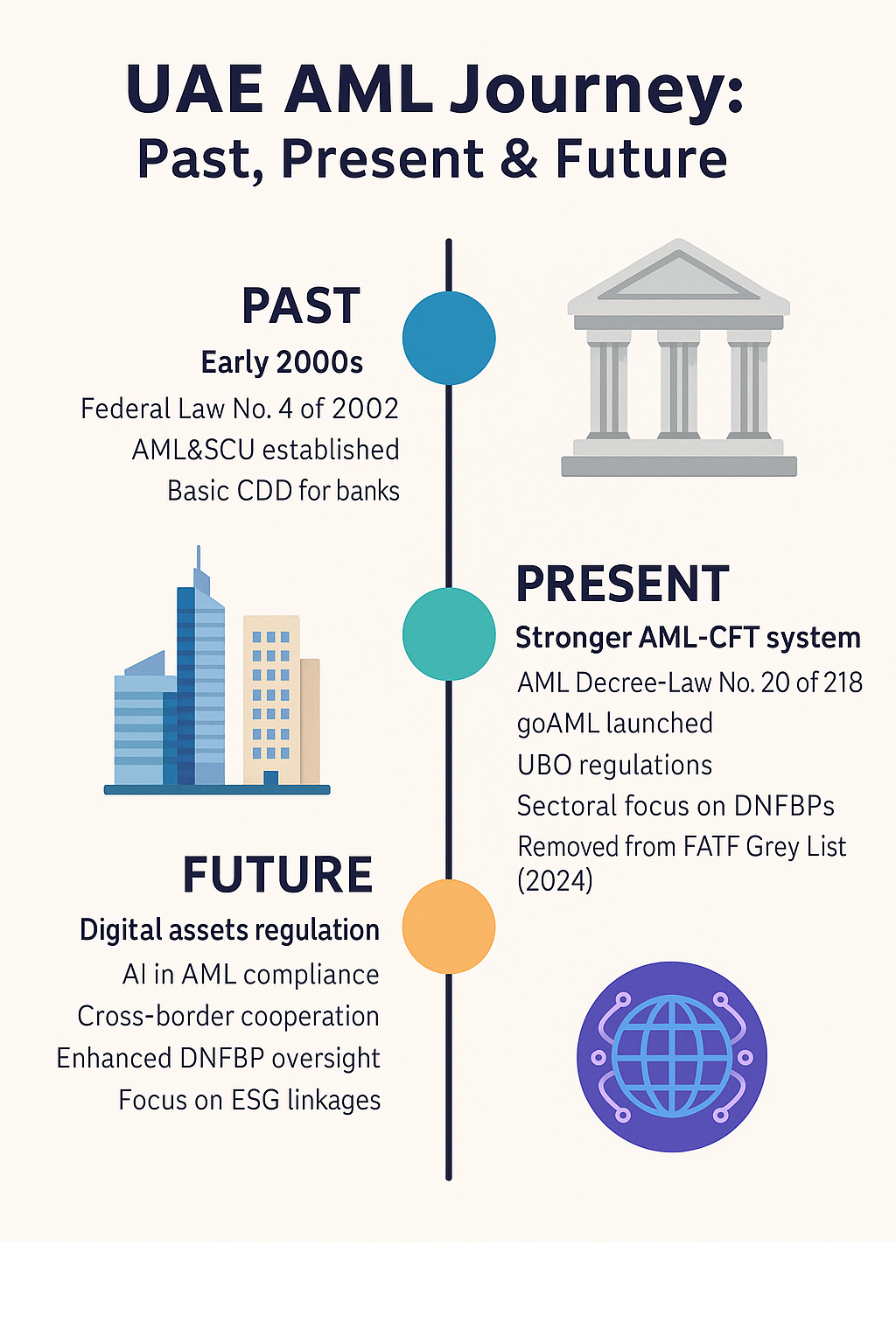
It highlights the UAE’s AML journey: past, present, and future.
________________________________________
The Past: Building the Foundations
In the early 2000s, the UAE began strengthening its financial regulations in response to global concerns about terrorism financing and money laundering. Initial efforts focused on:
• Federal Law No. 4 of 2002: One of the UAE’s first comprehensive AML laws.
• Establishment of the UAE Central Bank’s Anti-Money Laundering and Suspicious Cases Unit (AMLSCU).
• Basic requirements for Customer Due Diligence (CDD) and record-keeping in banks.
At that stage, AML compliance was still evolving, with greater focus on the financial sector and limited enforcement in non-financial businesses.
________________________________________
The Present: Strengthening AML Frameworks
The UAE has made remarkable progress in building a robust AML and Counter-Terrorism Financing (CTF) system that covers both financial institutions and Designated Non-Financial Businesses and Professions (DNFBPs).
Key Developments:
1. Federal Decree-Law No. 20 of 2018 – Comprehensive AML-CFT law aligning with FATF standards.
2. Cabinet Decision No. 10 of 2019 – Implementing regulations covering DNFBPs.
3. Federal Decree-Law No. 26 of 2021 – Enhancing supervisory powers and penalties.
4. Cabinet Decision No. 111 of 2022 – Expanding DNFBP obligations.
5. goAML Portal – Launched for STR and CTR filing to the UAE Financial Intelligence Unit (FIU).
6. Ultimate Beneficial Ownership (UBO) Regulations – Ensuring transparency in company ownership.
7. Sectoral Focus – Special oversight for high-risk sectors such as gold, jewellery, real estate, and corporate services.
Current Enforcement
• Fines ranging from AED 50,000 to AED 5 million for non-compliance.
• Business license suspensions for repeat violators.
• Increased inspections by the Ministry of Economy, Central Bank, and Securities & Commodities Authority.
• Ongoing training and awareness campaigns for DNFBPs.
These reforms led to the UAE being removed from the FATF “Grey List” in 2024, strengthening its global reputation.
________________________________________
The Future: Adapting to New Challenges
The UAE is continuously evolving its AML frameworks to stay ahead of emerging risks. The future focus will include:
1. Digital Assets & Cryptocurrencies
• Regulation of Virtual Asset Service Providers (VASPs) by the Virtual Asset Regulatory Authority (VARA).
• Stronger monitoring of crypto transactions to prevent abuse.
2. Artificial Intelligence (AI) in AML
• Greater use of AI and machine learning for transaction monitoring, sanctions screening, and fraud detection.
3. Cross-Border Cooperation
• Strengthening partnerships with global regulators to combat international money laundering and terrorism financing.
4. Enhanced DNFBP Oversight
• Continued focus on real estate, gold trading, auditors, and corporate service providers to ensure compliance.
5. Capacity Building & Awareness
• More training for employees, compliance officers, and startups.
• Development of simplified AML solutions for SMEs.
6. Sustainability & ESG Linkages
• AML compliance increasingly linked with good governance, corporate responsibility, and ESG standards to attract global investors.
________________________________________
Conclusion
The UAE’s AML journey reflects its commitment to protecting its financial system and maintaining its role as a trusted global hub. From early laws in 2002 to a sophisticated AML regime today, the UAE has built a framework aligned with global standards while addressing local risks.
Looking ahead, technology, cross-border collaboration, and enhanced regulatory enforcement will shape the future of AML in the UAE, ensuring long-term financial security and investor confidence.
________________________________________
About Sheikh Anwar Accounting and Auditing LLC
At Sheikh Anwar Accounting and Auditing LLC, we help businesses stay compliant with evolving AML requirements. Our services include:
• AML risk assessments and policies.
• STR/CTR filing via goAML.
• UBO compliance support.
• Outsourced MLRO and compliance officer services.
• Staff training and awareness.
• 📍 Head Office: Dubai, UAE
• 🌐 Website: www.sa-auditors.com
• 📧 Email: info@sa-auditors.com