Transfer Pricing in UAE Corporate Tax
Introduction
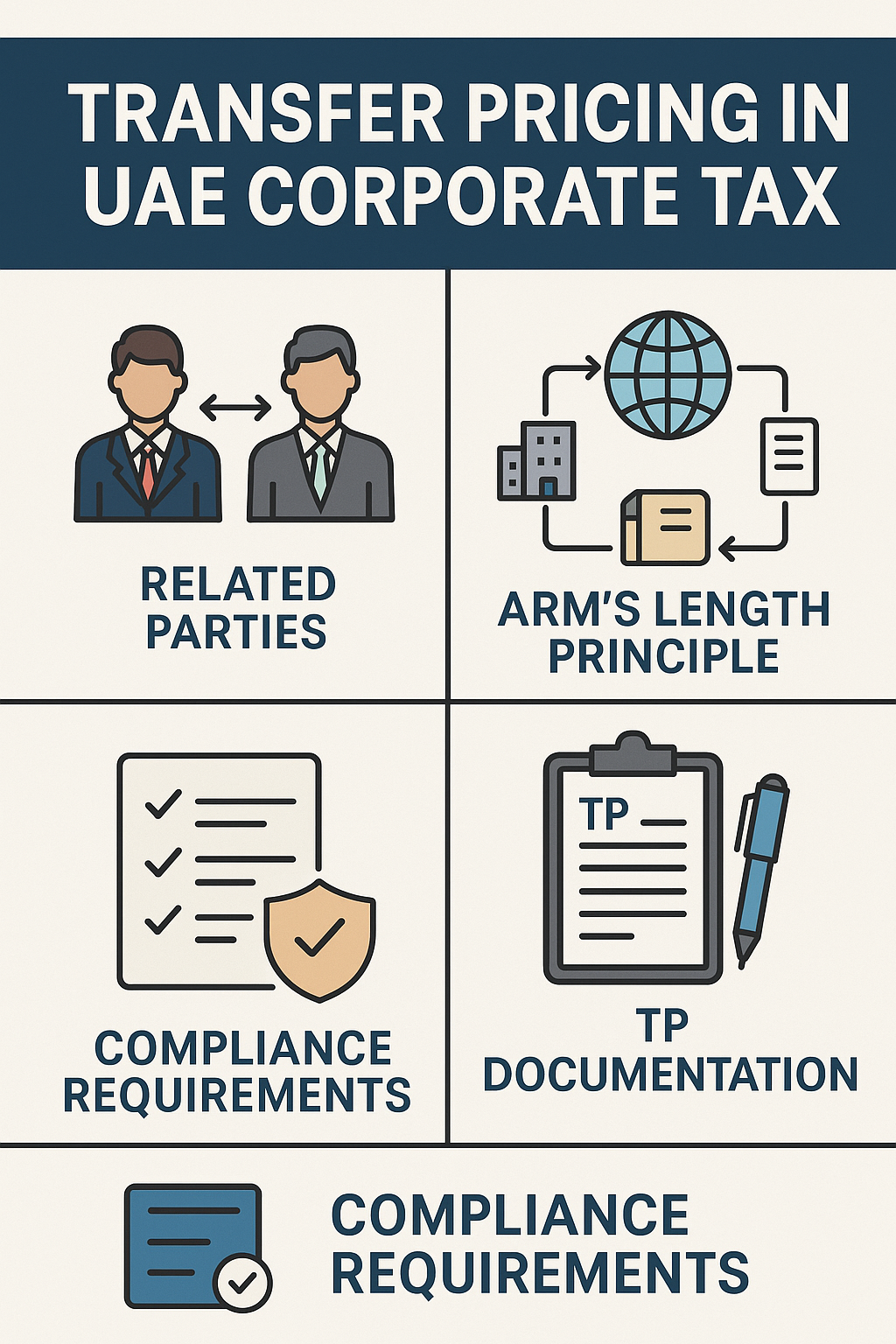
With the introduction of UAE Corporate Tax (Federal Decree-Law No. 47 of 2022), Transfer Pricing (TP) has become a critical compliance area for businesses, particularly for multinational groups and related-party transactions. Transfer Pricing ensures that transactions between related parties are conducted on an arm’s length basis, preventing artificial shifting of profits between jurisdictions.
The UAE’s Transfer Pricing regime is aligned with OECD Guidelines and applies to a wide range of businesses, from large conglomerates to Free Zone entities engaging in related-party or connected transactions.
________________________________________
1. What is Transfer Pricing?
Transfer Pricing refers to the pricing of goods, services, financing, and intellectual property exchanged between related entities (e.g., parent companies, subsidiaries, or group entities). The UAE requires such transactions to be priced as if they were conducted between independent third parties, ensuring fairness and preventing tax avoidance.
________________________________________
2. Applicability of Transfer Pricing in UAE
Transfer Pricing rules apply to:
• Related Party Transactions: Between parent companies, subsidiaries, or group entities.
• Connected Persons: Individuals or entities with significant influence over the company (e.g., shareholders, directors).
• Cross-Border & Domestic Transactions: Both within the UAE and with foreign affiliates.
• Free Zone Entities: Even those benefiting from 0% Corporate Tax must comply with Transfer Pricing.
________________________________________
3. The Arm’s Length Principle
The foundation of UAE TP rules is the Arm’s Length Principle, requiring related-party transactions to be conducted at market value.
Commonly accepted TP methods include:
• Comparable Uncontrolled Price (CUP) method.
• Resale Price Method.
• Cost Plus Method.
• Transactional Net Margin Method (TNMM).
• Profit Split Method.
Businesses must select the most appropriate method based on transaction type and data availability.
________________________________________
4. Transfer Pricing Documentation Requirements
To comply with TP rules, companies must maintain proper documentation:
1. Disclosure Form:
o Required with annual Corporate Tax Return.
o Discloses details of related-party transactions.
2. Local File (if thresholds are met):
o Provides detailed TP documentation for UAE entity.
o Includes analysis of controlled transactions, benchmarking studies, and method justification.
3. Master File (if thresholds are met):
o Provides group-wide information.
o Includes organizational structure, global transfer pricing policies, and consolidated financials.
________________________________________
5. Thresholds for TP Documentation
As per UAE Corporate Tax law:
• Companies that are part of a Multinational Enterprise (MNE) Group with consolidated revenues of AED 3.15 billion or more must file a Master File & Country-by-Country Report (CbCR).
• Other entities crossing specific revenue or transaction thresholds may also be required to prepare a Local File.
• All taxpayers, regardless of size, must submit the TP Disclosure Form.
________________________________________
6. Common Related-Party Transactions in UAE
Examples of transactions that fall under TP compliance include:
• Intercompany sale or purchase of goods.
• Service fees (management, IT, HR support).
• Financing arrangements (loans, guarantees, interest).
• Use of intellectual property (royalties, licensing fees).
• Cost-sharing arrangements within group entities.
________________________________________
7. Penalties for Non-Compliance
Failure to comply with TP requirements can lead to:
• Administrative Penalties by the FTA.
• Increased risk of tax reassessment.
• Loss of Free Zone tax benefits if TP compliance is not maintained.
________________________________________
8. Strategic TP Planning in UAE Corporate Tax
• Benchmarking Studies: Justify pricing of goods/services against market comparables.
• Restructure Intercompany Agreements: Align contracts with TP rules.
• Free Zone Compliance: Ensure related-party transactions don’t jeopardize 0% tax benefits.
• Advanced Pricing Agreements (APAs): Consider entering into APAs for clarity on complex transactions.
• Documentation Readiness: Maintain contemporaneous records to withstand FTA audits.
________________________________________
Conclusion
Transfer Pricing is a core compliance area under the UAE Corporate Tax regime, impacting businesses of all sizes that engage in related-party or connected transactions. By adhering to the arm’s length principle, maintaining proper documentation, and adopting proactive TP strategies, businesses can ensure compliance, avoid penalties, and optimize their tax position.
The UAE’s alignment with OECD standards strengthens its reputation as a global investment hub while ensuring tax transparency and fairness.
________________________________________
✍️ By Sheikh Anwar Accounting and Auditing LLC (SA-Auditors)
📍 Dubai, United Arab Emirates
🌐 www.sa-auditors.com | ✉️ info@sa-auditors.com