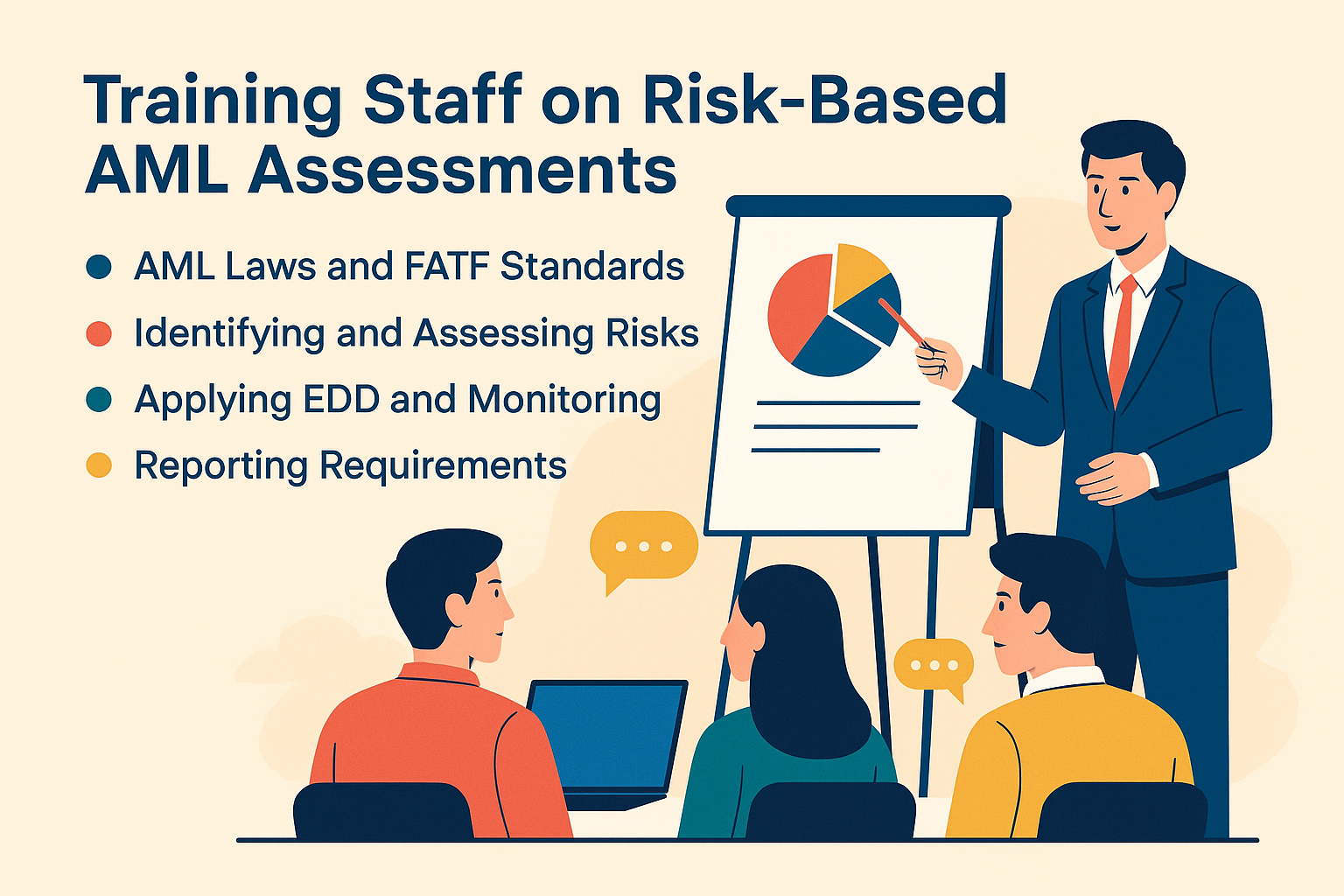
Training Staff on Risk-Based AML Assessments
Introduction
The foundation of any successful Anti-Money Laundering (AML) program lies in the knowledge and vigilance of its people. While technology and policies play critical roles, it is the human element—trained, alert, and compliant staff—that truly determines how effectively financial crime is prevented.
In the UAE, Federal Decree-Law No. 20 of 2018 and Cabinet Decision No. 10 of 2019 mandate that all entities—especially Designated Non-Financial Businesses and Professions (DNFBPs)—train employees to identify, assess, and mitigate money laundering and terrorist financing risks.
It explores how organizations can effectively train their staff on risk-based AML assessments, ensuring compliance and operational excellence.
________________________________________
1. Why AML Training is Essential
AML training is not merely a legal obligation—it is a strategic safeguard. A single oversight by an untrained employee can expose an entire organization to legal penalties, regulatory sanctions, and reputational damage.
Key Benefits:
• Ensures staff understand AML laws and regulatory expectations.
• Enhances ability to detect suspicious transactions early.
• Strengthens overall compliance culture.
• Demonstrates due diligence during regulatory inspections.
The UAE Ministry of Economy (MOE), which supervises DNFBPs, frequently checks whether AML training programs are conducted, documented, and tailored to staff roles.
________________________________________
2. Understanding Risk-Based AML Assessments
A Risk-Based Approach (RBA) requires identifying where risks are highest and allocating resources accordingly. Employees must be trained to:
• Recognize high-risk customers, products, and jurisdictions.
• Apply Enhanced Due Diligence (EDD) where required.
• Maintain vigilance during ongoing monitoring.
In essence, training should help staff think critically about risk exposure and make informed compliance decisions.
________________________________________
3. Key Training Objectives
To build competence, AML training programs must aim to:
1. Explain AML laws and FATF standards.
2. Clarify the concept of risk-based thinking.
3. Demonstrate how to perform AML risk assessments (customer, product, and geography-based).
4. Teach how to identify red flags and suspicious activity.
5. Emphasize reporting procedures (STR/DPMSR filing).
6. Reinforce the importance of record-keeping and internal communication.
________________________________________
4. Who Should Be Trained?
Every employee has a role to play in AML compliance, but the depth of training should vary by function.
Employee Group Training Focus
Frontline Staff / Sales Identifying suspicious customers, KYC, documentation.
Finance & Operations Transaction monitoring, cash handling risks.
Compliance / MLRO Conducting risk assessments, EDD, STR reporting.
Senior Management Oversight, risk appetite, and strategic compliance decisions.
New Employees Introductory AML awareness training.
________________________________________
5. Designing a Risk-Based AML Training Program
Step 1: Assess Training Needs
Identify which departments and employees are exposed to AML risk. For example:
• Gold traders and real estate brokers handle high-value transactions.
• Corporate service providers manage entity formations and ownership verification.
Step 2: Develop Tailored Modules
Segment training by job role:
• Basic AML Awareness – For all employees.
• Risk Assessment Skills – For compliance teams.
• Suspicious Activity Detection – For operations and customer-facing staff.
• Regulatory Reporting & Documentation – For MLROs and management.
Step 3: Incorporate Case Studies
Use real-world examples of money laundering schemes in the UAE (such as misuse of trade, gold transactions, or complex ownership structures) to make learning practical and memorable.
Step 4: Include Interactive Elements
Use quizzes, role-playing, and workshops to simulate AML risk assessment exercises. Encourage employees to identify risk scenarios and propose mitigation steps.
Step 5: Evaluate and Certify
Conduct post-training assessments to measure understanding. Provide certificates of completion as evidence for regulatory inspections.
________________________________________
6. Key Topics to Include in AML Risk-Based Training
1. Overview of UAE AML/CFT laws and FATF recommendations.
2. Understanding of Risk-Based Approach (RBA).
3. How to perform Customer Due Diligence (CDD) and Enhanced Due Diligence (EDD).
4. Risk indicators for customers, products, and geographies.
5. Recognizing red flags of money laundering and terrorist financing.
6. Reporting obligations (STRs, DPMSRs, goAML platform).
7. Maintaining AML records for five years.
8. Role of technology and data analytics in risk monitoring.
9. Handling confidential information and regulatory cooperation.
________________________________________
7. Practical Example – Applying Training in Real Scenarios
Case 1: A jewellery trader receives a large cash transaction from a foreign client with unclear business background.
Trained Response:
• Staff identifies the client as high risk due to non-residency and cash payment.
• EDD is applied – obtain proof of source of funds and beneficial ownership documents.
• If suspicion remains, an STR is filed through goAML.
Case 2: A real estate broker notices property purchases funded through multiple transfers from different accounts.
Trained Response:
• Review for potential layering activity.
• Escalate to MLRO for risk evaluation.
• Document the transaction and file STR if needed.
________________________________________
8. Frequency of AML Training
AML training should not be a one-time exercise. Regulators expect regular, ongoing programs to ensure staff stay updated.
Recommended Frequency:
• Annually for all employees.
• Semi-annually for high-risk sectors (gold, real estate, corporate services).
• Onboarding sessions for all new staff.
• Ad-hoc training when regulations, FATF lists, or internal policies change.
________________________________________
9. Documentation and Compliance Evidence
Every AML training program must be documented and auditable. Maintain:
• Training calendar and attendance records.
• Training materials and presentations.
• Employee test results and feedback.
• Certificates and sign-in sheets.
• Annual AML training summary for internal audits and regulators.
This documentation demonstrates organizational commitment and regulatory compliance.
________________________________________
10. Leveraging Technology for AML Training
Modern training platforms allow companies to automate and track learning:
• Learning Management Systems (LMS): Track attendance, quizzes, and certifications.
• E-learning modules: Provide flexible access for busy professionals.
• AI-driven analytics: Measure training effectiveness and identify knowledge gaps.
At Sheikh Anwar Academy, digital AML training programs can be tailored for each business type—making compliance accessible and affordable for DNFBPs across the UAE.
________________________________________
Conclusion
Training staff on Risk-Based AML Assessments is not just about fulfilling legal obligations—it’s about building a culture of awareness, integrity, and responsibility.
In the UAE’s evolving AML landscape, businesses that empower their teams with knowledge are the ones that stay compliant, resilient, and trustworthy.
Regular, role-specific, and practical training ensures that every employee—from entry-level staff to senior management—understands their responsibility in safeguarding the organization from financial crime.
________________________________________
By Sheikh Anwar Accounting & Auditing LLC
AML & Compliance Experts in the UAE
📞 +971 4 876 9890 | ✉️ info@sa-auditors.com | 🌐 www.sa-auditors.com