Top 10 Common VAT Filing Errors to Avoid in the UAE
Introduction
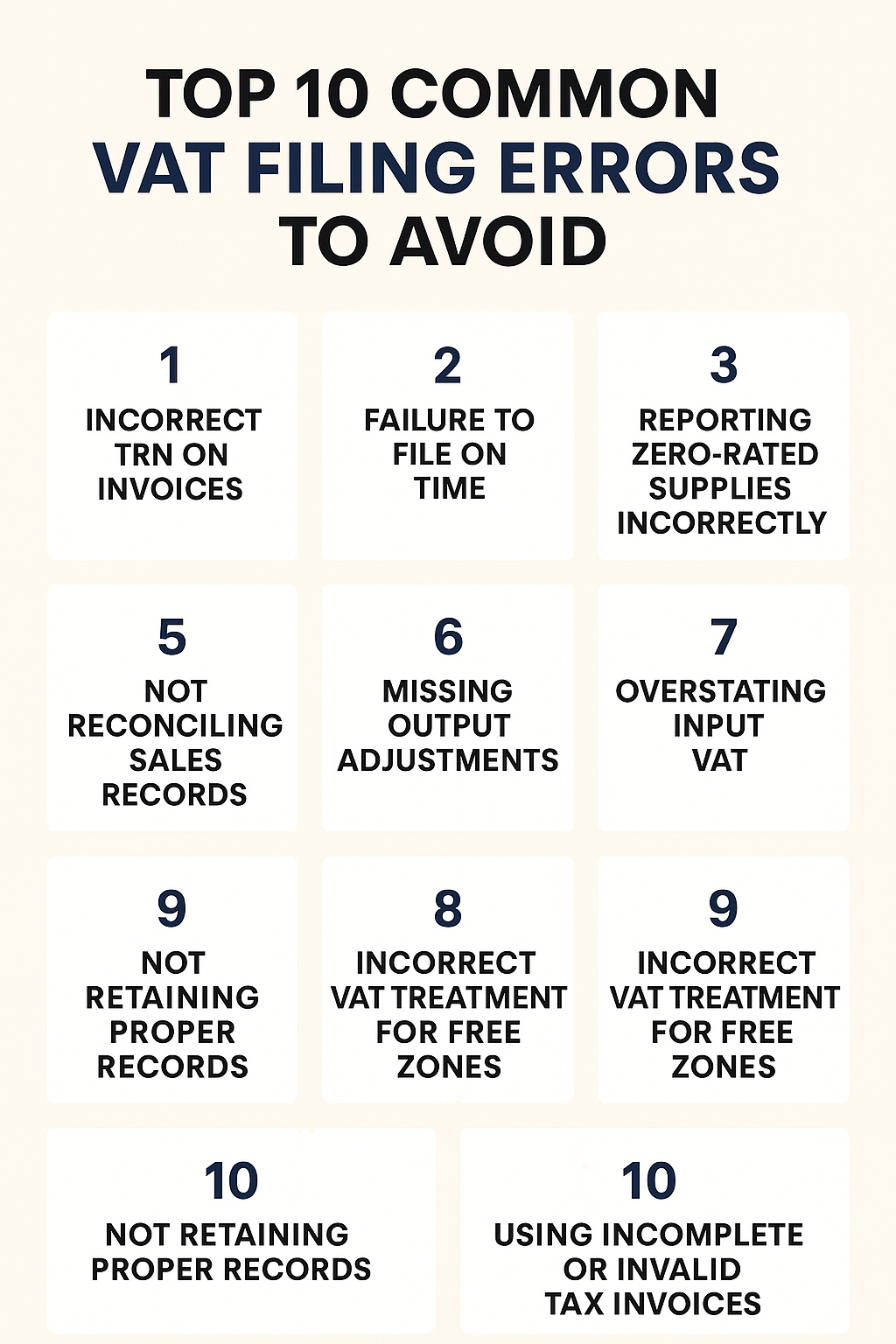
Filing your VAT return might seem straightforward, but even small mistakes can lead to hefty penalties or delays. Whether you're a startup or an established business, ensuring accuracy is key to staying compliant with the Federal Tax Authority (FTA). Below are the top 10 common VAT filing errors businesses should avoid—and how to prevent them.
________________________________________
1. Incorrect TRN on Invoices
Many businesses mistakenly use the wrong Tax Registration Number (TRN) or forget to mention it altogether.
✅ Solution: Always verify your TRN and that of your suppliers before issuing or accepting invoices.
________________________________________
2. Failure to File on Time
Missing the VAT return deadline (typically 28 days after the tax period ends) can attract late filing penalties.
✅ Solution: Set reminders or use accounting software with automated alerts.
________________________________________
3. Reporting Zero-Rated Supplies Incorrectly
Businesses often confuse zero-rated supplies with exempt supplies, leading to incorrect reporting.
✅ Solution: Understand the difference and classify transactions properly.
________________________________________
4. Ignoring Reverse Charge Mechanism (RCM)
For imports and some cross-border services, businesses must apply the reverse charge—but many forget.
✅ Solution: Train your finance team on RCM and ensure it's reflected in both input and output VAT.
________________________________________
5. Not Reconciling Sales Records
Discrepancies between actual sales and reported sales figures can trigger FTA reviews.
✅ Solution: Reconcile POS, bank records, and invoices before submitting returns.
________________________________________
6. Missing Output Adjustments
Changes like credit notes or bad debts often go unreported in output VAT adjustments.
✅ Solution: Include valid adjustments in the correct tax period.
________________________________________
7. Overstating Input VAT
Claiming VAT on non-deductible expenses (like entertainment or blocked items) is a common error.
✅ Solution: Maintain a list of blocked input categories as per UAE VAT law.
________________________________________
8. Incorrect VAT Treatment for Free Zones
Not all free zones are the same. Treating all free zone supplies as outside scope is incorrect.
✅ Solution: Check whether the free zone is designated and apply the correct VAT treatment.
________________________________________
9. Not Retaining Proper Records
VAT records must be kept for at least 5 years. Some businesses neglect documentation.
✅ Solution: Store digital and physical records of all VAT transactions, invoices, and filings.
________________________________________
10. Using Incomplete or Invalid Tax Invoices
A VAT invoice must meet all FTA requirements. Missing fields like the TRN, VAT amount, or sequential invoice number can make it invalid.
✅ Solution: Use automated invoice templates that comply with FTA guidelines.
________________________________________
🧠 Final Thoughts
Avoiding these common VAT errors not only ensures compliance but also helps in faster refunds, smoother audits, and a strong business reputation. At Sheikh Anwar Accounting & Auditing LLC, we help businesses file accurate VAT returns and stay penalty-free.
Need help with VAT filings or EmaraTax setup? Contact us today.