The Role of UAE Free Zones in AML Leadership
Introduction
The precious metals and jewellery (PMJ) sector has long been identified as one of the most vulnerable industries for money laundering (ML) and terrorist financing (TF) due to its unique characteristics—high value, portability, and complex supply chains.
As the global landscape evolves, new AML (Anti-Money Laundering) risks are emerging, driven by technology, digital currencies, and changing trading practices.
In the UAE, where Dubai serves as one of the world’s leading gold and diamond trading hubs, Dealers in Precious Metals and Stones (DPMS) are classified as Designated Non-Financial Businesses and Professions (DNFBPs).
They must comply with the Federal Decree-Law No. (20) of 2018 and Cabinet Decision No. (10) of 2019, which impose clear obligations for customer due diligence, record keeping, and suspicious activity reporting.
At Sheikh Anwar Accounting and Auditing LLC, we specialize in AML compliance services for DPMS, helping businesses establish effective systems to mitigate current and emerging AML risks.
________________________________________
1. Inherent Vulnerabilities in the Jewellery and Precious Metals Sector
The PMJ sector possesses characteristics that make it particularly attractive to money launderers:
• High Value in Small Volume: Gold and diamonds can store large sums in compact, portable forms.
• Cash-Intensive Transactions: Many dealers continue to accept cash, reducing traceability.
• Ease of Conversion: Precious metals can be melted, reshaped, or rebranded, erasing identifying features.
• Cross-Border Trade Complexity: Multiple jurisdictions and intermediaries make tracing difficult.
• Subjective Valuation: Items can be easily over- or under-valued, enabling trade-based money laundering (TBML).
These factors create ideal conditions for disguising illicit funds through legitimate trade.
________________________________________
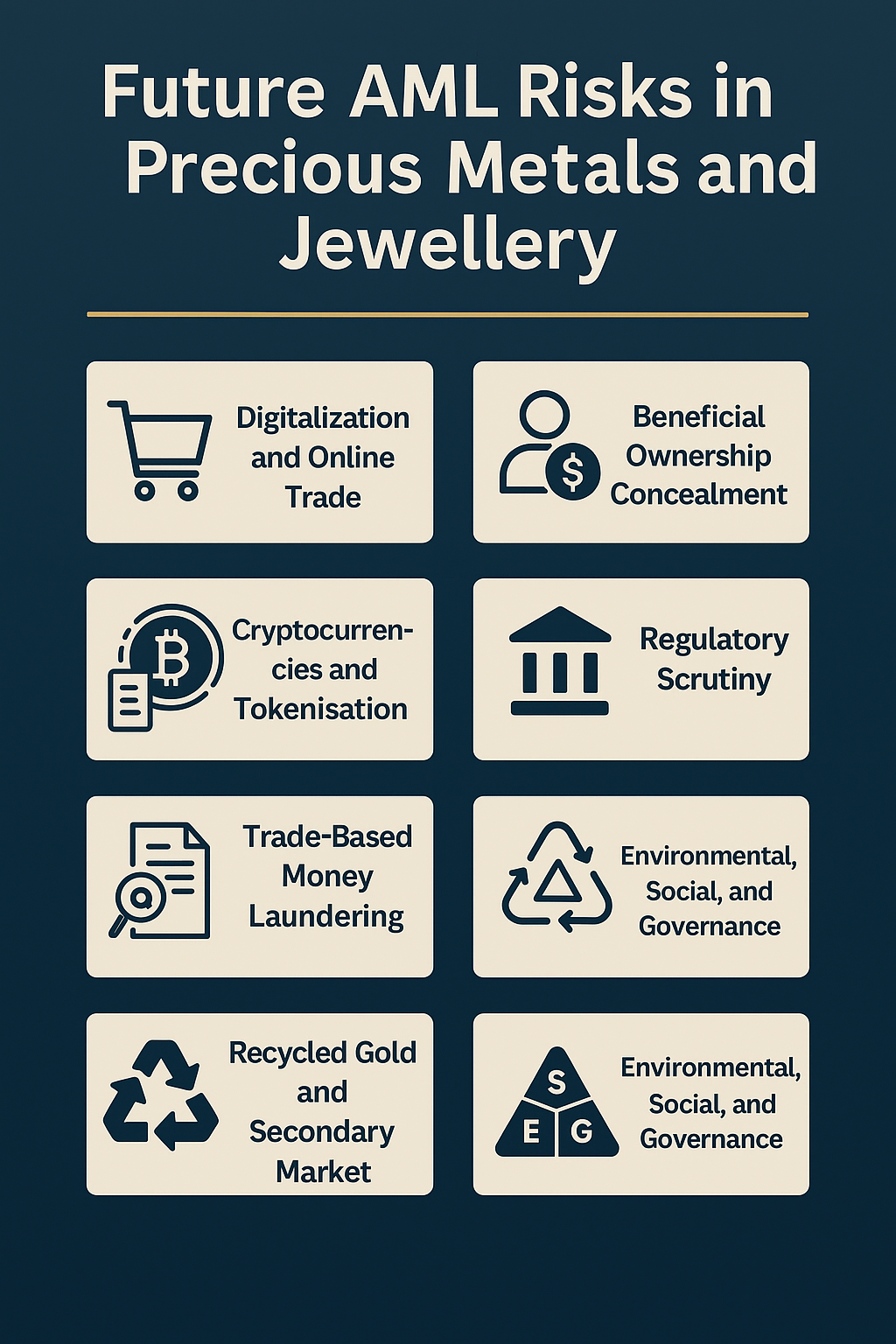
2. Emerging and Future AML Risks
a. Digitalisation and Online Trade
With the rise of online jewellery sales, remote customer interactions are increasing. While this expands market access, it also reduces visibility into customers’ identities.
Risks:
• Remote onboarding and payments from unknown jurisdictions.
• False identity verification or misuse of third-party accounts.
Mitigation:
• Implement digital KYC (Know Your Customer) processes.
• Use verification tools such as video identification and address validation.
________________________________________
b. Integration of Cryptocurrencies and Tokenised Assets
The integration of virtual assets into the precious metals market is one of the most significant future AML challenges.
Gold-backed cryptocurrencies and blockchain-based trading platforms are gaining traction.
Risks:
• Criminals may convert illicit crypto funds into gold or jewellery to obscure the money trail.
• Lack of regulation in virtual asset transactions increases exposure.
Mitigation:
• Apply enhanced due diligence for transactions involving virtual currencies.
• Monitor wallet addresses, crypto exchanges, and digital asset links to trade activity.
________________________________________
c. Trade-Based Money Laundering (TBML)
TBML continues to be a key threat to the jewellery sector. It occurs when illicit funds are disguised through complex trade transactions.
Risks:
• Over-invoicing and under-invoicing of gold exports and imports.
• False documentation, multiple free zone shipments, and round-tripping.
Mitigation:
• Verify invoice values against market rates.
• Cross-check supplier authenticity and shipment data.
• Use technology to monitor trade flows and anomalies.
________________________________________
d. Recycled Gold and Secondary Market Risks
As sustainability trends grow, the demand for recycled gold and pre-owned jewellery is increasing. However, these channels are often exploited by criminals to launder illicit metals.
Risks:
• Integration of smuggled or conflict gold into legitimate supply chains.
• Inconsistent documentation on origin and ownership.
Mitigation:
• Maintain documentation of gold sourcing and purity testing.
• Apply enhanced due diligence for second-hand or scrap suppliers.
________________________________________
e. Beneficial Ownership and Corporate Structuring Risks
The use of shell companies, offshore accounts, and complex corporate structures is a common method for concealing ownership.
Risks:
• Hidden politically exposed persons (PEPs) or sanctioned individuals.
• Misrepresentation of beneficial owners in company records.
Mitigation:
• Verify Ultimate Beneficial Owners (UBOs).
• Request source of funds and source of wealth declarations.
• Conduct periodic re-verification and sanction screening.
________________________________________
f. Increasing Regulatory Oversight
Regulators worldwide, including the Financial Action Task Force (FATF), have raised scrutiny over the precious metals and jewellery trade.
In the UAE, the Ministry of Economy has intensified inspections of DPMS businesses to ensure AML compliance.
Risks:
• Non-compliance leading to heavy administrative penalties, license suspension, or criminal prosecution.
Mitigation:
• Regularly update AML policies.
• Conduct independent AML audits and training for staff.
________________________________________
g. Environmental, Social, and Governance (ESG) Risks
Ethical sourcing and responsible supply chains are becoming key global compliance expectations.
Jewellers dealing in conflict minerals or untraceable gold may face regulatory and reputational damage.
Mitigation:
• Implement ESG-aligned due diligence procedures.
• Verify suppliers against global databases for conflict minerals and sanctions.
________________________________________
3. Strengthening AML Compliance for the Future
To address these evolving risks, jewellery and gold traders should proactively strengthen their AML frameworks:
✅ Develop an Entity-Wide Risk Assessment (EWRA):
Identify and evaluate product, customer, geography, and transaction risks.
✅ Implement Robust AML Policies and Procedures:
Tailor controls to your business operations and regulatory obligations.
✅ Enhance Customer Due Diligence (CDD):
Apply EDD for high-risk clients and maintain comprehensive KYC documentation.
✅ Use Technology and Automation:
Employ AML software for real-time transaction screening, risk scoring, and monitoring.
✅ Regular Staff Training:
Train employees to identify suspicious activities and report to the MLRO.
✅ Periodic Independent Review:
Have AML frameworks reviewed and tested annually for compliance effectiveness.
________________________________________
4. Conclusion
The future of AML compliance in the precious metals and jewellery sector lies in adaptability and digital transformation.
As financial crimes evolve, dealers must move beyond reactive compliance and adopt risk-based, technology-driven solutions.
Firms that proactively invest in AML frameworks not only protect themselves from legal and reputational risks but also gain trust from regulators, banks, and international partners.
________________________________________
About Sheikh Anwar Accounting and Auditing LLC
Sheikh Anwar Accounting and Auditing LLC is a Ministry of Economy–licensed audit and compliance firm in Dubai, UAE.
We provide Audit, VAT, Corporate Tax, and AML Compliance Services to Designated Non-Financial Businesses and Professions (DNFBPs) such as jewellers, gold traders, real estate brokers, and law firms.
Our AML expertise includes:
• AML Policy and Procedure Drafting
• Entity-Wide Risk Assessments (EWRA)
• Customer Due Diligence (CDD) Documentation
• MLRO Outsourcing and goAML Reporting
• AML Training and Independent Audits
📍 Address: Dubai Creek Tower, M 35, United Arab Emirates
📞 Phone: +971 55 883 5020
✉️ Email: info@sa-auditors.com
🌐 Website: www.sa-auditors.com