The Link Between AML and Cybercrime
Introduction
In today’s digital economy, cybercrime and money laundering (ML) have become deeply interconnected. Criminals exploit digital platforms, online payment systems, and cryptocurrencies to move illicit funds, making it harder for regulators and businesses to trace the origins of money.
For the United Arab Emirates (UAE)—a global financial and trade hub with a growing fintech ecosystem—the link between Anti-Money Laundering (AML) compliance and cybercrime prevention is especially critical. Businesses must understand how digital crime and money laundering overlap to effectively protect themselves and stay compliant.
________________________________________
How Cybercrime Fuels Money Laundering
Cybercrime generates vast amounts of illegal money, which must then be laundered into the legitimate financial system. Common cybercrime activities include:
• Phishing & Identity Theft – Stealing customer credentials to access bank accounts.
• Hacking & Ransomware Attacks – Demanding payments, often in cryptocurrency, that must later be laundered.
• Online Fraud & Scams – Fake investment platforms or e-commerce sites that funnel illegal profits.
• Cryptocurrency Abuse – Using digital assets for anonymous cross-border transfers.
Once criminals acquire illicit funds through these methods, they rely on laundering techniques—often exploiting weak AML frameworks in businesses and financial institutions.
________________________________________
The Role of AML in Combating Cybercrime
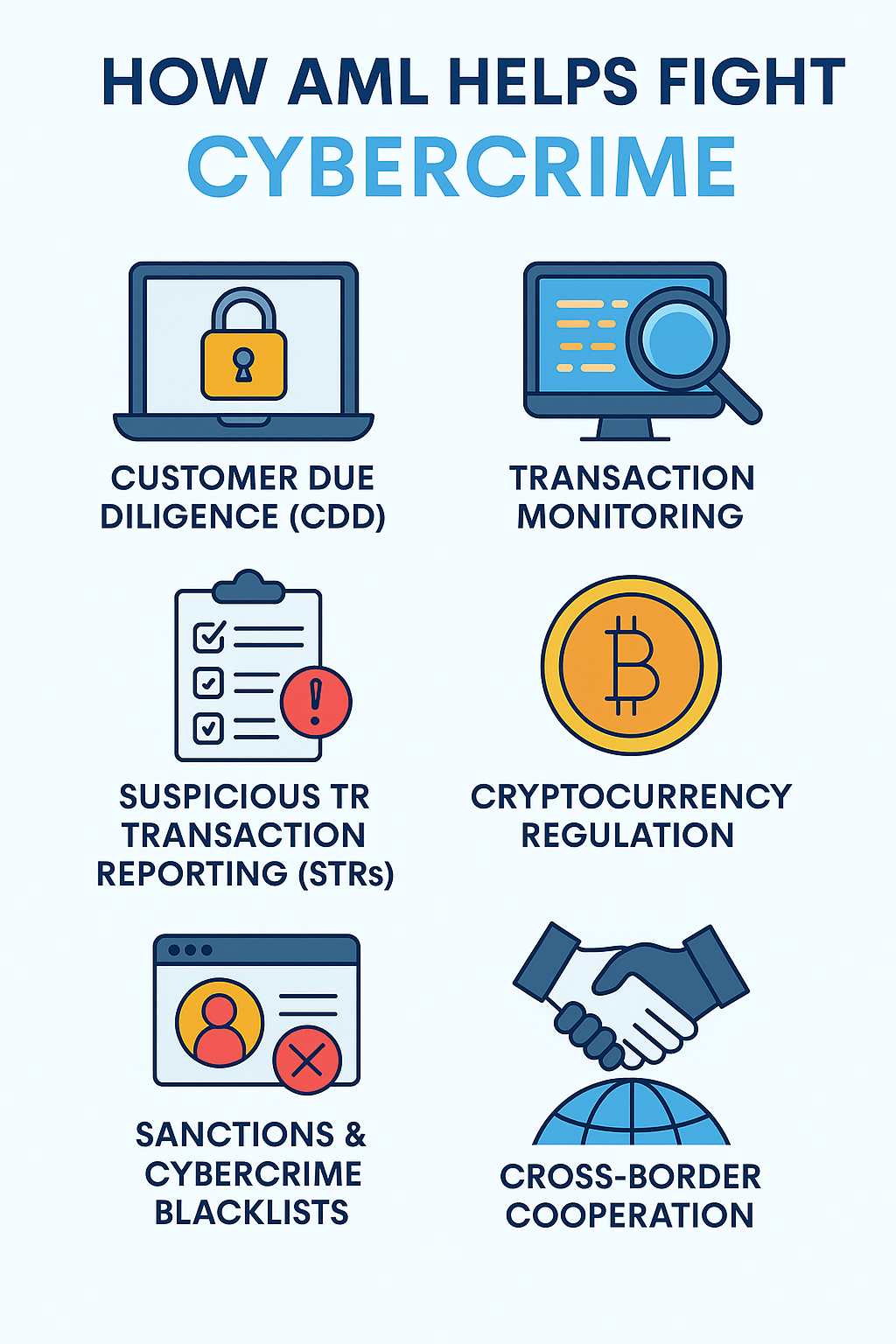
1. Customer Due Diligence (CDD) in Digital Channels
AML laws require businesses to verify customer identities and assess risks, even for online accounts. This prevents cybercriminals from hiding behind fake or stolen identities.
2. Transaction Monitoring in Real Time
Automated AML systems can monitor online transactions for unusual activity—such as sudden spikes in payments, multiple small transfers (smurfing), or cryptocurrency conversions.
3. Suspicious Transaction Reporting (STRs)
When unusual online activity is detected, businesses must file STRs to the UAE Financial Intelligence Unit (FIU) via the goAML portal, providing authorities with critical intelligence.
4. Cryptocurrency Regulations
The UAE has introduced AML rules that extend to virtual assets and exchanges, requiring them to register, implement KYC checks, and monitor transactions. This ensures cryptocurrencies are not misused for laundering or terror financing.
5. Sanctions & Cybercrime Blacklists
AML compliance requires screening against sanctions lists, terrorist watchlists, and cybercrime databases, preventing criminals from accessing financial systems.
6. Cross-Border Cooperation
Since cybercrime often spans multiple countries, AML frameworks—aligned with Financial Action Task Force (FATF) standards—promote global cooperation in tracking illicit online flows.
________________________________________
UAE AML Framework and Cybercrime
• Federal Decree-Law No. 20 of 2018 (AML-CFT Law).
• Cabinet Decision No. 10 of 2019 (Implementing Regulations).
• Cabinet Decision No. 111 of 2022 (Expanding DNFBP obligations).
• Virtual Asset Regulatory Authority (VARA) oversees cryptocurrency service providers.
• goAML portal ensures suspicious digital transactions are promptly reported.
These laws ensure that both traditional businesses and digital platforms are accountable in preventing cyber-enabled financial crimes.
________________________________________
Challenges Businesses Face
• Rapidly Evolving Threats – Cybercriminals constantly develop new laundering methods.
• Cryptocurrency Anonymity – Makes tracing funds more difficult.
• Skill Gaps – Many firms lack trained staff in both cybersecurity and AML compliance.
• Integration Costs – Implementing advanced monitoring systems can be expensive for SMEs.
________________________________________
Conclusion
Cybercrime and money laundering are two sides of the same coin—criminals exploit digital systems to generate illicit funds and then launder them into the financial system. Strong AML frameworks, combined with advanced technology-driven compliance, are essential to break this cycle.
For UAE businesses, compliance with AML laws not only helps prevent cybercrime but also builds trust, resilience, and international credibility in an increasingly digital economy.
________________________________________
About Sheikh Anwar Accounting and Auditing LLC
At Sheikh Anwar Accounting and Auditing LLC, we help businesses strengthen both AML and cybercrime defenses. Our services include:
• AML policy and risk framework design.
• STR/CTR filing via goAML.
• Cryptocurrency compliance guidance.
• Staff training on AML and cybercrime awareness.
• 📍 Head Office: Dubai, UAE
• 🌐 Website: www.sa-auditors.com
• 📧 Email: info@sa-auditors.com
•