The 3 Stages of Money Laundering Explained
Introduction
Money laundering is the process of concealing the origin of illegally obtained money and making it appear legitimate. This crime poses a significant threat to the global financial system, and in the United Arab Emirates (UAE), it is a top regulatory priority due to the country’s role as a global financial and trade hub.
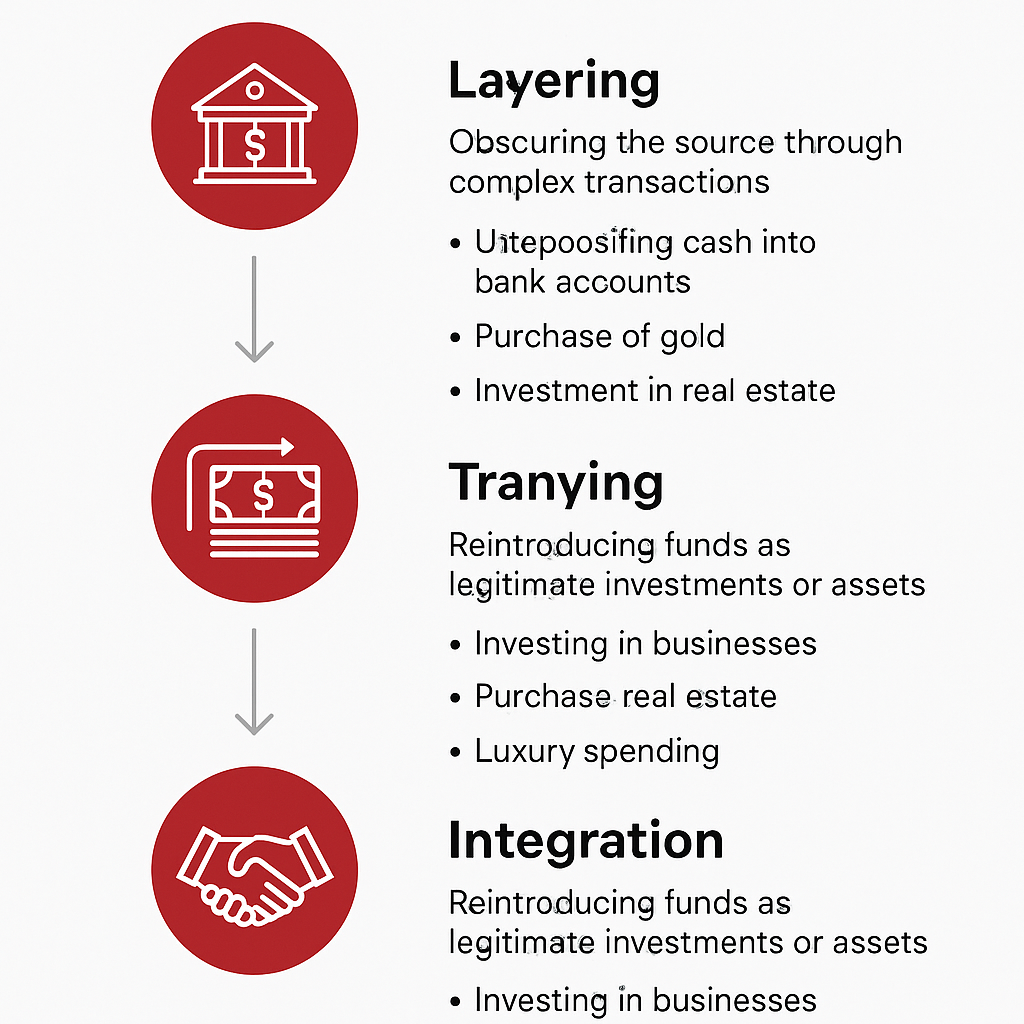
To effectively combat money laundering, it is important to understand the three key stages: Placement, Layering, and Integration. Each stage plays a distinct role in disguising illicit funds and recognizing them helps businesses comply with Anti-Money Laundering (AML) obligations.
________________________________________
Stage 1: Placement
This is the initial stage, where illicit funds are first introduced into the financial system. Criminals attempt to deposit, transfer, or use illegal money without raising suspicion.
Common Methods:
• Depositing cash into bank accounts (often in small amounts to avoid detection).
• Purchasing gold, diamonds, or other high-value goods.
• Investing in real estate or luxury vehicles.
• Using money exchange houses for remittances.
UAE Context:
The UAE’s gold and precious metals sector and real estate market are particularly vulnerable to placement risks. As a result, the Ministry of Economy requires DNFBPs (Dealers in Precious Metals and Stones, real estate agents, auditors, and company service providers) to perform enhanced Customer Due Diligence (CDD) to detect suspicious transactions.
________________________________________
Stage 2: Layering
This stage involves creating complex financial transactions to obscure the origin of funds. The objective is to distance the money from its illegal source.
Common Methods:
• Transferring funds through multiple bank accounts (often across different countries).
• Converting cash into financial instruments such as bonds, shares, or money market products.
• Using offshore companies and free zone entities to complicate ownership structures.
• Over-invoicing or under-invoicing in trade transactions (trade-based money laundering).
UAE Context:
With over 40 free zones, the UAE offers legitimate opportunities for global business—but it can also be exploited for layering through complex company structures. That’s why the UAE has strict Ultimate Beneficial Ownership (UBO) disclosure requirements to enhance transparency.
________________________________________
Stage 3: Integration
The final stage is where illicit funds are fully absorbed into the economy, appearing legitimate and ready for normal use.
Common Methods:
• Investing in legitimate businesses.
• Purchasing real estate with laundered funds.
• High-value luxury spending (cars, yachts, art).
• Creating front companies to mix illicit and legitimate income.
UAE Context:
The real estate sector in Dubai and Abu Dhabi has historically been attractive for integration. To address this, the UAE authorities have issued mandatory reporting requirements for real estate brokers and developers when transactions involve high-risk clients or large cash payments.
________________________________________
Summary of the 3 Stages
1. Placement – Injecting illicit funds into the financial system.
2. Layering – Obscuring the source through complex transactions.
3. Integration – Reintroducing funds as legitimate investments or assets.
Understanding these stages is essential for businesses to spot red flags, file Suspicious Transaction Reports (STRs), and stay compliant with UAE law.
________________________________________
Why This Matters for UAE Businesses
• Regulatory Compliance: Non-compliance with AML rules can lead to fines of up to AED 5 million, license suspension, and even imprisonment.
• Reputation Risk: Businesses involved in money laundering (even unknowingly) risk severe reputational damage.
• International Trust: As the UAE continues to strengthen its AML/CTF framework in line with FATF standards, businesses must ensure their operations remain transparent and credible.
________________________________________
Conclusion
The three stages of money laundering—placement, layering, and integration—form the foundation of how illicit funds are disguised. By understanding these processes, businesses in the UAE can identify suspicious activities, comply with AML obligations, and contribute to safeguarding the country’s financial integrity.
________________________________________
About Sheikh Anwar Accounting and Auditing LLC
At Sheikh Anwar Accounting and Auditing LLC, we specialize in AML compliance, audits, corporate tax, and VAT advisory. We help businesses in high-risk sectors such as gold trading, real estate, and DNFBPs establish strong AML frameworks, conduct ongoing monitoring, and train employees to detect suspicious activity.
• 📍 Head Office: Dubai, UAE
• 🌐 Website: www.sa-auditors.com
• 📧 Email: info@sa-auditors.com