Technology Adoption Challenges for DNFBPs
Introduction
Designated Non-Financial Businesses and Professions (DNFBPs) — including gold and precious metal traders, real estate brokers, auditors, lawyers, and company service providers — play a critical role in the fight against money laundering and terrorist financing.
While regulatory authorities such as the UAE Ministry of Economy and free zone regulators mandate the use of digital solutions for AML monitoring, goAML reporting, and record management, the journey toward technology adoption is not always smooth.
Let’s explore the key challenges DNFBPs face in adopting technology — and how they can overcome them.
________________________________________
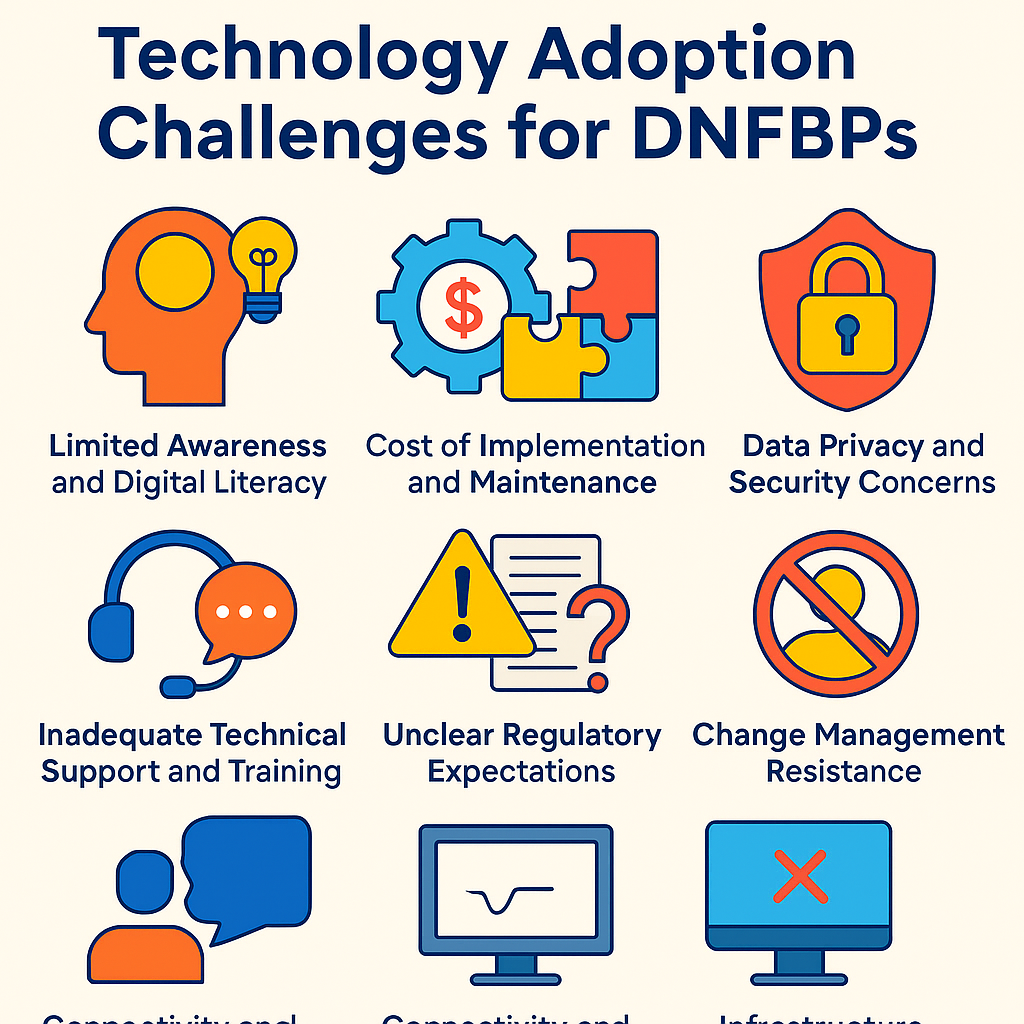
1. Limited Awareness and Digital Literacy
Many DNFBPs, particularly small and medium-sized firms, lack in-depth awareness of modern compliance technologies such as AML screening tools, risk assessment platforms, and digital KYC solutions.
Staff members may be more comfortable with traditional, paper-based methods, leading to resistance toward adopting new systems. This digital literacy gap becomes a major barrier to effective AML compliance.
Example:
A gold trading company may still maintain manual CDD forms and Excel sheets instead of integrating a centralized digital AML system such as MyAML.io, resulting in fragmented and delayed reporting.
________________________________________
2. Cost of Implementation and Maintenance
The initial setup cost for advanced compliance tools — including transaction monitoring systems, risk scoring engines, and eKYC integration — can be high. For smaller DNFBPs, these expenses may appear burdensome, especially when combined with staff training and periodic system updates.
Furthermore, some software providers charge recurring subscription or per-user fees, adding to ongoing operational costs.
Tip:
DNFBPs can explore shared compliance solutions or outsourced AML platforms managed by professional firms to minimize costs while maintaining compliance quality.
________________________________________
3. Lack of Integration with Existing Systems
Many DNFBPs use separate software for accounting, customer management, and compliance — often without integration. As a result, data duplication, inconsistency, and manual reconciliation become everyday challenges.
A lack of unified systems increases the risk of missing suspicious transactions or delays in STR filing.
Solution:
Adopting integrated platforms that combine accounting, AML, and reporting modules — such as Finabooks with AML compliance add-ons — ensures seamless data flow and real-time monitoring.
________________________________________
4. Data Privacy and Security Concerns
AML compliance involves collecting and storing sensitive customer data, including identification documents, source-of-funds proofs, and transaction details.
DNFBPs often worry about data leaks, cyber threats, and non-compliance with the UAE’s Federal Decree-Law No. 45 of 2021 on Personal Data Protection (PDPL). These concerns can delay or prevent the use of cloud-based or AI-powered tools.
Mitigation:
Choose systems with UAE data residency, end-to-end encryption, and role-based access control. Conduct vendor due diligence to ensure compliance with both AML and data protection laws.
________________________________________
5. Inadequate Technical Support and Training
Technology adoption is not a one-time event — it requires continuous support, updates, and user training.
DNFBPs often report frustration when software providers fail to offer local support or user-friendly documentation. This discourages long-term use and reduces the effectiveness of the technology.
Recommendation:
Opt for providers that offer localized support in the UAE, regular training sessions, and user manuals aligned with regulatory requirements such as Cabinet Decision No. 10 of 2019 and subsequent AML updates.
________________________________________
6. Unclear Regulatory Expectations
Many DNFBPs are unsure about the extent of technology required to meet AML/CFT obligations.
Questions like “Do we need automated screening tools?” or “Can Excel-based monitoring suffice?” often arise due to vague or evolving regulatory guidance. This uncertainty causes hesitation in investing in technology.
Advice:
Refer to official guidance from the Ministry of Economy, goAML manuals, and sector-specific AML notices. It’s also advisable to consult outsourced compliance officers or licensed AML advisors for clarity on minimum system expectations.
________________________________________
7. Change Management Resistance
Human factors are often the biggest obstacle. Employees used to manual methods may perceive new systems as disruptive or fear losing control over processes. Without top management involvement and a clear implementation plan, adoption efforts often fail.
Best Practice:
Adopt a phased rollout approach — starting with one department or function — and communicate the long-term benefits clearly to the team. Reinforce the message that technology enhances efficiency, not replaces jobs.
________________________________________
8. Connectivity and Infrastructure Limitations
Some DNFBPs, especially those operating in remote areas or with limited IT infrastructure, face network instability, outdated hardware, or lack of secure VPN access.
This affects their ability to access cloud-based AML systems or submit STRs on the goAML platform efficiently.
Solution:
Invest in basic IT upgrades, reliable internet connectivity, and secure data storage solutions. Many affordable cloud tools are optimized for low-bandwidth usage and can be configured easily.
________________________________________
Conclusion
Technology is no longer optional — it is the backbone of modern AML compliance.
By overcoming these challenges, DNFBPs can enhance efficiency, accuracy, and regulatory trustworthiness while minimizing risks associated with manual processes.
Partnering with experienced compliance advisors and using integrated solutions such as MyAML.io or Finabooks can help DNFBPs transform compliance from a burden into a competitive advantage.
________________________________________
Author:
Sheikh Anwar Accounting & Auditing LLC
Licensed Auditor – Ministry of Economy (Entry No. 5817)
📍 Dubai Creek Tower, Office M35, Dubai, UAE
🌐 www.sa-auditors.com
✉️ info@sa-auditors.com

