Tax Planning for Tech Startups
Introduction
The tech startup ecosystem is one of the fastest-growing sectors in the UAE and globally. Entrepreneurs focus heavily on innovation, funding, and scaling—but often overlook one critical aspect: tax planning. Proper tax planning is not just about compliance; it is about creating a sustainable financial strategy that supports growth, attracts investors, and avoids unnecessary liabilities.
This highlights the importance of tax planning for tech startups, key areas to consider, and strategies to optimize taxes under the UAE corporate tax framework.
________________________________________
Why Tax Planning Matters for Startups
1. Cash Flow Protection – Startups typically operate with limited resources, and tax efficiency ensures more funds are available for growth.
2. Investor Confidence – Venture capitalists and angel investors prefer startups with strong compliance and transparent tax structures.
3. Regulatory Compliance – With the UAE’s Corporate Tax (9%), VAT, and ESR requirements, startups must comply from day one.
4. Global Expansion – Tech startups often scale internationally, making cross-border tax planning crucial.
5. Exit Strategy – Early tax planning makes IPOs, acquisitions, or buyouts more tax-efficient.
________________________________________
Key Tax Challenges for Tech Startups
• Revenue Recognition: Subscription-based SaaS or platform models need correct revenue recognition under IFRS and UAE tax law.
• R&D and IP Ownership: Intellectual property may be developed in one country and monetized in another, raising transfer pricing and withholding tax issues.
• Transfer Pricing: Startups with group structures or cross-border transactions must comply with OECD arm’s length principles.
• VAT Treatment: Digital services and cross-border sales often create VAT complexities.
• Loss Utilization: Startups usually incur losses in the early years; planning how to carry forward losses is vital.
• ESR & PoEM: Offshore IP or holding structures require real substance in the UAE to avoid taxation elsewhere.
________________________________________
Tax Planning Strategies for Tech Startups
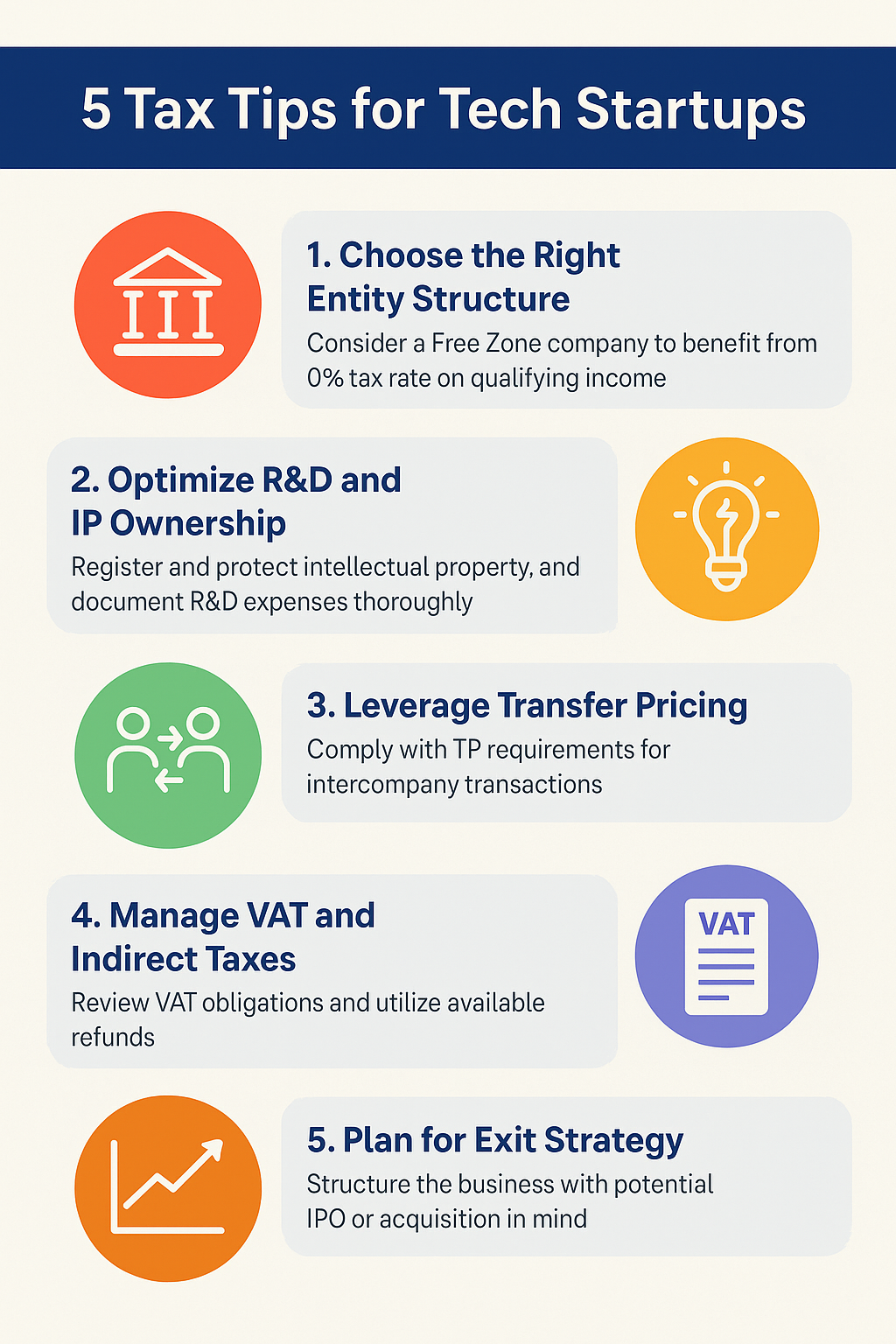
1. Choose the Right Entity Structure
• Free Zone Company: May qualify as a Qualifying Free Zone Person (QFZP) with 0% tax on eligible income.
• Mainland Company: Needed if dealing with UAE government entities or mainland clients.
• Hybrid Structures: Offshore holding for IP, UAE Free Zone for operations.
________________________________________
2. Optimize R&D and IP Ownership
• Ensure that intellectual property (IP) is registered in a jurisdiction offering tax benefits and treaty protection.
• Keep proper documentation of R&D expenses for potential tax credits or deductions (if available under future UAE tax updates).
________________________________________
3. Leverage Transfer Pricing
• Draft clear intercompany agreements for licensing, royalties, and service fees.
• Maintain documentation to avoid penalties and ensure deductibility of expenses.
________________________________________
4. Manage VAT and Indirect Taxes
• Register for VAT if revenue exceeds AED 375,000 threshold.
• Understand VAT rules for digital services, exports, and B2C transactions.
• Plan VAT refunds to improve cash flow.
________________________________________
5. Plan for Losses and Financing
• Carry Forward Tax Losses: UAE allows offsetting against future taxable income (up to 75%).
• Debt vs Equity: Balance financing to maximize interest deductibility while avoiding thin capitalization risks.
• Convertible Notes / SAFE Agreements: Understand tax treatment of fundraising instruments.
________________________________________
6. Plan for Exit Early
• M&A or IPO: Proper structuring ensures gains may be exempt under participation exemption.
• Succession Planning: Consider holding structures and trusts for smooth ownership transfers.
________________________________________
Best Practices for Tech Startup Tax Planning
• Engage Advisors Early: Don’t wait until the first tax filing—plan from day one.
• Use Technology: Implement cloud-based ERP/accounting software for real-time tax compliance.
• Review Quarterly: Update tax forecasts as the business scales.
• Focus on Substance: Ensure real operations in the UAE to protect Free Zone benefits and avoid PoEM risks.
• Be Investor Ready: Maintain clean financials and tax compliance for due diligence.
________________________________________
Conclusion
Tax planning is not a burden—it is a growth enabler for tech startups. By choosing the right structure, managing IP, staying compliant with VAT and corporate tax, and preparing for an eventual exit, startups can save costs, attract investors, and focus on innovation.
For UAE-based startups, proactive tax planning is especially important given the new corporate tax regime and international tax standards. The earlier it is implemented, the stronger the foundation for long-term success.
________________________________________
📌 Sheikh Anwar Accounting & Auditing LLC
Approved Auditor – UAE Ministry of Economy (Entry No. 5817)
📧 info@sa-auditors.com
🌐 www.sa-auditors.com
________________________________________