Tax Planning for Restaurants & Cafes
Introduction
The food and beverage (F&B) industry is one of the UAE’s fastest-growing sectors, with restaurants and cafes catering to residents, tourists, and business visitors. While the industry enjoys strong demand, it also faces high operating costs and strict regulatory requirements. With the implementation of UAE Corporate Tax (Federal Decree-Law No. 47 of 2022) and the existing Value Added Tax (VAT) regime, restaurants and cafes must adopt proper tax planning strategies to ensure compliance and optimize profitability.
________________________________________
1. Applicability of Corporate Tax to Restaurants & Cafes
• Mainland Businesses: All profits from restaurant and café operations are subject to Corporate Tax.
• Free Zone Outlets: Entities in Free Zones may enjoy 0% Corporate Tax on qualifying income, but sales to mainland customers are generally subject to 9%.
• Franchises & Chains: Franchise income, royalties, and management fees are taxable.
• Foreign Investors: Any foreign-owned café/restaurant with a permanent establishment in the UAE is taxable on UAE-sourced income.
________________________________________
2. Corporate Tax Rates for Restaurants & Cafes
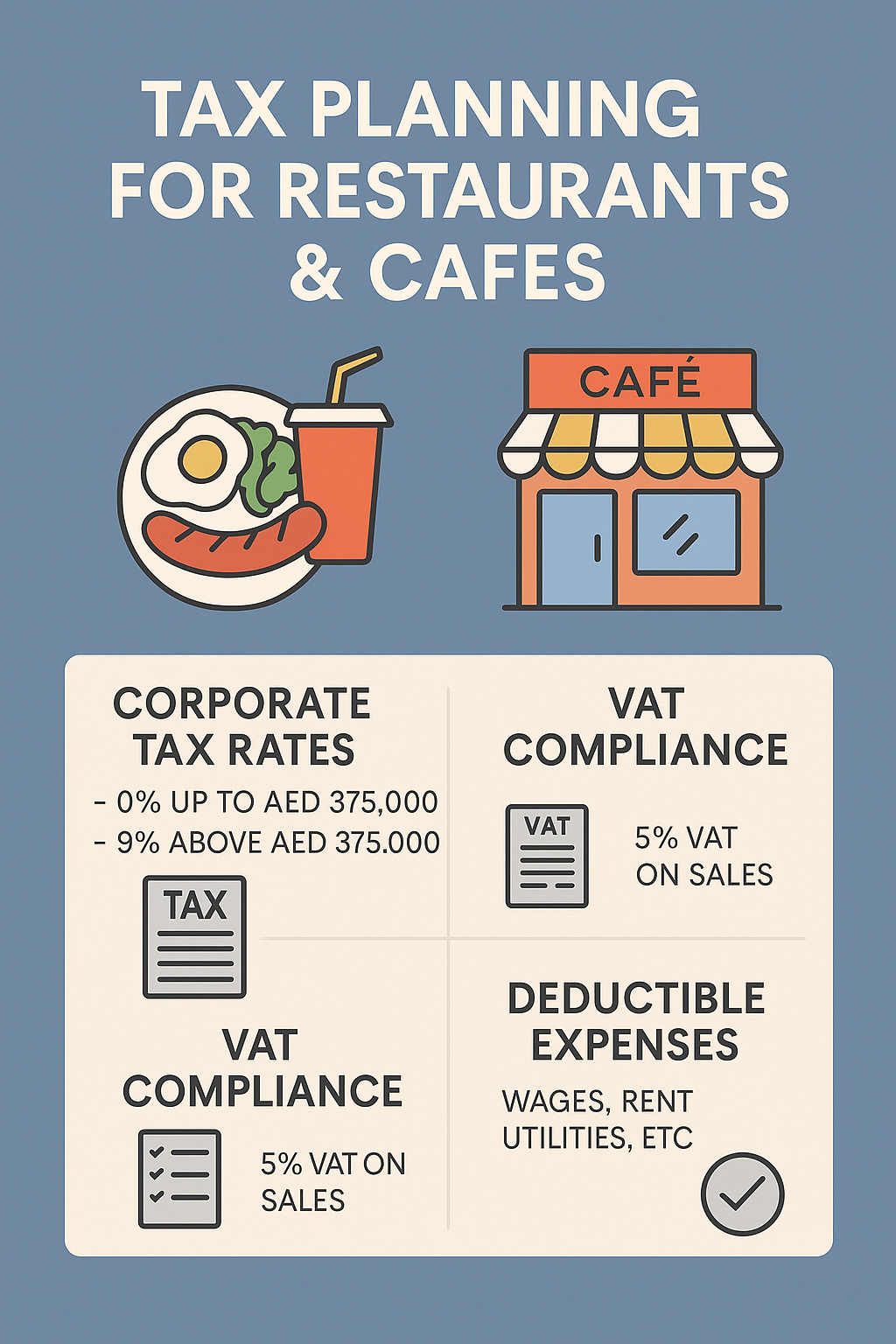
• 0% on taxable income up to AED 375,000.
• 9% on taxable income above AED 375,000.
• Free Zone restaurants must meet economic substance requirements to claim any tax benefits.
________________________________________
3. VAT Compliance in the F&B Sector
Restaurants and cafes must also comply with 5% VAT, which applies to:
• Dine-in and takeaway services.
• Online food delivery.
• Catering services.
VAT-registered businesses can claim input VAT credits on eligible expenses such as rent, utilities, and supplies, helping reduce overall costs.
________________________________________
4. Taxable Income Sources in Restaurants & Cafes
Taxable income includes:
• Food & Beverage Sales (dine-in, takeaway, delivery).
• Franchise Income (if operating under a brand or granting franchises).
• Catering Contracts for events and businesses.
• Advertising & Sponsorship Deals (for branded cafes/restaurants).
________________________________________
5. Deductible vs. Non-Deductible Expenses
Tax planning for restaurants and cafes involves carefully managing expenses.
• Deductible Expenses:
o Staff salaries and gratuities.
o Rent, utilities, and licenses.
o Purchase of raw materials and ingredients.
o Kitchen equipment depreciation.
o Marketing and promotions.
o Delivery and logistics costs.
• Non-Deductible Expenses:
o Fines and penalties (e.g., hygiene violations).
o Personal or non-business expenses.
o Certain entertainment costs not directly linked to business.
________________________________________
6. Inventory & Cost Management for Tax Planning
• Inventory Valuation: Accurate tracking of food stock prevents wastage and ensures correct profit calculation.
• Food Cost Control: Managing cost of goods sold (COGS) is crucial for optimizing taxable profits.
• Depreciation Planning: Claiming tax depreciation on furniture, kitchen equipment, and technology systems reduces taxable income.
________________________________________
7. Free Zone Opportunities for Restaurants & Cafes
Some Free Zones, particularly in hospitality clusters, allow F&B businesses to operate.
• 0% Corporate Tax on qualifying Free Zone income.
• 9% Corporate Tax on mainland sales.
• Substance requirements must be met (staff, physical premises, and management within the UAE).
________________________________________
8. Transfer Pricing Considerations for Franchise Chains
Restaurant groups and franchise networks often involve related-party transactions:
• Intercompany royalties for brand usage.
• Management service fees.
• Procurement of food supplies across entities.
These arrangements must comply with Transfer Pricing (TP) rules under UAE Corporate Tax Law, following the arm’s length principle.
________________________________________
9. Strategic Tax Planning for Restaurants & Cafes
• Optimize Expense Deductions: Record all business-related expenses accurately.
• Leverage Free Zone Benefits: Consider Free Zone setup for central kitchens and franchise operations.
• Group Structuring: Use tax grouping for chains with multiple outlets to offset profits and losses.
• Technology Adoption: Use ERP/POS systems to integrate VAT, Corporate Tax, and financial reporting.
• Loss Relief: Carry forward tax losses to offset future profits.
________________________________________
10. Compliance Requirements
• Corporate Tax Registration with the Federal Tax Authority (FTA).
• Annual Corporate Tax Return filed within 9 months of financial year-end.
• VAT Filings (monthly or quarterly depending on turnover).
• Audited Financial Statements (mandatory for many Free Zone and larger mainland entities).
• Record-Keeping: Maintain invoices, receipts, contracts, and inventory records for at least 7 years.
________________________________________
Conclusion
For restaurants and cafes in the UAE, Corporate Tax introduces new compliance requirements, but also opportunities for efficient tax planning. By optimizing deductions, managing inventory, leveraging Free Zone benefits, and maintaining robust accounting systems, F&B businesses can minimize tax exposure and improve profitability.
In a competitive market, effective tax planning not only ensures compliance but also provides a financial edge to thrive in the dynamic UAE hospitality sector.
________________________________________
✍️ By Sheikh Anwar Accounting and Auditing LLC (SA-Auditors)
📍 Dubai, United Arab Emirates
🌐 www.sa-auditors.com | ✉️ info@sa-auditors.com