Tax Planning for Holding Investment Structures
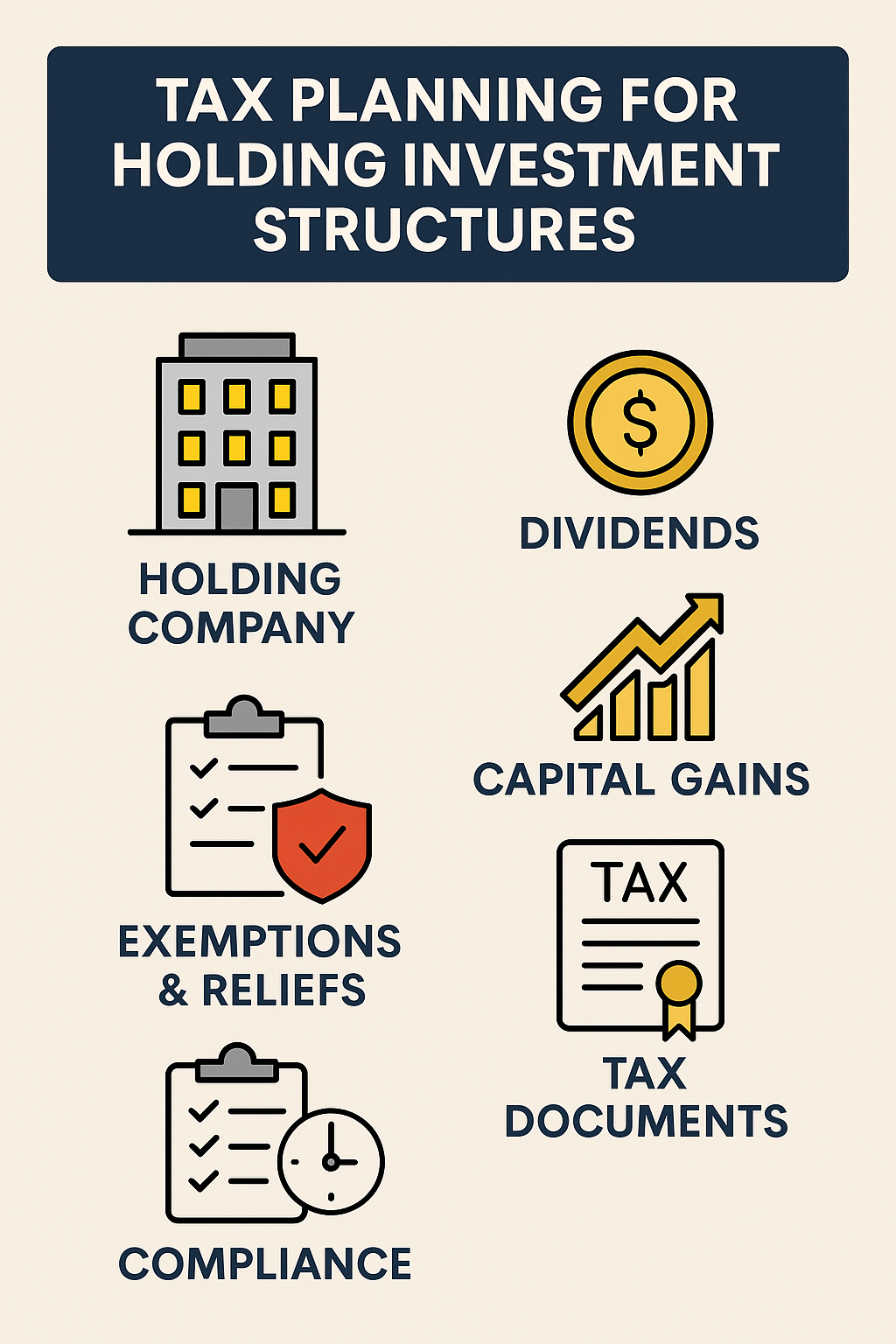
Introduction
The UAE has established itself as a preferred jurisdiction for holding and investment structures, thanks to its competitive tax regime, Free Zone benefits, and extensive double tax treaty network. With the introduction of the UAE Corporate Tax (Federal Decree-Law No. 47 of 2022), companies managing diversified investments must re-evaluate their structures to ensure both tax efficiency and compliance.
Holding structures are commonly used for family businesses, multinational groups, and private equity funds to consolidate ownership, protect assets, and optimize tax planning across multiple jurisdictions.
1. Applicability of Corporate Tax to Holding Structures
Holding Companies: Entities primarily owning shares in subsidiaries fall under Corporate Tax unless exempt.
Investment Companies: Taxable on income such as interest, rentals, or advisory fees.
Foreign Holding Entities: Liable if they have a permanent establishment (PE) in the UAE.
Free Zone Holding Structures: May benefit from 0% Corporate Tax on qualifying income (dividends, capital gains, cross-border income).
2. Corporate Tax Rates
0% on taxable income up to AED 375,000.
9% on taxable income above AED 375,000.
Free Zone Holding Companies: 0% Corporate Tax on qualifying income, 9% on mainland transactions.
3. Taxable Income in Holding & Investment Structures
Holding structures may generate diverse income streams:
Dividends from UAE and foreign subsidiaries.
Capital Gains from the sale of shares or business units.
Interest Income on intercompany loans or external investments.
Royalties & Licensing Fees for intellectual property.
Rental Income from property assets.
Advisory or Management Fees charged to subsidiaries.
4. Exemptions & Reliefs Available
The UAE Corporate Tax law provides generous exemptions and reliefs for holding and investment companies:
Participation Exemption: Dividends and capital gains are exempt if:
At least 5% shareholding is maintained.
The subsidiary is subject to at least 9% tax abroad (or equivalent).
Domestic Dividends: Exempt from Corporate Tax.
Group Relief: Tax losses can be transferred across group entities.
Restructuring Relief: Business reorganizations can be tax neutral if conditions are met.
5. Deductible vs. Non-Deductible Expenses
Efficient tax planning requires proper classification of expenses.
Deductible Expenses:
Staff salaries and office costs.
Audit, legal, and professional services.
Financing costs (interest, within limits).
Depreciation of office assets and IT systems.
Non-Deductible Expenses:
Fines and penalties.
Non-business-related expenses.
Certain entertainment expenses.
6. Free Zone Opportunities for Holding Companies
Popular Free Zones such as DIFC, ADGM, DMCC, and JAFZA are widely used for holding structures.
0% Corporate Tax on dividends and capital gains from qualifying shareholdings.
Access to double tax treaties for cross-border investments.
Regulatory and governance frameworks tailored for holding structures.
Requirement: Must meet economic substance rules (offices, management, and staff in UAE).
7. Transfer Pricing in Holding & Investment Structures
Large groups often involve extensive intercompany transactions.
Transfer Pricing rules apply to:
Intercompany financing (loans, guarantees).
Management and advisory service fees.
Licensing of intellectual property (IP).
Firms must comply with the arm’s length principle and maintain Transfer Pricing documentation (Local File, Master File, and Benchmarking reports) if thresholds apply.
8. Compliance Requirements
Corporate Tax Registration with the Federal Tax Authority (FTA).
Annual Corporate Tax Return submission within 9 months of year-end.
Audited Financial Statements mandatory for medium and large holding companies.
Record-Keeping: Maintain financials, contracts, and investment records for at least 7 years.
9. Strategic Tax Planning for Holding Investment Structures
Leverage Participation Exemption: Maximize use of dividend and capital gain exemptions.
Use Free Zones: Base holding entities in DIFC/ADGM/DMCC for treaty access and tax benefits.
Optimize Intercompany Financing: Align interest rates with thin capitalization and TP rules.
Loss Relief: Consolidate losses within group companies through tax grouping.
Double Tax Treaties: Structure cross-border holdings to minimize withholding tax on dividends, interest, and royalties.
Conclusion
The UAE’s Corporate Tax regime provides both challenges and opportunities for holding and investment structures. While compliance obligations are stricter, the participation exemption, Free Zone incentives, and group relief provisions ensure that the UAE remains one of the most attractive jurisdictions for global investors.
By structuring investments strategically, maintaining compliance, and leveraging tax treaty networks, holding companies can optimize their tax position while safeguarding long-term growth.
✍️ By Sheikh Anwar Accounting and Auditing LLC (SA-Auditors)
📍 Dubai, United Arab Emirates
🌐 www.sa-auditors.com
| ✉️ info@sa-auditors.com