Tax Planning Case Study for Real Estate Firm
Executive Summary
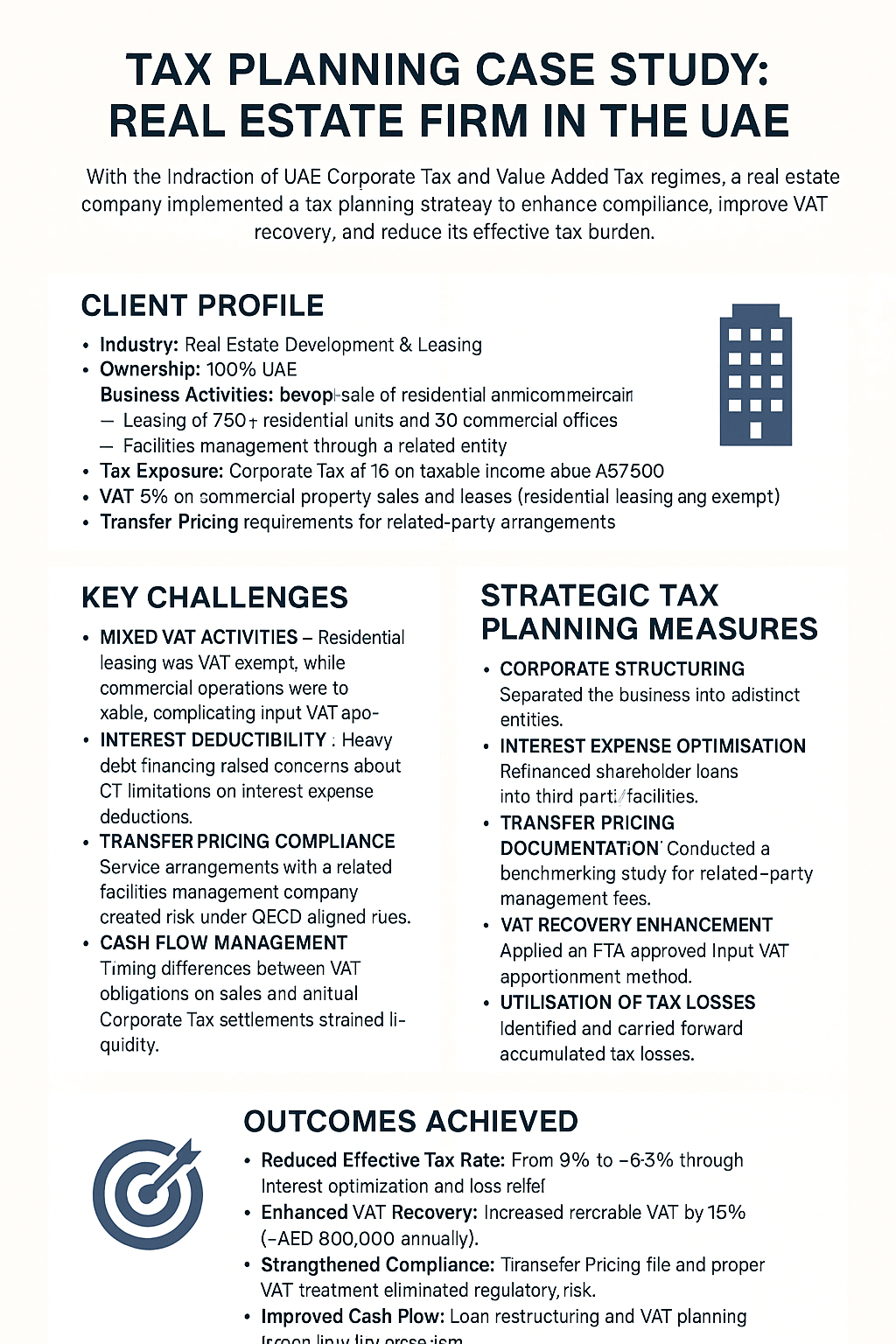
With the implementation of UAE Corporate Tax (CT) and the existing Value Added Tax (VAT) regime, real estate companies are under increasing pressure to align operations with tax regulations while preserving profitability. This case study examines how a mid-sized Dubai-based real estate firm implemented a comprehensive tax planning strategy that improved compliance, optimised VAT recovery, and reduced its overall effective tax burden.
________________________________________
Client Profile
• Industry: Real Estate Development & Leasing
• Ownership: 100% UAE Nationals
• Business Activities:
o Development and sale of residential and commercial properties
o Leasing of 250+ residential units and 30 commercial offices
o Facilities management through a related entity
Tax Exposure:
• Corporate Tax at 9% on taxable income above AED 375,000
• VAT at 5% on commercial property sales and leases (residential leasing exempt)
• Transfer Pricing requirements for related-party arrangements
________________________________________
Key Challenges
1. Mixed VAT Activities – Residential leasing was VAT exempt, while commercial operations were taxable, complicating input VAT apportionment.
2. Interest Deductibility – Heavy debt financing raised concerns about CT limitations on interest expense deductions.
3. Transfer Pricing Compliance – Service arrangements with a related facilities management company created risk under OECD-aligned rules.
4. Cash Flow Management – Timing differences between VAT obligations on sales and annual Corporate Tax settlements strained liquidity.
________________________________________
Strategic Tax Planning Measures
1. Corporate Structuring
• Separated the business into two distinct entities:
o Entity A: Real estate development and sales
o Entity B: Leasing and property management
• Improved clarity of taxable vs. exempt activities and streamlined VAT recovery.
________________________________________
2. Interest Expense Optimisation
• Refinanced shareholder loans into third-party facilities at arm’s length interest rates.
• Ensured compliance with the 30% EBITDA interest deduction cap under CT rules.
• Achieved full deductibility of financing costs.
________________________________________
3. Transfer Pricing Documentation
• Conducted a benchmarking study for related-party management fees.
• Prepared a Transfer Pricing Local File to demonstrate compliance.
• Mitigated penalty risk (up to AED 500,000 for non-compliance).
________________________________________
4. VAT Recovery Enhancement
• Applied an FTA-approved input VAT apportionment method.
• Maximised recovery on taxable commercial operations.
• Reduced irrecoverable VAT costs on mixed-use projects.
________________________________________
5. Utilisation of Tax Losses
• Identified and carried forward accumulated tax losses from development phases.
• Offset future taxable profits, generating significant Corporate Tax savings.
________________________________________
Outcomes Achieved
• Reduced Effective Tax Rate: From 9% to ~6.5% through interest optimisation and loss relief.
• Enhanced VAT Recovery: Increased recoverable VAT by 15% (~AED 800,000 annually).
• Strengthened Compliance: Transfer Pricing file and proper VAT treatment eliminated regulatory risk.
• Improved Cash Flow: Loan restructuring and VAT planning eased liquidity pressures.
________________________________________
Lessons for Real Estate Firms
1. Entity Segmentation enables efficient tax allocation between taxable and exempt activities.
2. Financing Strategy must align with CT rules on interest deductibility.
3. Transfer Pricing Documentation is essential for related-party transactions.
4. VAT Apportionment should be proactively managed to optimise recovery.
5. Tax Loss Relief is a valuable tool to reduce future liabilities.
________________________________________
Conclusion
Tax planning is now a strategic priority for real estate businesses in the UAE. Proactive measures not only mitigate compliance risks but also unlock measurable financial benefits. By combining corporate structuring, VAT optimisation, and robust Transfer Pricing practices, this firm achieved sustainable tax efficiency aligned with UAE regulations.
________________________________________
About Us
Sheikh Anwar Accounting & Auditing LLC is a trusted advisor to real estate and construction companies across the UAE. Our expertise covers Corporate Tax, VAT compliance, Transfer Pricing, and sector-specific structuring strategies. We deliver tailored tax solutions that drive efficiency, compliance, and long-term value creation.
📩 Contact us at info@sa-auditors.com | 🌐 www.sa-auditors.com