Tax Implications for Investment Companies
Introduction
The UAE is a preferred destination for investment companies and holding structures, thanks to its strong financial markets, Free Zone frameworks, and international tax treaties. With the implementation of the UAE Corporate Tax (Federal Decree-Law No. 47 of 2022), investment firms now face new compliance requirements.
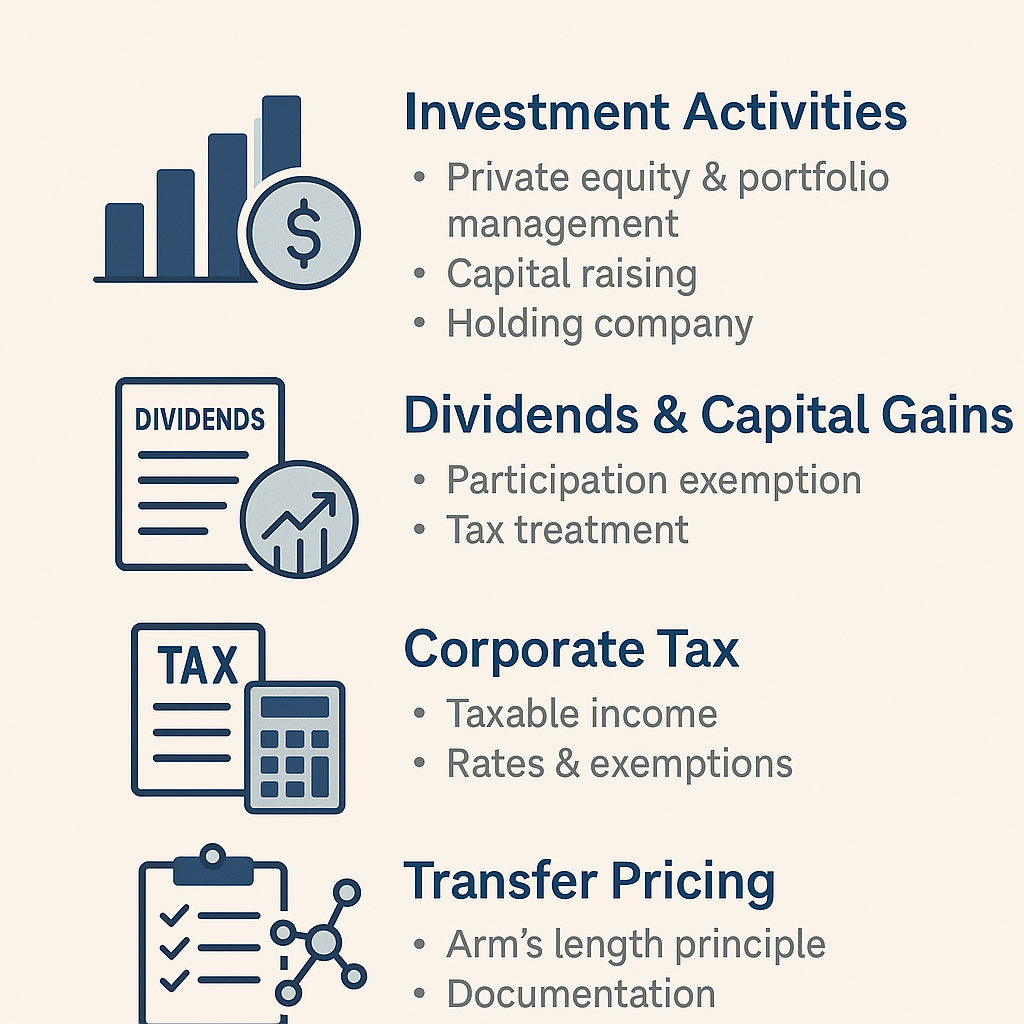
Investment companies — whether focused on private equity, real estate, portfolio management, or venture capital — must evaluate the tax treatment of dividends, capital gains, interest, and related-party transactions to optimize their tax planning strategies.
1. Applicability of Corporate Tax to Investment Companies
Corporate Tax applies broadly to companies carrying out investment activities in the UAE, including:
Private Equity Firms managing portfolio investments.
Asset & Fund Management Companies.
Real Estate Investment Companies (excluding certain regulated REITs that may be exempt).
Holding Companies owning shares and subsidiaries.
Family Investment Offices.
Foreign Investment Companies with a permanent establishment (PE) in the UAE.
2. Corporate Tax Rates
0% on taxable income up to AED 375,000.
9% on taxable income above AED 375,000.
Free Zone Investment Firms: May qualify for 0% Corporate Tax on qualifying income (e.g., foreign dividends, capital gains on shares), provided they meet economic substance rules.
3. Taxable Income for Investment Companies
Income streams for investment companies include:
Dividends from UAE and foreign subsidiaries (often exempt if participation conditions are met).
Capital Gains from sale of shares or investments (exempt in many cases if participation exemption applies).
Interest Income from loans, bonds, or fixed-income securities (generally taxable).
Management & Advisory Fees from portfolio companies.
Rental Income (for real estate investment firms).
Other Service Income linked to fund management or structuring.
4. Exempt & Relief Provisions
The UAE Corporate Tax Law provides several relief measures for investment firms:
Participation Exemption: Dividends and capital gains may be exempt if the UAE company holds at least 5% in the subsidiary and the subsidiary is subject to at least 9% tax abroad.
Domestic Dividends: Dividends from UAE companies are exempt.
Group Relief: Losses may be transferred between group entities, and qualifying group reorganizations may be tax-neutral.
5. Deductible vs. Non-Deductible Expenses
Investment firms incur significant management and operational costs.
Deductible Expenses:
Staff salaries and bonuses.
Rent, utilities, and office expenses.
Professional services (audit, legal, advisory).
Financing costs (interest within limits).
Depreciation of office and IT infrastructure.
Non-Deductible Expenses:
Fines and penalties.
Non-business personal expenses.
Certain entertainment costs beyond thresholds.
6. VAT Implications for Investment Companies
Exempt: Many financial services (e.g., dividends, capital gains).
Standard 5% VAT: Applies to fee-based services (management/advisory fees).
Zero-Rated: Certain cross-border services may qualify for 0%.
Investment companies must carefully reconcile VAT with Corporate Tax filings.
7. Free Zone Opportunities for Investment Firms
Free Zones such as DIFC, ADGM, and DMCC offer benefits for investment structures:
0% Corporate Tax on qualifying foreign income (dividends, capital gains).
Access to international investors and financial markets.
Independent legal frameworks for fund management.
Requirement: Firms must meet economic substance conditions (offices, employees, and management in UAE).
8. Transfer Pricing for Investment Groups
Investment companies often manage cross-border holdings and financing structures.
Transfer Pricing rules apply to:
Intercompany loans and interest rates.
Management and advisory fees charged to group companies.
Licensing of intellectual property.
Compliance with the arm’s length principle is required, with documentation such as Local File, Master File, and Benchmarking studies (if thresholds apply).
9. Compliance Requirements
Corporate Tax Registration with the Federal Tax Authority (FTA).
Annual Corporate Tax Returns within 9 months of financial year-end.
Audited Financial Statements for medium and large investment firms.
Record-Keeping: Contracts, investment reports, and financial records must be kept for 7 years.
10. Strategic Tax Planning for Investment Companies
Leverage Participation Exemption for dividends and capital gains.
Optimize Financing Structures: Align intercompany loans with thin capitalization rules.
Use Free Zone Entities for international holdings and funds.
Loss Relief: Use tax grouping to balance profits and losses across subsidiaries.
ERP & Reporting Tools: Integrate accounting and compliance systems for efficient reporting.
Conclusion
The UAE’s Corporate Tax regime significantly impacts investment companies, particularly in areas of dividends, capital gains, and financing structures. However, with exemptions, Free Zone benefits, and strategic planning, investment firms can achieve compliance while optimizing tax efficiency.
By leveraging the participation exemption, Free Zone opportunities, and Transfer Pricing compliance, investment companies can continue to thrive as key players in the UAE’s financial ecosystem.
✍️ By Sheikh Anwar Accounting and Auditing LLC (SA-Auditors)
📍 Dubai, United Arab Emirates
🌐 www.sa-auditors.com
| ✉️ info@sa-auditors.com