Tax Due Diligence During M&A
Mergers and acquisitions (M&A) are powerful growth strategies, enabling businesses to expand, consolidate market share, and diversify operations. However, one of the most overlooked yet critical aspects of M&A is tax due diligence. A poorly executed tax review can result in unforeseen liabilities, penalties, and even collapse of the deal.
This explains why tax due diligence is essential in M&A transactions, what it covers, and how businesses can manage risks effectively.
________________________________________
What is Tax Due Diligence?
Tax due diligence is the process of reviewing and analyzing a target company’s tax affairs before an acquisition or merger. The goal is to identify potential risks, verify compliance, and uncover opportunities for tax efficiency.
It helps the acquiring company ensure that it does not inherit hidden tax liabilities and that the transaction is structured in the most tax-efficient way.
________________________________________
Why Tax Due Diligence is Critical in M&A
1. Uncover Hidden Liabilities
– Unpaid corporate taxes, VAT, customs duties, or transfer pricing adjustments can surface after the acquisition.
2. Evaluate Compliance History
– Assess whether the target complied with UAE Corporate Tax, VAT regulations, and international tax standards.
3. Optimize Deal Structuring
– Helps determine whether to structure the acquisition as a share deal or asset deal for tax efficiency.
4. Mitigate Post-Deal Risks
– Without due diligence, buyers risk inheritance of disputes, penalties, or double taxation.
5. Improve Negotiation Power
– Identified tax exposures can be factored into purchase price adjustments or indemnities.
________________________________________
Scope of Tax Due Diligence
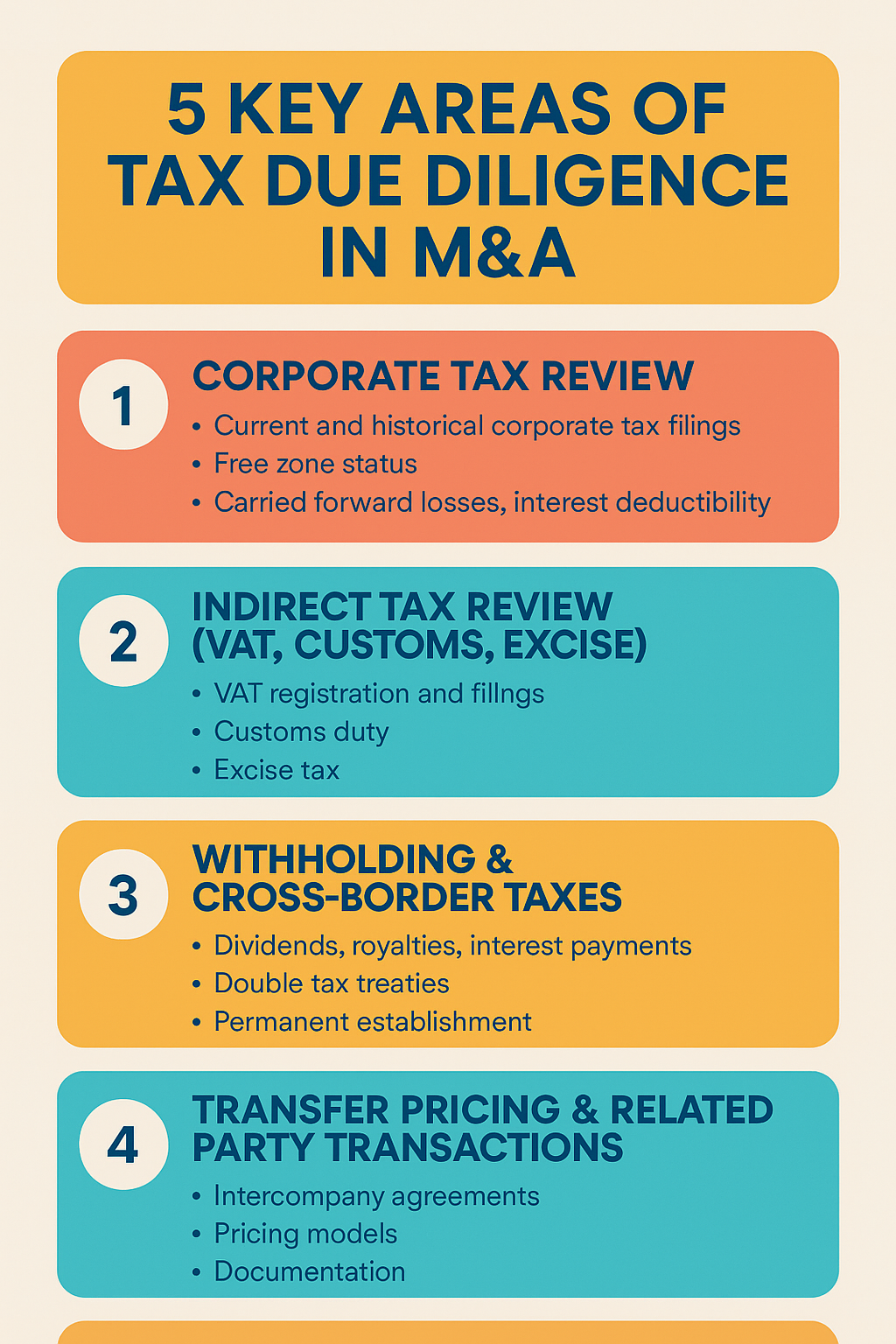
1. Corporate Tax Review
• Review of current and historical corporate tax filings.
• Check eligibility for free zone 0% QFZP status.
• Assess impact of carried forward losses and interest deductibility.
2. Indirect Tax Review (VAT, Customs, Excise)
• Verification of VAT registration, filings, and refund claims.
• Customs duty implications for trading and manufacturing businesses.
• Potential excise duty risks in industries like beverages, tobacco, or luxury goods.
3. Withholding & Cross-Border Taxes
• Review payments of dividends, royalties, and interest.
• Application of Double Tax Treaties.
• Risks of Permanent Establishment (PE) in foreign jurisdictions.
4. Transfer Pricing & Related Party Transactions
• Compliance with UAE TP Regulations under OECD guidelines.
• Review of intercompany agreements, pricing models, and documentation.
5. Tax Litigation & Disputes
• Pending cases with the Federal Tax Authority (FTA) or foreign tax authorities.
• Potential exposures from past assessments or audits.
6. Economic Substance & PoEM Risks
• Review of compliance with Economic Substance Regulations (ESR).
• Assess whether management/control is genuinely in the UAE to avoid Place of Effective Management (PoEM) issues elsewhere.
________________________________________
Key Red Flags in Tax Due Diligence
• Incomplete or inaccurate tax filings.
• Aggressive tax planning strategies without proper documentation.
• Related-party transactions without transfer pricing justification.
• Pending tax audits or litigation.
• Non-compliance with ESR or VAT rules.
________________________________________
Best Practices for Effective Tax Due Diligence
1. Engage Experts Early – Tax advisors should be part of the deal team from the beginning.
2. Go Beyond Compliance – Focus not only on compliance but also on structuring opportunities.
3. Leverage Technology – Use tax analytics tools for faster identification of risks.
4. Negotiate Protections – Ensure warranties, indemnities, and purchase price adjustments are included in the SPA (Share Purchase Agreement).
5. Post-Deal Integration – Align accounting, tax, and ERP systems immediately after acquisition.
________________________________________
Conclusion
Tax due diligence is not just a compliance exercise—it is a deal protection tool. By thoroughly analyzing the target company’s tax position, acquirers can avoid unexpected liabilities, negotiate better terms, and structure the deal in the most tax-efficient manner.
In the UAE, where corporate tax is new and VAT compliance is heavily monitored, thorough tax due diligence is now more important than ever. Businesses that prioritize it will ensure smoother transactions and stronger long-term value creation.
________________________________________
📌 Sheikh Anwar Accounting & Auditing LLC
Approved Auditor – UAE Ministry of Economy (Entry No. 5817)
📧 info@sa-auditors.com
🌐 www.sa-auditors.com