Suspicious Cross-Border Transactions
Introduction
Cross-border transactions are essential to international business, but they also provide opportunities for money launderers and terrorist financiers to move illicit funds undetected. Criminals exploit weaknesses in cross-border payment systems, correspondent banking, and trade finance to disguise the origin and purpose of funds.
For UAE-based businesses and DNFBPs, it is critical to identify red flags in cross-border activity to comply with Federal Decree-Law No. 20 of 2018, Cabinet Decision No. 10 of 2019, and Cabinet Decision No. 109 of 2023, while aligning with FATF recommendations.
________________________________________
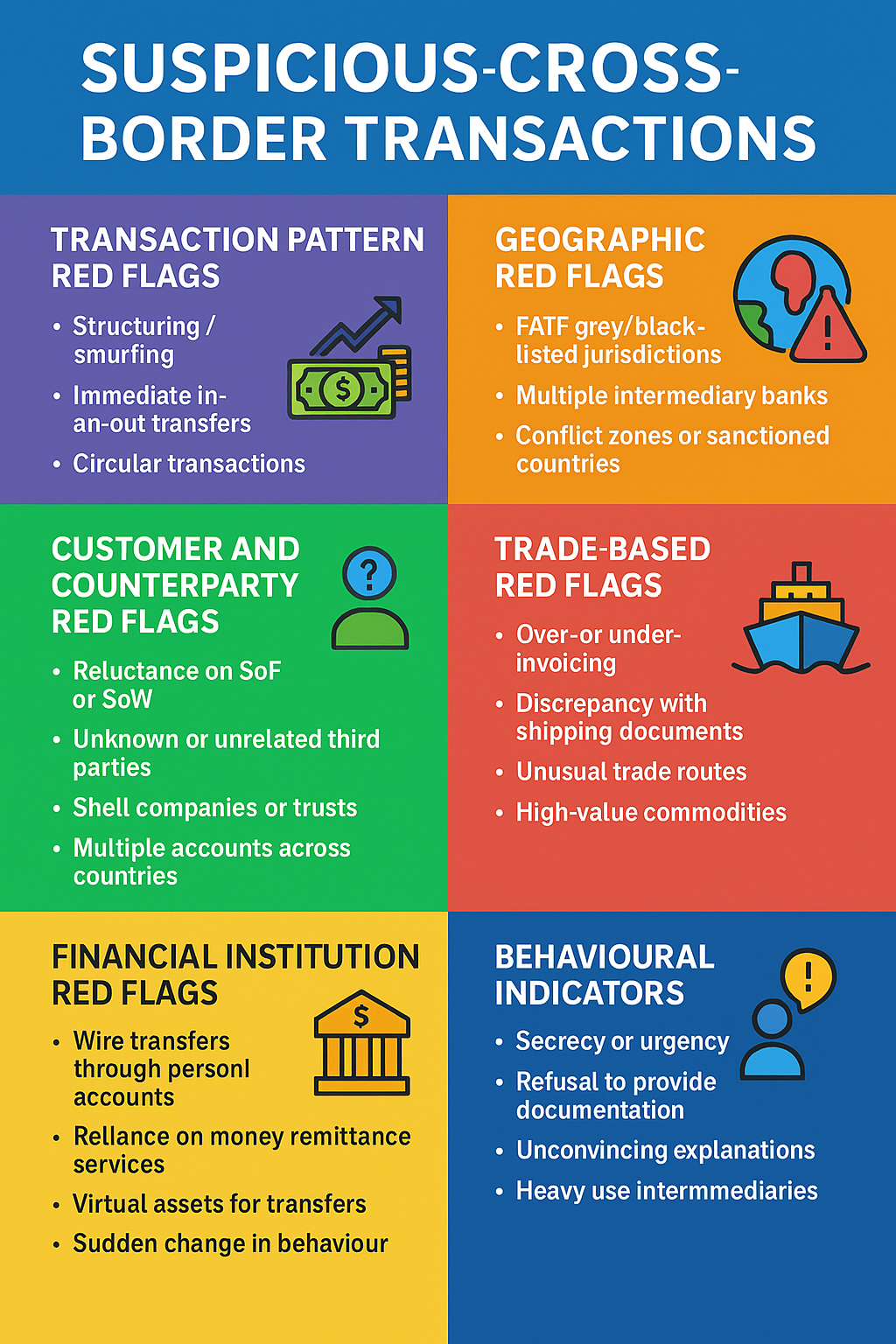
1. Transaction Pattern Red Flags
• Structuring / Smurfing: Funds split into smaller amounts across multiple transfers to avoid reporting thresholds.
• Immediate in-and-out transfers without legitimate business purpose.
• Circular transactions between accounts in different countries.
• Transfers inconsistent with the client’s business profile or declared income.
• Payments made in currencies uncommon for the client’s business.
________________________________________
2. Geographic Red Flags
• Transfers to or from FATF grey/black-listed jurisdictions.
• Use of multiple intermediary banks across secrecy jurisdictions.
• Frequent remittances involving conflict zones or sanctioned countries.
• Offshore centres with weak AML/CFT controls used as transaction routes.
________________________________________
3. Customer and Counterparty Red Flags
• Reluctance to disclose source of funds or wealth for cross-border transfers.
• Transactions involving unknown or unrelated third parties.
• Beneficiaries with no business or personal relationship to the sender.
• Accounts opened by shell companies or trusts in offshore jurisdictions.
• Multiple bank accounts across countries used for layering funds.
________________________________________
4. Trade-Based Red Flags
• Over- or under-invoicing of goods to disguise movement of funds.
• Discrepancy between shipping documents and actual goods shipped.
• Unusual trade routes involving multiple transshipment points.
• Same goods repeatedly imported/exported with inflated values.
• Involvement of high-value commodities (gold, diamonds, luxury goods) often linked to ML/TF risks.
________________________________________
5. Financial Institution Red Flags
• Wire transfers through personal accounts rather than corporate accounts.
• Heavy reliance on money remittance services instead of banks.
• High-value transfers funded by cash deposits.
• Use of virtual assets (cryptocurrency) to transfer funds cross-border with poor traceability.
• Sudden change in transaction behaviour (e.g., dormant accounts becoming active with large transfers).
________________________________________
6. Behavioural Indicators
• Customers showing secrecy, urgency, or resistance when questioned.
• Refusal to provide supporting documentation for transfers.
• Unconvincing explanations for the purpose of international payments.
• Heavy use of intermediaries or agents with no legitimate business role.
________________________________________
7. UAE-Specific Typologies
• Gold and jewellery traders exporting or importing through offshore centres.
• Real estate purchases funded via offshore entities with no economic substance.
• Hawala/informal value transfer systems overlapping with formal banking channels.
• Free zone companies with no employees used to route cross-border funds.
________________________________________
8. Mitigation Measures for DNFBPs and Financial Institutions
• Apply Enhanced Due Diligence (EDD) for high-risk jurisdictions and clients.
• Screen transactions and counterparties against sanctions, PEP, and watch lists.
• Use automated monitoring tools to detect unusual patterns.
• Verify trade documentation and ensure consistency with actual shipments.
• Report suspicious activities promptly through goAML.
• Provide regular AML/CTF training to staff with focus on cross-border typologies.
________________________________________
✅ Conclusion
Cross-border activity is often exploited by criminals due to its complexity and international nature. For businesses and DNFBPs in the UAE, vigilance in identifying suspicious cross-border red flags is vital to ensuring compliance, protecting reputation, and supporting the global fight against financial crime.
________________________________________
📌 About Us
At Sheikh Anwar Accounting & Auditing LLC, we specialize in AML compliance, cross-border transaction monitoring, DNFBP risk assessments, and outsourced MLRO services. Our expertise helps businesses navigate cross-border complexities while ensuring compliance with UAE AML/CFT laws.
📧 Email: info@sa-auditors.com
🌐 Website: www.sa-auditors.com