Suspicious Activity in Offshore Structures
Introduction
Offshore structures—such as companies, trusts, and foundations—are often established for legitimate purposes, including international tax planning, asset protection, or cross-border investments. However, these structures can also be misused for money laundering, terrorist financing, tax evasion, and hiding beneficial ownership.
For regulators, compliance officers, and DNFBPs in the UAE, identifying suspicious activity in offshore structures is critical to mitigating AML/CFT risks and ensuring compliance with Federal Decree-Law No. 20 of 2018, Cabinet Decision No. 10 of 2019, and Cabinet Decision No. 109 of 2023.
________________________________________
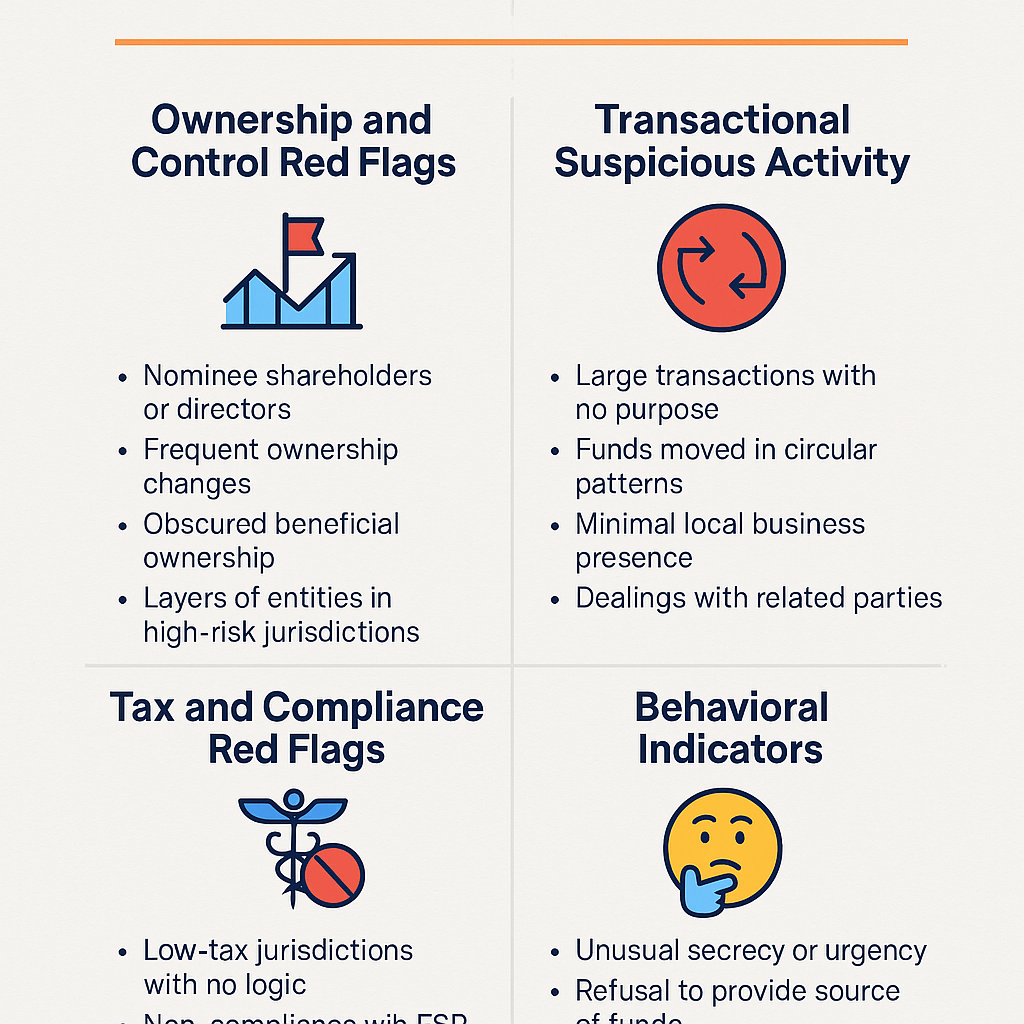
1. Ownership and Control Red Flags
• Use of nominee shareholders or directors with no real decision-making authority.
• Frequent or unexplained changes in ownership or control.
• Structures designed to obscure the Ultimate Beneficial Owner (UBO).
• Multiple layers of companies in high-risk jurisdictions with little or no transparency.
________________________________________
2. Transactional Suspicious Activity
• Offshore companies engaged in large transactions without economic rationale.
• Funds moving in and out of offshore accounts in a circular pattern.
• Offshore entities with minimal or no local presence yet conducting high-value trade.
• Transactions with related parties without clear documentation or pricing.
________________________________________
3. Tax and Compliance Red Flags
• Offshore entities created in jurisdictions with low or no tax but no valid commercial purpose.
• Non-compliance with UAE Economic Substance Regulations (ESR).
• Offshore companies filing incomplete or inconsistent tax returns.
• Use of structures to evade VAT, corporate tax, or customs duties.
________________________________________
4. Sector-Specific Misuse of Offshore Structures
Real Estate
• Offshore companies purchasing UAE property with cash or complex financing structures.
• Ownership transfers at inflated or deflated prices.
Precious Metals & Jewellery
• Offshore shell companies buying or selling gold, diamonds, or luxury goods.
• Transactions conducted via offshore entities to avoid local AML reporting.
Professional Services
• Requests for complex trust or foundation structures with no legitimate justification.
• Clients insisting on secrecy or resisting disclosure of UBO information.
________________________________________
5. Behavioural Indicators
• Clients showing unusual secrecy or urgency when setting up offshore structures.
• Refusal to provide documentation on source of funds or wealth.
• Reliance on intermediaries or proxies to shield the real owners.
• Inconsistent explanations for why an offshore structure is necessary.
________________________________________
6. Mitigation Steps for Businesses and DNFBPs
• Conduct Enhanced Due Diligence (EDD) for offshore entities and their controllers.
• Verify UBO information in line with UAE AML laws and ESR obligations.
• Apply continuous transaction monitoring for unusual offshore dealings.
• File Suspicious Activity Reports (SARs) to the UAE FIU when necessary.
• Train staff to detect and escalate offshore red flags.
________________________________________
✅ Conclusion
While offshore structures can serve legitimate business needs, they remain a key tool for those seeking to obscure illicit activity. By proactively identifying suspicious activity, DNFBPs and compliance professionals in the UAE can protect themselves against regulatory risk, financial penalties, and reputational damage.
________________________________________
📌 About Us
At Sheikh Anwar Accounting & Auditing LLC, we provide expert services in AML compliance, risk assessment, outsourced MLRO support, and regulatory reporting. We help businesses in the UAE identify and manage risks linked to offshore structures and high-risk clients.
📧 Email: info@sa-auditors.com
🌐 Website: www.sa-auditors.com