Structuring for Tax Efficiency
Introduction
The way a business is structured directly impacts its tax obligations, compliance requirements, and profitability. In the UAE, with the introduction of Corporate Tax under Federal Decree-Law No. 47 of 2022 and the existing VAT regime, proper structuring has become a strategic necessity for both new and existing businesses.
Structuring for tax efficiency is not about avoiding taxes — it’s about designing a business model that optimises tax benefits, ensures compliance, and supports long-term growth.
At Sheikh Anwar Accounting and Auditing LLC, we specialise in helping companies design tax-efficient structures aligned with UAE laws and international best practices.
________________________________________
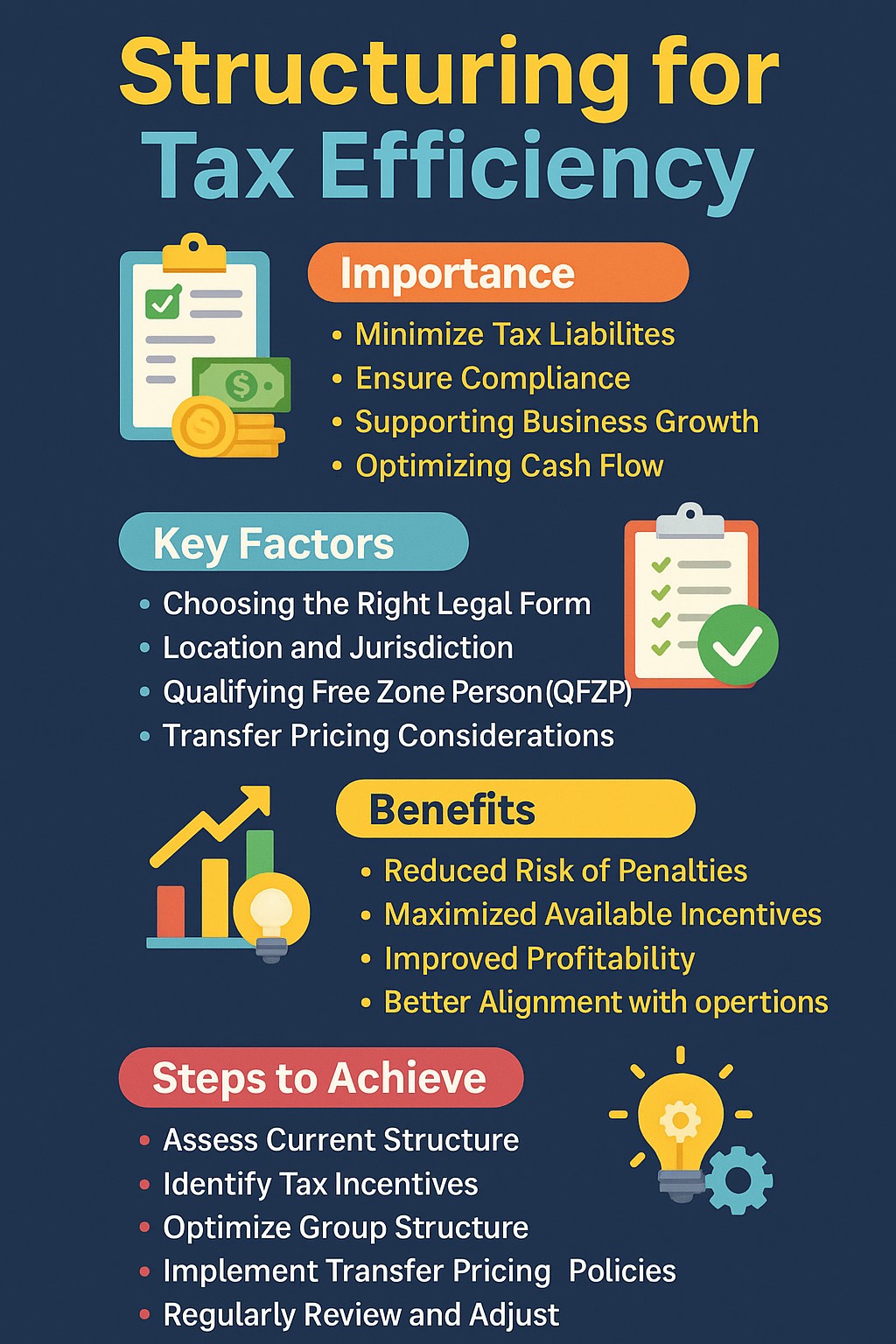
1. Why Tax-Efficient Structuring is Important
a) Minimising Tax Liabilities
• Ensures that the business pays the legally required minimum tax.
• Takes advantage of free zone incentives, exemptions, and deductions.
b) Compliance Assurance
• Aligns the structure with UAE corporate tax, VAT, and economic substance regulations.
• Reduces the risk of FTA penalties and reputational damage.
c) Supporting Business Growth
• Structures revenue flows for scalability.
• Creates a framework that adapts to international expansion.
d) Cash Flow Optimisation
• Minimises unnecessary tax outflows.
• Allows reinvestment into operations.
________________________________________
2. Key Factors in Designing a Tax-Efficient Structure
1. Choosing the Right Legal Form
• Mainland LLC – Allows trade across the UAE but subject to standard corporate tax rules.
• Free Zone Company – Potential 0% tax rate for Qualifying Free Zone Persons (QFZP) on qualifying income.
• Branch Office – For foreign companies to operate in the UAE without full incorporation.
• Holding Company – For managing group entities and optimising dividend and capital gains tax treatment.
2. Location and Jurisdiction
• Some designated free zones offer customs and VAT benefits for trading businesses.
• DIFC and ADGM provide specific incentives for financial and professional services.
3. Qualifying Free Zone Person (QFZP) Status
• Maintain adequate substance (staff, office space, expenses).
• Keep non-qualifying income within de-minimis limits.
• Separate qualifying and non-qualifying transactions.
4. Transfer Pricing Considerations
• Related-party transactions must follow the Arm’s Length Principle.
• Maintain Master File and Local File documentation if required.
5. Capital Structure Optimisation
• Balance between equity and debt financing to maximise deductible interest without breaching thin capitalisation rules.
6. Cross-Border Structuring
• Use Double Taxation Agreements (DTAs) to reduce withholding taxes on dividends, interest, and royalties.
• Consider foreign tax credit rules where applicable.
________________________________________
3. Common Structuring Mistakes to Avoid
1. Choosing a free zone without considering QFZP compliance.
2. Mixing personal and business expenses, leading to disallowed deductions.
3. Ignoring transfer pricing obligations for group companies.
4. Failing to maintain proper documentation for tax audits.
5. Structuring purely for tax benefits without considering operational realities.
________________________________________
4. Steps to Achieve Tax-Efficient Structuring
1. Assess Current Structure – Review legal form, income sources, and compliance status.
2. Identify Tax Incentives – Evaluate free zone benefits, exemptions, and DTAs.
3. Optimise Group Structure – Centralise functions or create a holding entity for efficiency.
4. Implement Transfer Pricing Policies – Ensure related-party transactions meet UAE rules.
5. Regularly Review and Adjust – Laws and business operations evolve; structures must adapt.
________________________________________
5. Role of a Professional Advisor
A professional tax advisor can:
• Analyse your operations and identify opportunities for tax savings.
• Recommend the most beneficial corporate structure.
• Ensure compliance with UAE corporate tax, VAT, ESR, and transfer pricing.
• Support ongoing reviews to maintain efficiency.
________________________________________
Conclusion
In the UAE’s evolving tax environment, structuring for tax efficiency is both a compliance requirement and a competitive advantage. A well-planned structure ensures your business pays only what is necessary while maximising incentives, improving cash flow, and supporting sustainable growth.
At Sheikh Anwar Accounting and Auditing LLC, we help businesses of all sizes design customised, compliant, and tax-efficient structures for success in the UAE and beyond.
📍 Dubai, UAE
🌐 Website: www.sa-auditors.com