STR Filing Obligations for DNFBPs
Introduction
In the United Arab Emirates (UAE), Designated Non-Financial Businesses and Professions (DNFBPs) such as dealers in precious metals and stones, real estate agents, accountants, auditors, law firms, and trust/company service providers, are considered high-risk sectors for money laundering and terrorist financing. One of the most critical obligations imposed on DNFBPs under the UAE AML/CFT legal framework is the duty to file Suspicious Transaction Reports (STRs).
Failure to meet these obligations not only exposes DNFBPs to regulatory penalties but also increases their vulnerability to being misused by criminals.
________________________________________
What is an STR?
A Suspicious Transaction Report (STR) is a formal report submitted to the UAE’s Financial Intelligence Unit (FIU) through the goAML platform, when a DNFBP suspects or has reasonable grounds to suspect that funds, transactions, or attempted transactions are linked to:
• Money laundering,
• Terrorist financing, or
• Any criminal activity.
Importantly, the obligation to file an STR is based on suspicion, not proof. DNFBPs are not required to investigate or confirm the criminal activity—once suspicion arises, reporting is mandatory.
________________________________________
Legal & Regulatory Framework
The STR filing obligations for DNFBPs in the UAE are governed by:
• Federal Decree-Law No. 20 of 2018 on Anti-Money Laundering and Combating Financing of Terrorism and Illegal Organizations,
• Cabinet Decision No. 10 of 2019 (as amended by Cabinet Decision No. 109 of 2023),
• UAE Central Bank, Ministry of Economy, and free zone regulators’ AML/CFT guidance.
These frameworks mandate DNFBPs to adopt a risk-based approach and ensure suspicious activities are promptly reported to the FIU.
________________________________________
Key Obligations for DNFBPs
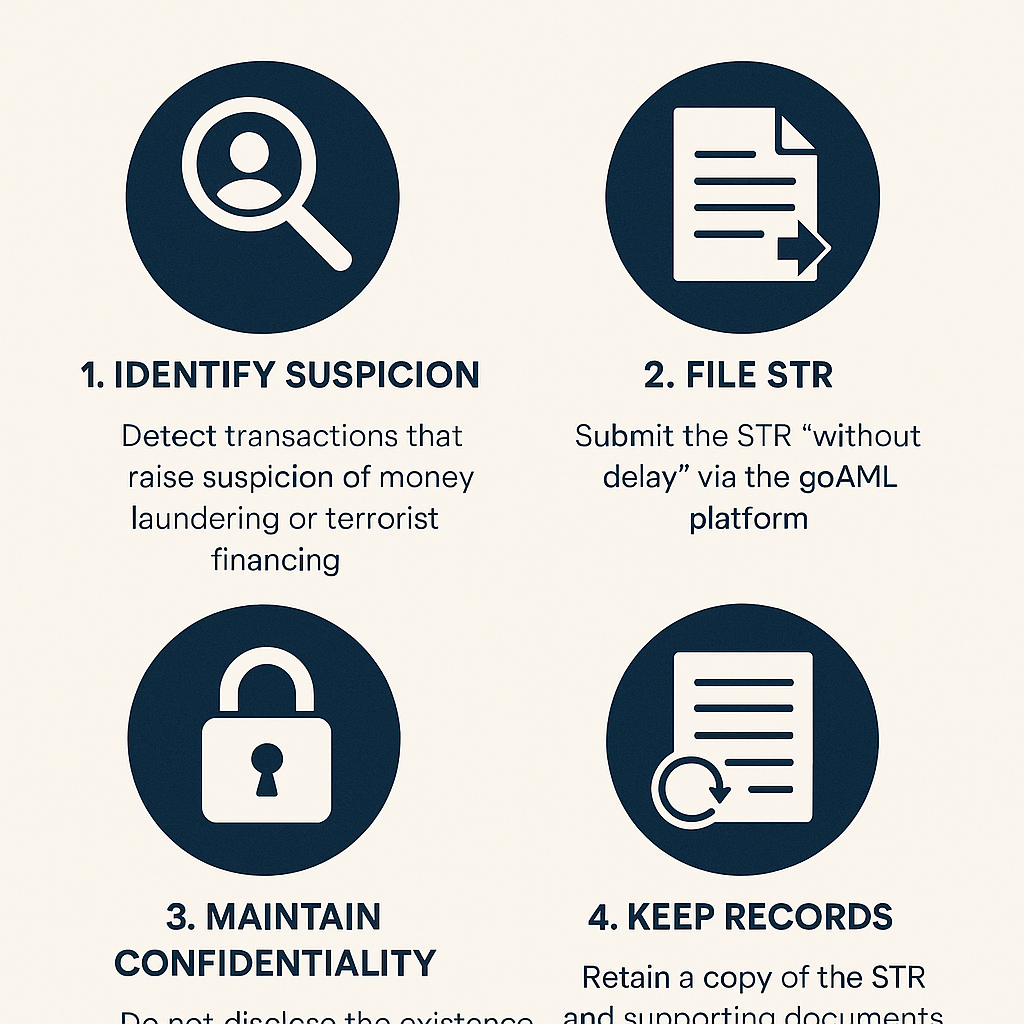
1. Identification of Suspicious Transactions
DNFBPs must have robust internal controls and monitoring systems to detect:
• Unusual cash transactions,
• Structuring of transactions to avoid reporting thresholds,
• Transactions inconsistent with a client’s profile or business,
• Dealings with high-risk jurisdictions or sanctioned entities.
2. Timely Filing of STRs
• STRs must be submitted “without delay” once suspicion is formed.
• Reports are filed electronically via the goAML platform managed by the UAE FIU.
• Delayed or non-filing may result in hefty fines (ranging from AED 50,000 to AED 5,000,000) and regulatory action.
3. Confidentiality Requirement
• DNFBPs must not disclose to the client or any third party that an STR has been filed.
• Breaching confidentiality can itself lead to penalties.
4. Record-Keeping
• Maintain copies of STRs and related supporting documents for at least five years.
• Ensure that these are available for regulatory inspections and audits.
5. MLRO Responsibility
• DNFBPs must appoint a Money Laundering Reporting Officer (MLRO).
• The MLRO is responsible for reviewing internal alerts, deciding on STR filings, and ensuring timely submission.
________________________________________
Practical Steps for DNFBPs
1. Develop internal reporting procedures – Employees should escalate any suspicious activities to the MLRO.
2. Train staff regularly – Staff must be trained to recognize red flags and understand reporting obligations.
3. Use automated monitoring tools – For high-volume businesses, automated systems help in identifying unusual patterns.
4. Conduct periodic audits – Test the effectiveness of your STR reporting process.
________________________________________
Penalties for Non-Compliance
The UAE authorities have imposed significant fines on DNFBPs for failing to comply with STR filing obligations. Examples include:
• Failure to file an STR – Fine up to AED 1,000,000.
• Late submission of STR – Fine up to AED 500,000.
• Failure to maintain records – Fine up to AED 300,000.
Repeated or deliberate violations may also lead to license suspension, revocation, or criminal liability.
________________________________________
Conclusion
For DNFBPs, filing Suspicious Transaction Reports is not optional—it is a legal duty. A proactive approach to monitoring and reporting not only safeguards the business from penalties but also strengthens the UAE’s financial integrity.
By investing in compliance frameworks, training employees, and empowering MLROs, DNFBPs can ensure they meet their STR obligations effectively.
________________________________________
✅ Sheikh Anwar Accounting & Auditing LLC
🌐 www.sa-auditors.com
📧 info@sa-auditors.com