Signs of Terrorism Financing
Introduction
Terrorism financing (TF) differs from money laundering (ML) in one key way: while ML focuses on hiding the illicit origin of funds, TF often uses both legal and illegal funds to support terrorist activities. The challenge for regulators, compliance officers, and businesses in the UAE is that TF amounts are often smaller and harder to detect but can be equally dangerous.
Identifying red flags and suspicious activity is therefore essential for compliance with Federal Decree-Law No. 20 of 2018, Cabinet Decision No. 10 of 2019, and FATF recommendations.
________________________________________
1. Customer Due Diligence Red Flags
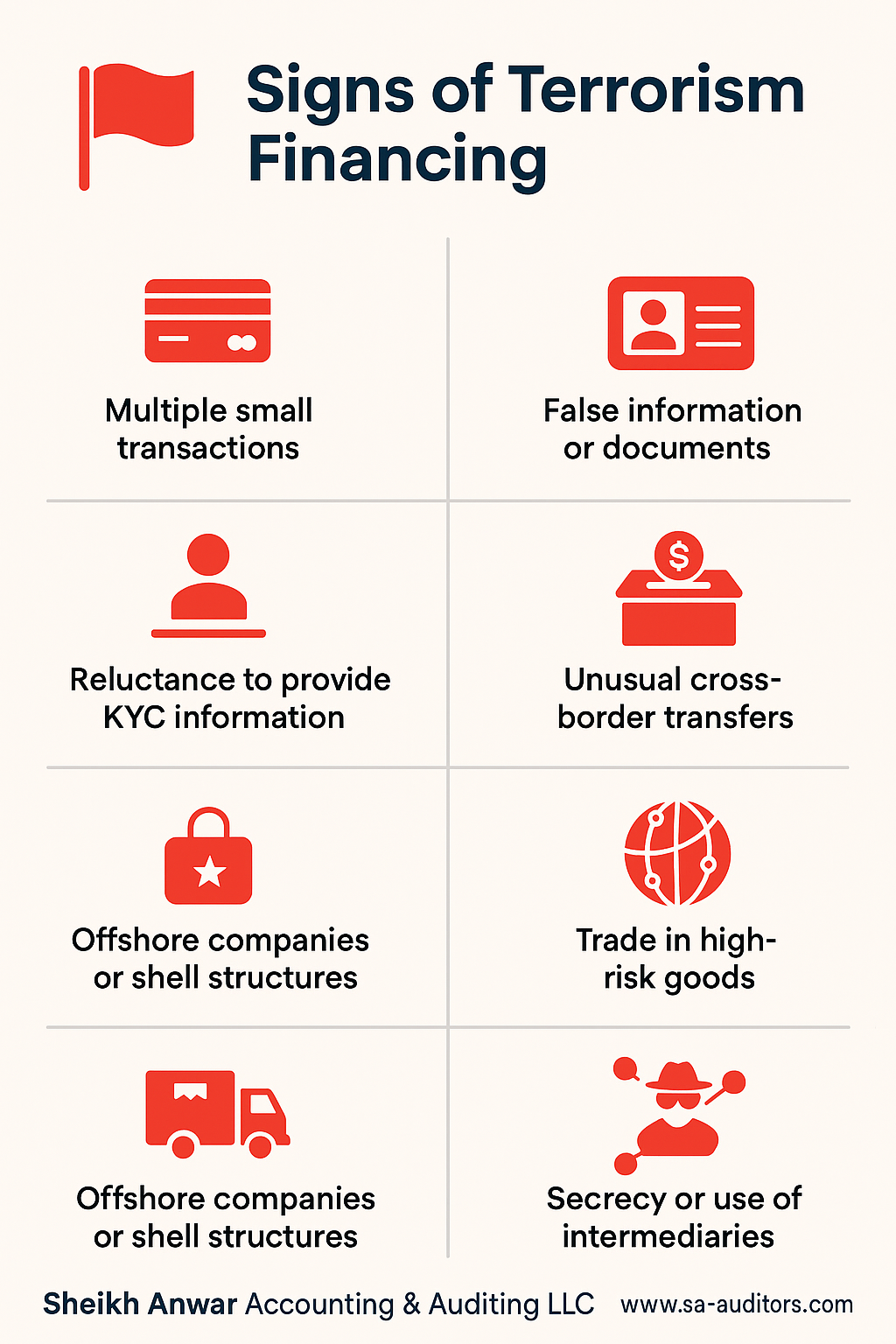
• Clients reluctant to provide KYC documents, source of funds, or wealth.
• Use of false identification or multiple aliases.
• Accounts opened in the names of charities, NGOs, or foundations with weak transparency.
• Links to individuals or organizations listed on sanctions or watch lists.
________________________________________
2. Transactional Red Flags
• Multiple small transactions (structuring) designed to avoid detection.
• Unusual cross-border transfers, especially to or from conflict zones.
• Transactions inconsistent with the client’s known profile or declared business.
• Use of third-party intermediaries without a clear business rationale.
________________________________________
3. Use of Non-Profit Organizations (NPOs)
• NPOs or charities that lack transparency in governance or finances.
• Donations routed through complex channels before reaching beneficiaries.
• Funds directed to high-risk regions under the guise of humanitarian aid.
• Excessive cash donations that do not match declared income.
________________________________________
4. Trade-Based Red Flags
• Over- or under-invoicing of goods to move value across borders.
• Repeated trade transactions with little or no commercial purpose.
• Unusual shipments routed through high-risk jurisdictions.
• Clients engaging in sectors vulnerable to misuse (gold, luxury goods, arms, etc.).
________________________________________
5. Banking and Financial Activity Red Flags
• Accounts with frequent cash deposits and withdrawals.
• Multiple low-value remittances to different beneficiaries in various countries.
• Use of informal value transfer systems (IVTS/hawala).
• High reliance on prepaid cards, e-wallets, or virtual assets with poor traceability.
________________________________________
6. Behavioural Indicators
• Customers displaying nervousness, secrecy, or urgency.
• Avoidance of face-to-face meetings, preferring only remote communication.
• Overuse of legal structures such as trusts and offshore companies to hide activity.
• Clients resisting enhanced due diligence or questioning compliance checks.
________________________________________
7. UAE-Specific Risks
• Abuse of charitable organizations operating in the UAE.
• Use of free zone companies or shell structures with no commercial substance.
• Exploitation of cash-intensive businesses like real estate, jewellery, and exchange houses.
• Use of virtual assets and peer-to-peer transfers to fund overseas activities.
________________________________________
8. Mitigation Measures
• Screen all clients and transactions against UN, FATF, and UAE sanctions lists.
• Apply Enhanced Due Diligence (EDD) for high-risk customers and jurisdictions.
• Monitor and report suspicious activity via goAML.
• Train staff to recognize TF-specific red flags, especially those linked to NPOs and small-value transfers.
• Implement automated transaction monitoring systems for early detection.
________________________________________
✅ Conclusion
Terrorism financing is often hidden under layers of legitimate business and charitable activity. By remaining vigilant and recognizing these signs, UAE businesses, DNFBPs, and financial institutions can play a key role in protecting the financial system from misuse and ensuring compliance with AML/CFT regulations.
________________________________________
📌 About Us
At Sheikh Anwar Accounting & Auditing LLC, we specialize in AML compliance, terrorism financing risk assessments, outsourced MLRO services, and regulatory reporting. We provide tailored solutions for DNFBPs, financial institutions, and charities in line with UAE AML/CFT frameworks.
📧 Email: info@sa-auditors.com
🌐 Website: www.sa-auditors.com