Screening Against Sanction Lists – Best Practices
Introduction
In today’s global regulatory landscape, sanctions compliance is a critical component of Anti-Money Laundering (AML) and Counter-Terrorist Financing (CTF) frameworks. Businesses in the UAE, particularly DNFBPs (gold and diamond traders, accountants, auditors, real estate firms, and law firms), are obligated under Federal Decree-Law No. 20 of 2018 and Cabinet Decision No. 10 of 2019 to conduct robust screening against international and domestic sanctions lists. Failure to do so can result in severe penalties, reputational harm, and regulatory scrutiny.
________________________________________
1. What Are Sanctions Lists?
Sanctions lists are official registers issued by governments or international bodies that identify:
• Individuals (e.g., terrorists, criminals, politically exposed persons).
• Entities (e.g., shell companies, organizations linked to illicit activity).
• Countries/Jurisdictions subject to restrictions.
Key sanction lists relevant for UAE businesses include:
• United Nations Security Council (UNSC) Sanctions List
• UAE Local Terrorist List issued by the Cabinet
• OFAC List (U.S. Treasury Office of Foreign Assets Control)
• EU Consolidated Sanctions List
• HM Treasury List (UK)
________________________________________
2. Why Sanctions Screening Is Critical
• Legal Compliance – Avoids regulatory fines and penalties.
• Risk Management – Protects businesses from being misused for illicit activity.
• Reputation Protection – Demonstrates integrity and responsibility to stakeholders.
• Operational Continuity – Prevents business relationships with restricted parties that may cause disruptions.
________________________________________
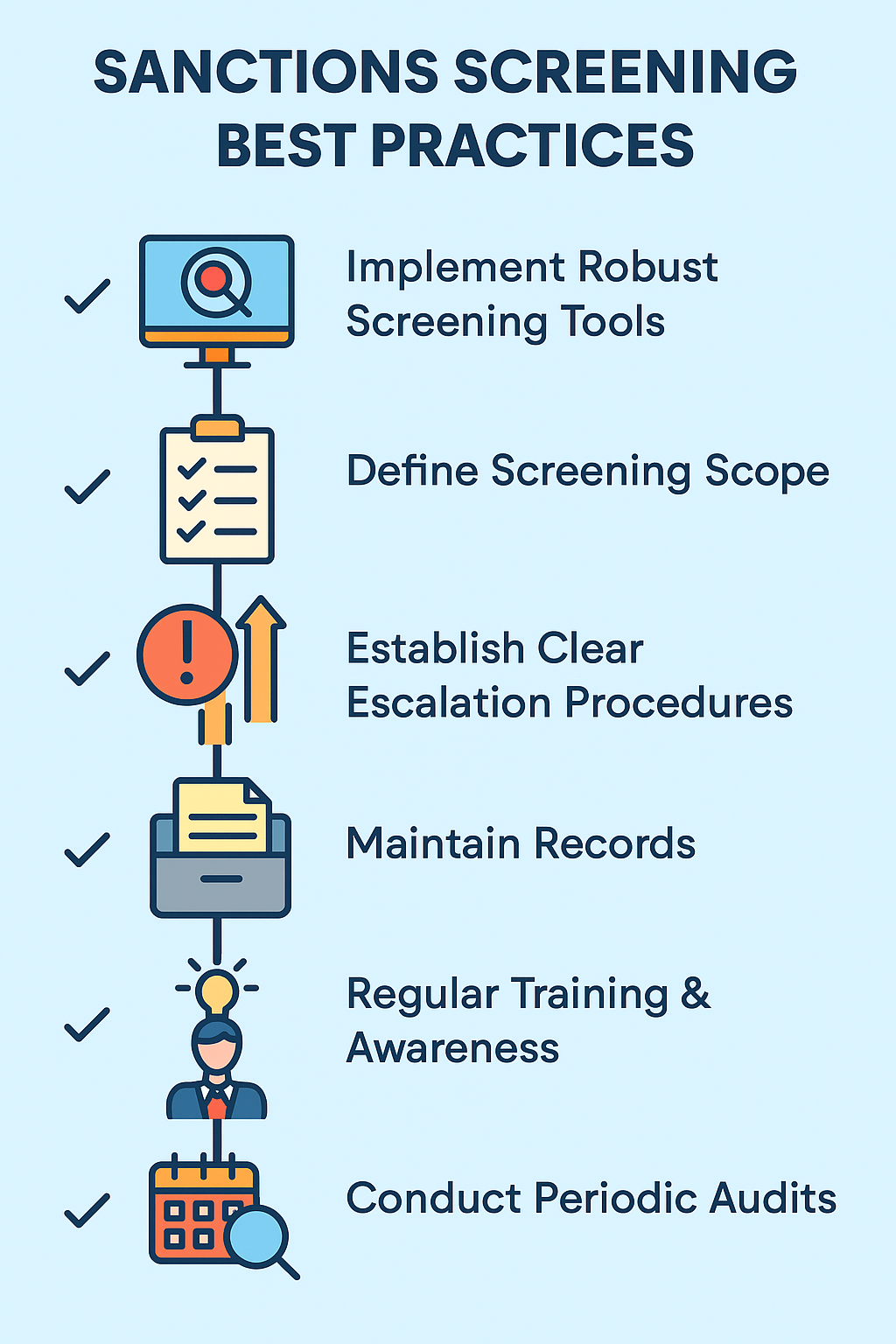
3. Best Practices for Screening Against Sanctions Lists
A. Implement Robust Screening Tools
• Use automated solutions integrated with updated global sanctions databases.
• Ensure real-time updates when lists change.
• Leverage fuzzy matching and AI to detect variations in names (e.g., spelling differences, aliases).
B. Define Screening Scope
• Screen all new customers at onboarding.
• Conduct ongoing screening of existing customers.
• Screen all counterparties, beneficial owners, vendors, and transactions.
• Pay special attention to cross-border and high-value transactions.
C. Establish Clear Escalation Procedures
• Develop internal policies for handling “positive matches.”
• Escalate potential hits to compliance officers or MLROs.
• File Suspicious Transaction Reports (STRs) via the goAML platform when required.
D. Maintain Records
• Keep records of all screenings, matches, and escalations.
• Document false positives with clear rationale for dismissal.
• Retain records for at least 5 years as per UAE law.
E. Regular Training & Awareness
• Train employees to identify red flags and understand screening obligations.
• Provide refreshers whenever lists or regulatory requirements change.
F. Conduct Periodic Audits
• Independent reviews of sanction screening systems.
• Test effectiveness of tools and processes.
• Update systems to address identified gaps.
________________________________________
4. Common Challenges in Sanctions Screening
• High Volume of False Positives – Causing inefficiencies if not properly managed.
• Data Quality Issues – Incomplete or inaccurate customer data leading to missed matches.
• Complex Ownership Structures – Difficulty in screening beneficial owners behind corporate entities.
• Rapidly Changing Regulations – Requires continuous updates to systems and processes.
________________________________________
5. How UAE Businesses Can Strengthen Compliance
• Adopt risk-based approaches to prioritize high-risk clients and geographies.
• Integrate screening into broader AML/CFT frameworks.
• Use outsourced MLRO services if internal expertise is limited.
• Collaborate with regulators by promptly reporting confirmed matches.
________________________________________
Conclusion
Sanctions screening is a non-negotiable requirement for businesses operating in the UAE. By adopting best practices such as automated tools, defined procedures, employee training, and robust record keeping, organizations can minimize risk, ensure compliance, and maintain credibility with regulators and stakeholders.
________________________________________
📌 About Us
Sheikh Anwar Accounting and Auditing LLC is a MOE-approved auditing and compliance firm in the UAE. We provide AML compliance services, including sanctions and PEP screening, AML risk assessments, MLRO services, training, and independent AML audits. Our expertise ensures your business remains compliant and protected from financial crime risks.
🌐 www.sa-auditors.com
📧 info@sa-auditors.com
📍 Dubai Creek Tower, M 35, Dubai, UAE