Scope of UAE Corporate Tax Law
Introduction
The UAE introduced Corporate Tax through Federal Decree-Law No. 47 of 2022, which came into effect for financial years beginning on or after 1 June 2023. As this tax regime is new to many businesses in the region, understanding its scope is critical.
It provides a comprehensive overview of the scope of UAE Corporate Tax Law — including who it applies to, what income is taxed, and the geographic and activity coverage of the law.
________________________________________
⚖️ Legal Basis
The Corporate Tax framework is built on:
• Federal Decree-Law No. 47 of 2022
• Cabinet and Ministerial decisions
• FTA Public Clarifications and guides
The law aligns with international tax standards such as the OECD BEPS framework and introduces the concept of taxable income, transfer pricing, and exemptions within a UAE context.
________________________________________
📍 Geographic Scope
Corporate Tax applies across all Emirates of the UAE. It is a federal tax, and revenues are collected by the Federal Tax Authority (FTA).
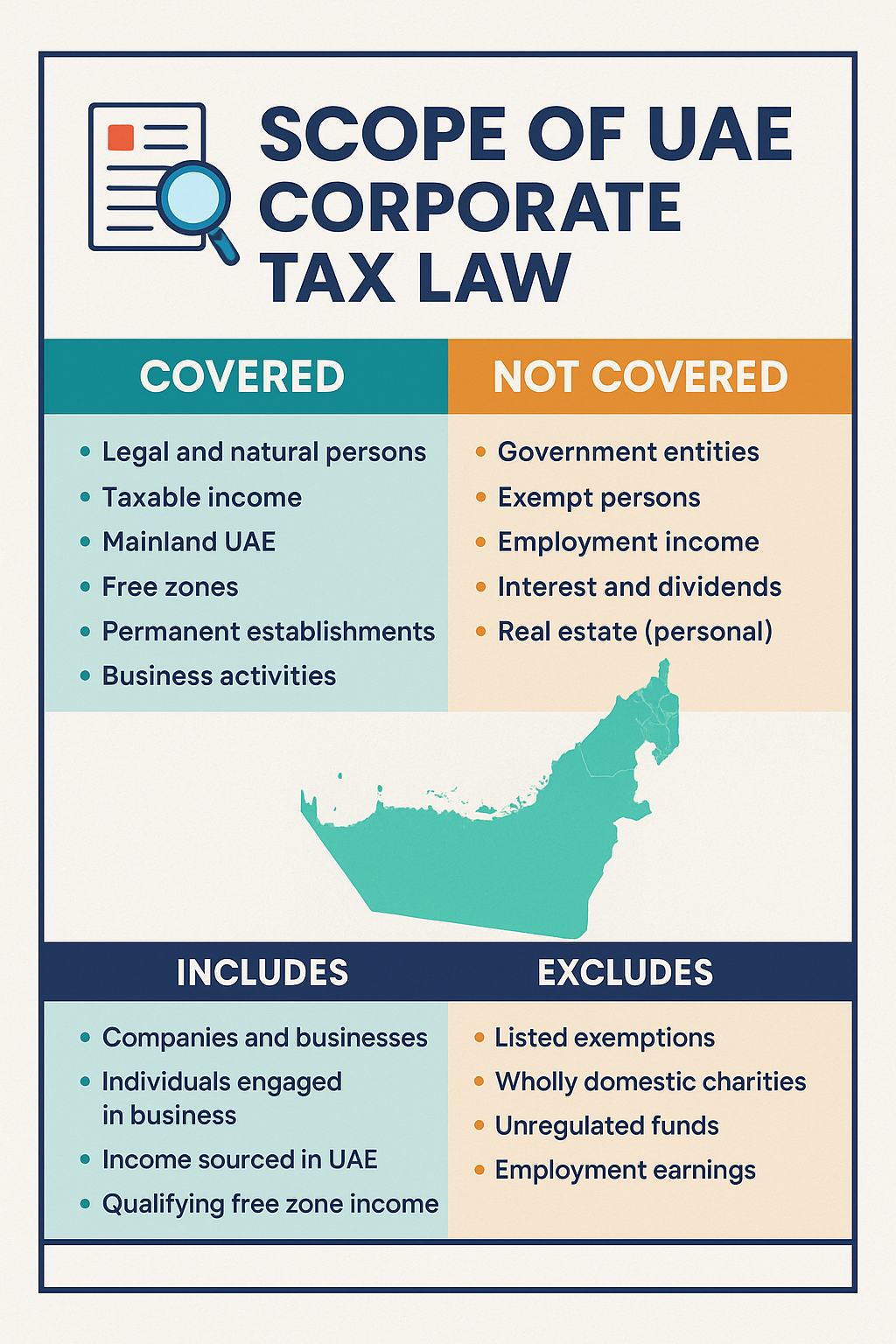
Covered Areas:
• Mainland UAE
• Free Zones (with specific provisions)
• Permanent Establishments of foreign entities
• Business activities by natural and legal persons
________________________________________
👥 Who Falls Under the Scope?
The law applies to both legal persons and natural persons engaged in business activities.
1. Resident Persons
• UAE incorporated companies
• Foreign companies effectively managed and controlled in the UAE
• Natural persons conducting business in the UAE
They are subject to Corporate Tax on their worldwide income (with exceptions for exempt income).
2. Non-Resident Persons
• Foreign companies with a Permanent Establishment (PE) in the UAE
• Foreign entities deriving UAE-sourced income
They are taxed only on UAE-based income or that attributable to their UAE PE.
________________________________________
🏢 Entities Covered Under the Law
Entity Type Covered?
LLCs & PSCs (mainland) ✅ Yes
Free Zone companies ✅ Yes (0% or 9% based on status)
Branches of foreign companies ✅ Yes
Freelancers & sole proprietors ✅ Yes (if licensed)
Government entities ❌ No (unless engaged in business activity)
Charities & Public Benefit Entities ❌ No (if approved and listed)
Investment funds ✅ / ❌ (depends on qualification criteria)
Natural resource companies ❌ No (taxed under Emirate-level laws)
________________________________________
💰 Income Covered Under UAE Corporate Tax
Corporate Tax is imposed on Taxable Income, calculated as:
Net Profit (per IFRS) + Adjustments - Exempt Income - Allowable Deductions
✅ Taxable Income Includes:
• Business profits
• Capital gains
• Dividends from foreign entities (if not exempt)
• Interest income
• Royalties
• Income from UAE and foreign sources (for resident persons)
❌ Not Taxed:
• Personal income (salary, investment, real estate rentals by individuals)
• Dividends from UAE companies
• Qualifying intra-group transactions
• Exempt income from foreign PEs and shareholdings (subject to conditions)
________________________________________
📊 Activities Covered
The law applies to any activity conducted with a business license or registration. These include:
• Manufacturing and trading
• Professional and consultancy services
• E-commerce and digital platforms
• Holding companies
• Real estate development and leasing (under commercial license)
• Financial services
• Oil and gas (if not covered by Emirate-level tax)
________________________________________
🏗️ Free Zones: Special Scope Rules
Free Zone Persons are within the scope of Corporate Tax but may benefit from a 0% tax rate if they qualify as a Qualifying Free Zone Person (QFZP).
To qualify, they must:
• Earn Qualifying Income
• Maintain adequate substance in the UAE
• Prepare audited financials
• Comply with transfer pricing rules
Non-qualifying income is subject to the standard 9% tax rate.
________________________________________
📉 Exemptions and Exclusions
Entities outside the scope of Corporate Tax or exempt under law include:
• Government and government-controlled entities
• Public benefit entities
• Qualifying investment funds
• Pension or social security funds
• Natural resource companies (taxed under separate Emirate-level laws)
Even these entities may be required to register and file declarations with the FTA.
________________________________________
💼 Scope of Taxable Income Calculation
The law applies the following principles:
• Accrual accounting based on IFRS
• Income aggregated across group companies (with group relief and transfer pricing)
• Losses carried forward up to 75% of taxable income
• Certain deductions restricted, such as entertainment or interest above 30% of EBITDA
________________________________________
📌 Summary: What’s in Scope?
Covered Not Covered
Business profits (legal/natural persons) Salaries of individuals
Mainland & Free Zone businesses Passive income of individuals
Foreign companies with PE in UAE Government entities
Professional services, consultancies Oil & gas taxed under Emirate rules
Holding companies Certain exempt funds and charities
________________________________________
🧾 How We Can Help
At Sheikh Anwar Accounting and Auditing LLC, we offer:
✅ Corporate Tax registration & return filing
✅ Free Zone scope eligibility review
✅ Tax structuring & planning
✅ Permanent Establishment analysis
✅ Exemption application assistance
✅ Transfer Pricing compliance
________________________________________
📞 Need Help Understanding Your Corporate Tax Scope?
🌐 www.sa-auditors.com
📩 info@sa-auditors.com | 📱 +971-XXX-XXXX
📍 Dubai | Abu Dhabi | Sharjah