Sanctions Screening Technology Explained
Introduction
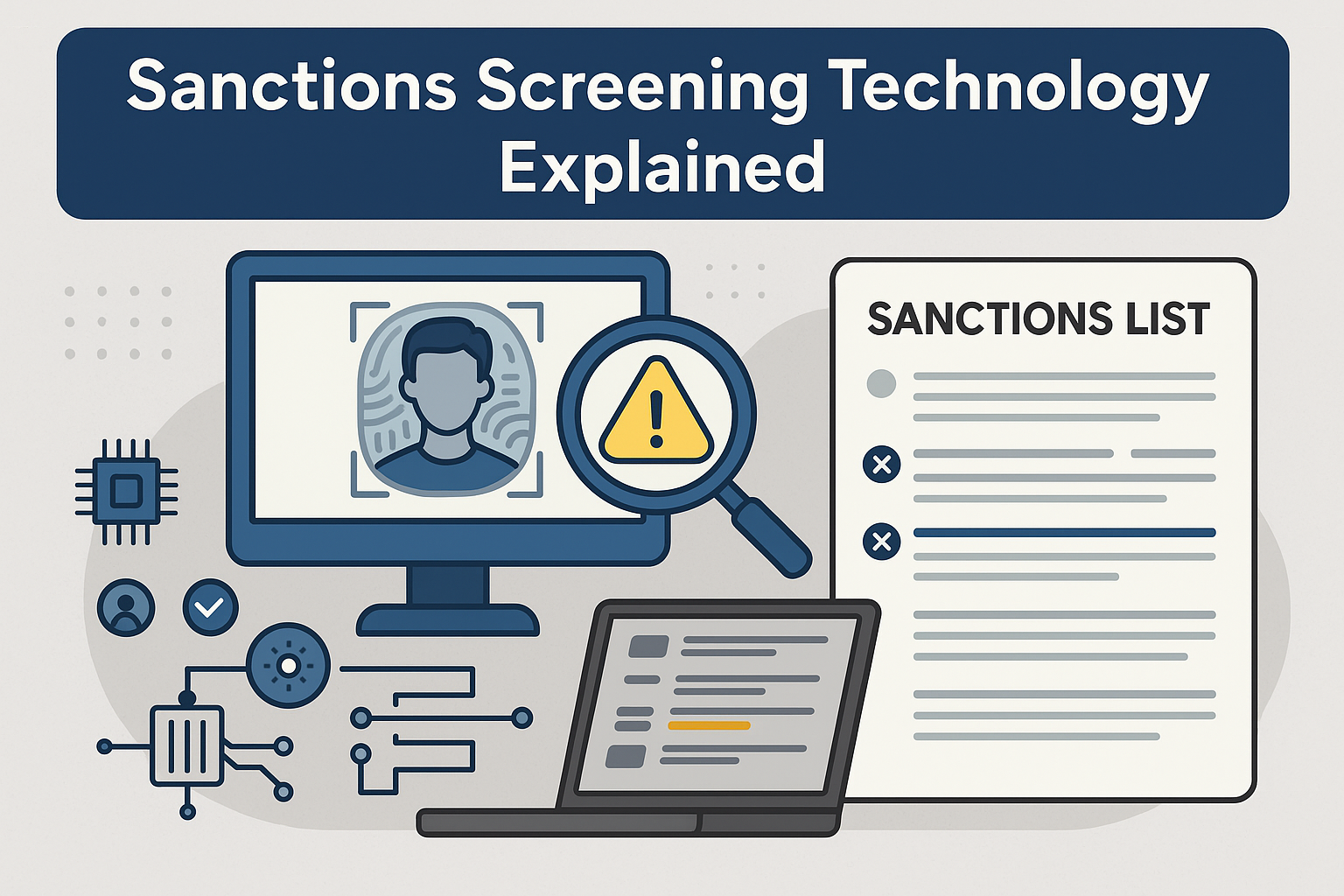
In today’s globalized financial system, businesses are under increasing pressure to prevent money laundering, terrorist financing, and violations of international sanctions. Regulators across the world, including in the UAE, require financial institutions and Designated Non-Financial Businesses and Professions (DNFBPs) to screen their customers and transactions against sanctions lists. This is where Sanctions Screening Technology plays a crucial role.
Sanctions screening solutions leverage databases, automation, and advanced technologies such as artificial intelligence (AI) to ensure that businesses stay compliant with AML and CFT regulations, including Federal Decree-Law No. 20 of 2018 and Cabinet Decision No. 10 of 2019 in the UAE.
________________________________________
What is Sanctions Screening?
Sanctions screening is the process of comparing customer names, transactions, and counterparties against official lists issued by regulatory and enforcement bodies such as:
• United Nations Security Council (UNSC)
• U.S. Office of Foreign Assets Control (OFAC)
• European Union Sanctions List
• UK Office of Financial Sanctions Implementation (OFSI)
• UAE Local Sanctions Lists
The goal is to ensure that businesses do not engage with individuals, entities, or countries subject to financial or trade restrictions.
________________________________________
How Sanctions Screening Technology Works
1. Data Collection & Integration
Customer onboarding data, transaction details, and third-party information are captured and fed into the screening system.
2. Name Matching Algorithms
The system uses fuzzy logic, phonetic matching, and AI-driven recognition to compare customer names against global sanctions lists. This helps identify risks even if there are spelling variations or transliterations (common in Arabic names in the UAE).
3. Risk Scoring
Each potential match is assigned a risk score, helping compliance officers prioritize alerts and investigate true positives.
4. Continuous Monitoring
Advanced tools provide real-time or batch monitoring of transactions to flag suspicious activity instantly.
5. Integration with AML Systems
Sanctions screening is often integrated with broader AML solutions, including PEP screening, adverse media checks, and goAML reporting.
________________________________________
Key Features of Modern Sanctions Screening Tools
• Automated Screening: Minimizes manual effort and reduces human error.
• AI & Machine Learning: Improves accuracy by learning from past false positives and enhancing detection.
• Real-Time Alerts: Instant notifications for high-risk matches.
• Customizable Rules: Allows businesses to set thresholds based on their risk appetite.
• Audit Trail: Provides a clear record for regulators during inspections or audits.
________________________________________
Benefits of Sanctions Screening Technology
• Regulatory Compliance: Helps businesses meet UAE Central Bank, DFSA, and ADGM AML requirements.
• Risk Reduction: Protects against hefty fines, reputational damage, and legal penalties.
• Operational Efficiency: Reduces the workload of compliance teams by filtering out false positives.
• Global Coverage: Screens against multiple lists simultaneously, including local UAE sanctions.
________________________________________
Challenges in Sanctions Screening
• False Positives: Excessive alerts can overwhelm compliance teams if not properly fine-tuned.
• Complex Name Structures: Variations in Arabic, Russian, or Chinese names make detection difficult.
• Rapidly Changing Lists: Sanctions lists are updated frequently, requiring constant system updates.
• Cost & Integration: Implementing advanced technology can be expensive for smaller DNFBPs.
________________________________________
UAE Regulatory Context
• The Ministry of Economy (MOE) requires DNFBPs (real estate, gold/jewellery traders, lawyers, auditors, etc.) to conduct regular sanctions screening of customers.
• goAML Reporting System: Matches flagged entities must be reported promptly via the UAE’s goAML portal.
• CBUAE Guidance: Mandates financial institutions to adopt risk-based screening solutions to detect and prevent prohibited transactions.
________________________________________
Best Practices for Businesses in the UAE
1. Regularly Update Sanctions Lists – Ensure your system is synced with the latest global and UAE lists.
2. Adopt Risk-Based Screening – Apply enhanced screening for high-risk customers such as politically exposed persons (PEPs).
3. Integrate with Customer Onboarding & Payments – Screening should happen both at onboarding and throughout the business relationship.
4. Conduct Independent Audits – Regular AML compliance audits help verify the effectiveness of the screening system.
5. Train Compliance Staff – Staff must understand how to manage alerts and handle false positives effectively.
________________________________________
Conclusion
Sanctions screening technology is no longer optional—it is a compliance essential in the UAE’s fight against financial crime. Businesses that invest in advanced screening systems not only safeguard themselves from regulatory penalties but also protect their reputation and build customer trust.
By adopting AI-powered sanctions screening tools integrated with AML compliance frameworks, companies can achieve both regulatory compliance and operational efficiency in today’s complex financial environment.
________________________________________
💡 Sheikh Anwar Accounting & Auditing LLC offers AML compliance services, including sanctions screening audits, system implementation guidance, and goAML reporting support.
📧 Email: info@sa-auditors.com
🌐 Website: www.sa-auditors.com