Sample Letter to FTA for Reconsideration
Introduction
The introduction of Corporate Tax (CT) in the UAE marks a significant shift in financial compliance for businesses. Proper documentation is now a legal requirement under the Federal Tax Authority (FTA) guidelines and also a safeguard against errors, disputes, and penalties.
Tax documentation is not just about maintaining files—it is about creating a compliance framework that ensures accuracy, transparency, and audit readiness. In Here, we explore the best practices in corporate tax documentation to help companies stay compliant while optimising their tax position.
________________________________________
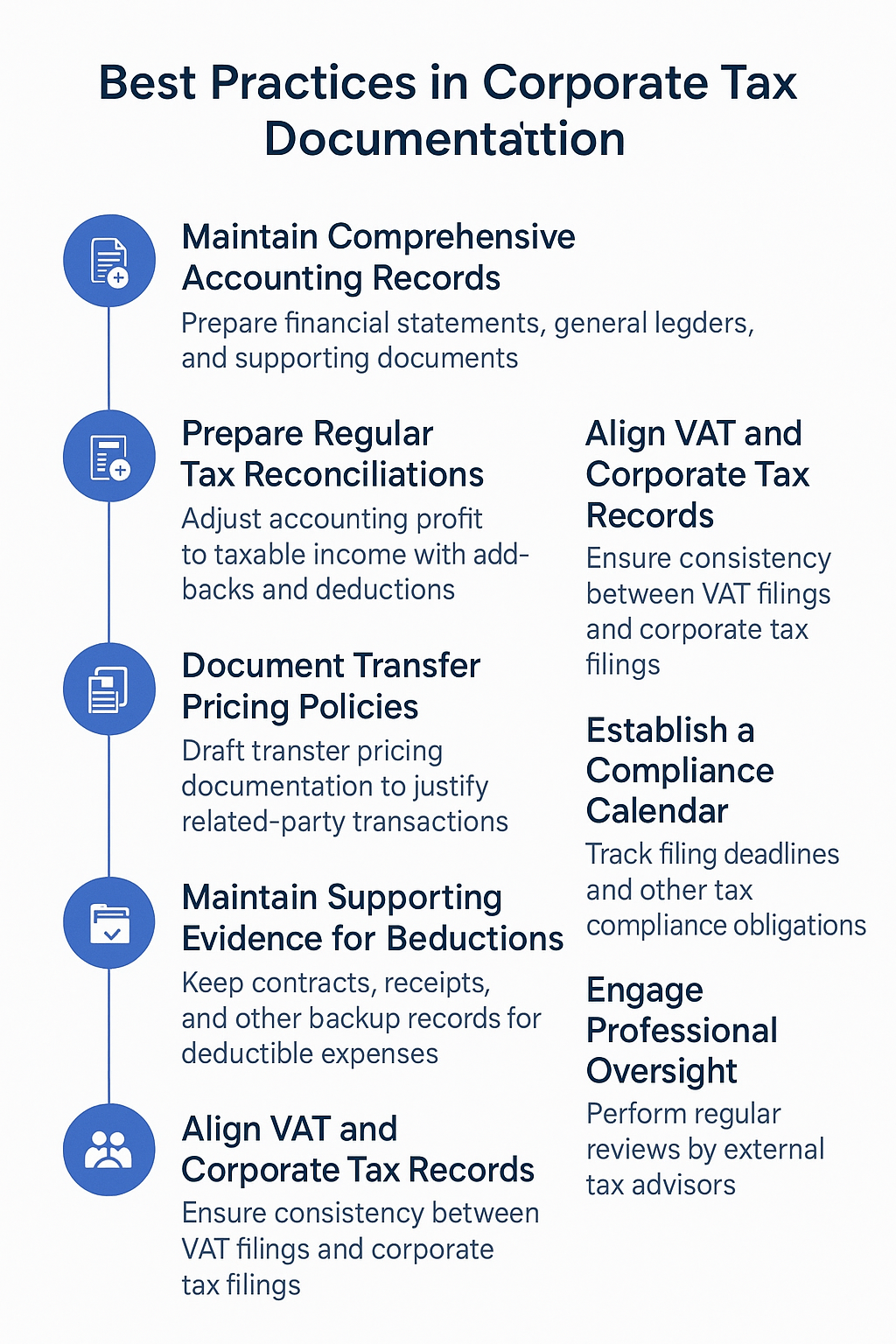
1. Maintain Comprehensive Accounting Records
A strong corporate tax filing starts with accurate financial statements. Businesses must ensure:
• IFRS Compliance: All financial statements are prepared as per International Financial Reporting Standards.
• Detailed Ledgers: Every transaction recorded with supporting documents like invoices, receipts, and contracts.
• Audit Trails: Easy traceability from financial statements to underlying records.
Example: A penalty of AED 100,000 recorded as an expense must have documentation proving its nature—this will also help in identifying it as non-deductible for tax purposes.
Best Practice: Invest in ERP or accounting systems with integrated tax modules for automated reporting and reconciliation.
________________________________________
2. Prepare Regular Tax Reconciliations
Tax reconciliation is the process of adjusting accounting profit to arrive at taxable income. Key adjustments include:
• Add-backs: Non-deductible expenses (penalties, entertainment, disallowed donations).
• Deductions: Exempt income such as dividends from qualifying shareholdings.
• Timing Differences: Differences between accounting depreciation and tax depreciation.
Example: If your books show AED 5,000,000 profit but AED 600,000 comes from exempt dividend income, your taxable base must be reduced accordingly.
Best Practice: Perform quarterly reconciliations instead of annual-only to reduce year-end pressure.
________________________________________
3. Document Transfer Pricing (TP) Policies
For businesses with related-party transactions, Transfer Pricing is a critical compliance requirement. UAE law, aligned with OECD guidelines, requires:
• Local File & Master File (for businesses crossing revenue thresholds).
• Benchmarking Studies to justify intercompany pricing.
• Contracts that reflect arm’s length terms.
Example: A facilities management company billing its sister concern must justify service fees with benchmarking reports.
Best Practice: Engage experts for TP studies early to avoid last-minute non-compliance penalties (up to AED 500,000).
________________________________________
4. Maintain Supporting Evidence for Deductions
Every deduction claimed in the CT return should have supporting proof.
• Interest expenses: Loan agreements, bank statements.
• R&D expenses: Technical reports, payroll breakdowns.
• Provisions: Board resolutions and evidence of expected losses.
Example: If claiming AED 1 million in R&D costs, detailed project reports should be available to justify tax deductibility.
Best Practice: Store all evidence (both physical and digital) for at least 7 years, as mandated by UAE regulations.
________________________________________
5. Align VAT and Corporate Tax Records
Most companies file VAT returns, and the same invoices form part of corporate tax documentation. Discrepancies can trigger audits.
• Cross-checking: Sales in VAT returns should match income in CT records.
• Consistency: Expense claims in VAT should align with corporate tax deductions.
Example: A sales invoice for AED 100,000 should appear in both VAT and CT records—any mismatch raises FTA queries.
Best Practice: Use a single document management system to store VAT and CT records together.
________________________________________
6. Establish a Compliance Calendar
Timeliness is crucial in corporate tax compliance. A compliance calendar should include:
• Corporate Tax registration deadlines.
• Return filing deadlines (9 months after year-end).
• VAT filing cycles (monthly/quarterly).
• Transfer Pricing disclosure dates.
Best Practice: Automate reminders using compliance software or accounting tools to avoid late filing penalties.
________________________________________
7. Engage Professional Oversight
While internal processes are important, independent oversight ensures quality.
• Tax Reviews: Annual review of tax documentation by external advisors.
• Training: Regular staff training on new FTA updates.
• Strategic Planning: Professional advice on tax-efficient structuring and loss utilisation.
Best Practice: Treat tax documentation as a strategic tool, not just a compliance task.
________________________________________
Conclusion
Corporate Tax documentation is the foundation of compliance under the UAE’s new tax regime. By maintaining clear accounting records, preparing reconciliations, documenting TP policies, aligning VAT and CT records, and establishing compliance calendars, businesses can reduce risks and optimise efficiency.
The goal is not only to stay compliant but also to use documentation as a strategic advantage—supporting tax planning, financial transparency, and business credibility.
________________________________________
How We Can Help
At Sheikh Anwar Accounting & Auditing LLC, we provide end-to-end support in corporate tax documentation, reconciliations, VAT alignment, and Transfer Pricing compliance. Our team ensures your records are complete, accurate, and audit-ready, helping you avoid penalties and optimise your tax position.
📩 Contact us at info@sa-auditors.com | 🌐 www.sa-auditors.com