Sample Corporate Tax Reconciliation Format
Introduction
Under the new UAE Corporate Tax regime, businesses must ensure that their accounting profit reported in financial statements is correctly adjusted to arrive at the taxable income for Corporate Tax purposes. This process is known as tax reconciliation.
Tax reconciliation is a critical step in Corporate Tax compliance because accounting standards (IFRS) and tax laws differ in their treatment of certain items. A well-prepared reconciliation provides transparency and helps avoid penalties during audits or FTA reviews.
________________________________________
What is Corporate Tax Reconciliation?
Corporate Tax Reconciliation is the process of aligning:
• Net profit (accounting basis) from audited financial statements, with
• Taxable income (tax basis) as defined under UAE Corporate Tax Law.
This reconciliation involves adding back non-deductible expenses, subtracting exempt income, and adjusting for temporary/timing differences.
________________________________________
Why is it Important?
1. Compliance – Ensures accuracy of corporate tax filings.
2. Transparency – Provides auditors and regulators with a clear trail.
3. Error Detection – Identifies misclassified expenses or missed deductions.
4. Audit Readiness – A structured reconciliation reduces disputes with the FTA.
________________________________________
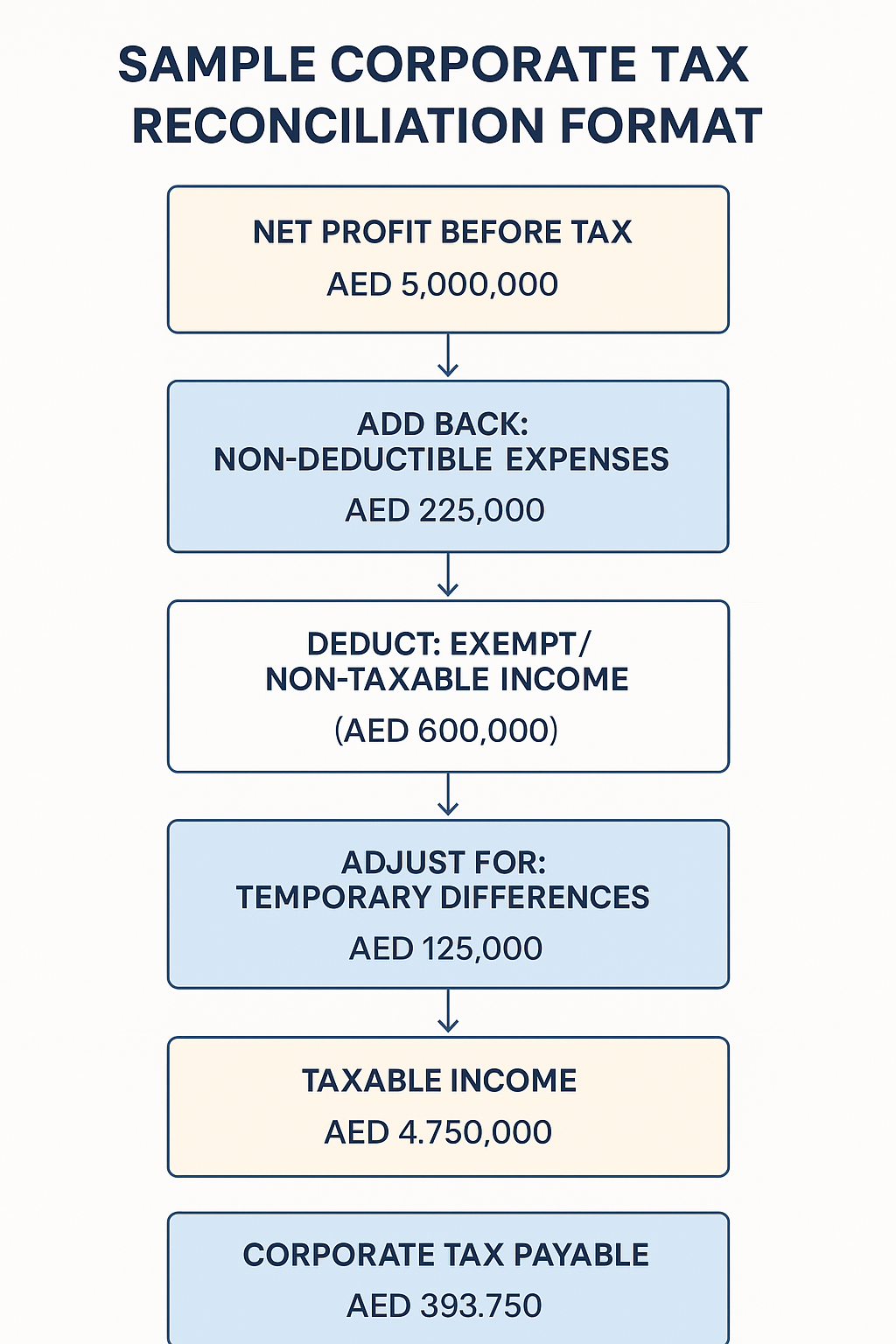
Sample Corporate Tax Reconciliation Format
Here’s a structured format businesses can follow:
Step 1: Start with Net Profit Before Tax
From the audited financial statements (prepared under IFRS).
Example:
Net Profit Before Tax (per financial statements): AED 5,000,000
________________________________________
Step 2: Add Back Non-Deductible Expenses
Certain expenses are not allowed under tax law.
• Penalties and fines: AED 100,000
• Entertainment expenses (non-deductible portion): AED 50,000
• Donations to unapproved entities: AED 75,000
Total Add-Backs: AED 225,000
________________________________________
Step 3: Deduct Exempt or Non-Taxable Income
Some income streams are exempt from Corporate Tax.
• Dividend income from qualifying shareholding: AED 400,000
• Income from foreign PE (exempted): AED 200,000
Total Deductions: AED 600,000
________________________________________
Step 4: Adjust for Temporary Differences
Timing differences between accounting and tax treatment:
• Depreciation difference (accounting vs. tax): +AED 50,000
• Provision for doubtful debts (allowed later): +AED 75,000
Net Adjustment: AED 125,000
________________________________________
Step 5: Arrive at Taxable Income
Net Profit Before Tax: AED 5,000,000
• Non-Deductible Expenses: AED 225,000
– Exempt Income: (AED 600,000)
• Temporary Differences: AED 125,000
Taxable Income: AED 4,750,000
________________________________________
Step 6: Apply Corporate Tax Rate
• 0% on first AED 375,000
• 9% on remaining AED 4,375,000
Corporate Tax Payable: AED 393,750
________________________________________
Final Reconciliation Table
Particulars Amount (AED)
Net Profit Before Tax (FS) 5,000,000
Add: Non-Deductible Expenses 225,000
Less: Exempt / Non-Taxable Income (600,000)
Add/Less: Temporary Differences 125,000
Taxable Income 4,750,000
Corporate Tax (0% up to 375,000; 9% thereafter) 393,750
________________________________________
Best Practices for Tax Reconciliation
1. Maintain Clear Documentation – Keep schedules for all adjustments.
2. Review Regularly – Conduct quarterly reconciliations, not just at year-end.
3. Separate Accounting vs. Tax Records – Avoid confusion between IFRS and CT adjustments.
4. Leverage Technology – Use accounting software or ERP with tax modules.
5. Engage Professionals – Seek guidance on complex items like transfer pricing, group relief, or foreign tax credits.
________________________________________
Conclusion
A structured Corporate Tax Reconciliation Format ensures businesses stay compliant with UAE Corporate Tax Law and avoid unnecessary penalties. It bridges the gap between financial reporting and tax computation, giving clarity to both management and regulators.
________________________________________
How We Can Help
At Sheikh Anwar Accounting & Auditing LLC, we assist businesses with corporate tax reconciliations, filing, and advisory services. Our experts prepare detailed reconciliations aligned with IFRS and UAE CT law, ensuring compliance and optimisation.
📩 Contact us at info@sa-auditors.com | 🌐 www.sa-auditors.com