Sample Corporate Tax Computation for UAE Entity
Introduction
With the introduction of the UAE Corporate Tax Law (Federal Decree-Law No. 47 of 2022), effective from 1 June 2023, businesses in the UAE must now calculate, report, and pay corporate tax in line with the Federal Tax Authority (FTA) guidelines.
Understanding the mechanics of corporate tax computation is crucial for ensuring compliance, avoiding penalties, and optimizing tax positions. This article provides a sample corporate tax computation for a UAE entity, highlighting key adjustments, exemptions, and reliefs available under the law.
Corporate Tax Rates in the UAE
0% – On taxable income up to AED 375,000 (to support SMEs and startups).
9% – On taxable income exceeding AED 375,000.
0% / Exempt – For qualifying free zone persons on qualifying income, subject to conditions.
Different rates – For certain large multinational enterprises (≥ EUR 750 million consolidated revenue), aligned with OECD Pillar Two rules (yet to be implemented fully).
Sample Case Study: Corporate Tax Computation
Company Profile:
Entity: ABC Trading LLC (Mainland UAE)
Financial Year: 1 Jan 2024 – 31 Dec 2024
Business: Wholesale trading of consumer goods
Net accounting profit before tax (as per financials): AED 1,500,000
Step 1: Adjust Net Profit for Tax Purposes
Start with accounting profit and make adjustments for non-deductible and exempt items:
Net Profit (before tax): AED 1,500,000
Add back (non-deductible expenses):
Entertainment expenses (50% disallowed): AED 20,000
Fines and penalties: AED 15,000
Donations to non-approved entities: AED 10,000
Total Add-Backs: AED 45,000
Adjusted Profit (Subtotal): AED 1,545,000
Less (exempt/relieved items):
Dividend income from UAE resident company: AED 100,000
Profit from foreign permanent establishment (eligible for exemption): AED 80,000
Total Deductions: AED 180,000
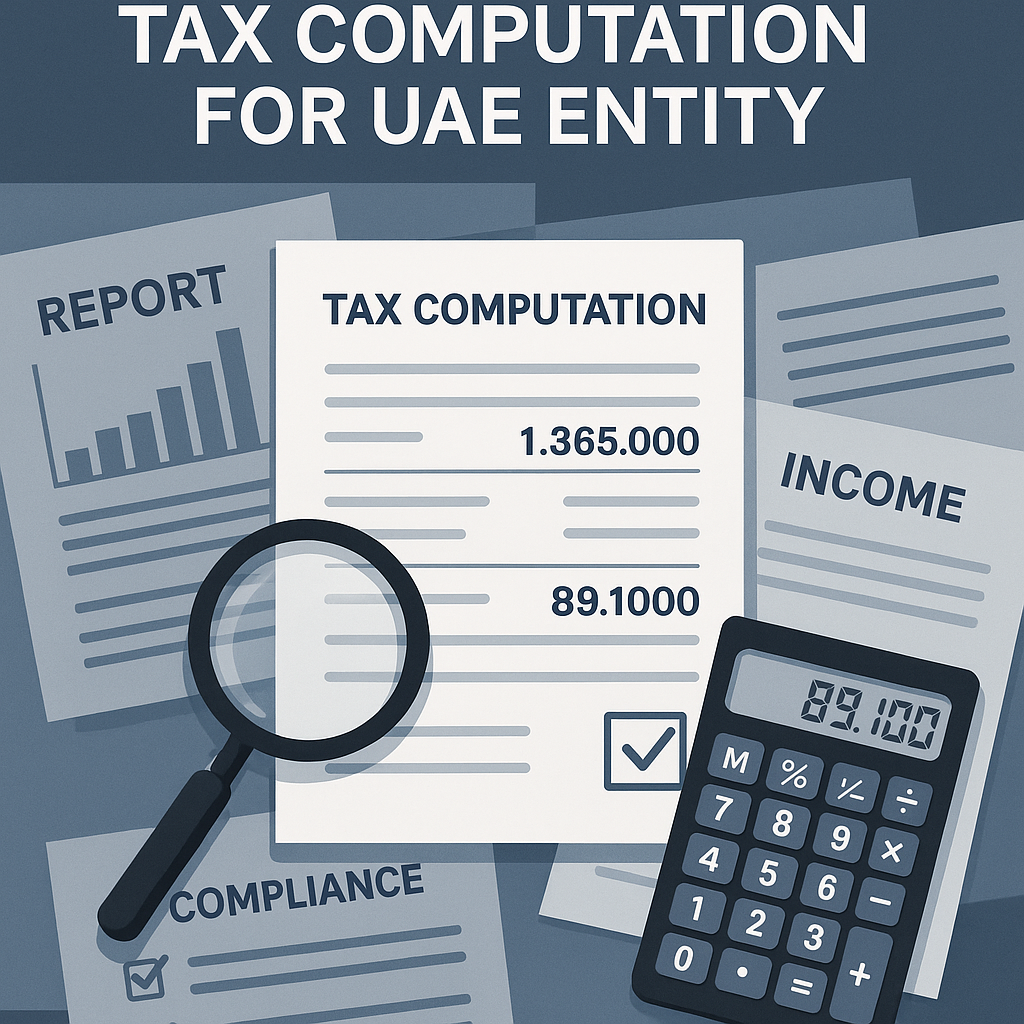
Taxable Income: AED 1,365,000
Step 2: Apply Corporate Tax Rates
0% on first AED 375,000 = AED 0
9% on remaining AED 990,000 (1,365,000 – 375,000) = AED 89,100
Corporate Tax Payable: AED 89,100
Key Considerations in UAE Tax Computation
Interest Deduction Limitation
Net interest expense is capped at 30% of EBITDA (with AED 12 million threshold).
Related Party Transactions & TP Adjustments
Intercompany dealings must comply with arm’s length principle and may require TP documentation.
Exempt Income
Dividends and capital gains from qualifying shareholdings.
Income from foreign permanent establishments (subject to conditions).
Tax Loss Relief
Tax losses can be carried forward and offset against up to 75% of future taxable income.
Group Relief & Transfers
Losses can be offset between group companies (≥75% ownership) under certain conditions.
Free Zone Entities
Qualifying Free Zone Persons (QFZPs) may benefit from 0% tax on qualifying income but must meet conditions (substance, TP compliance, and no election out).
Conclusion
Corporate tax computation in the UAE requires careful adjustment of accounting profits, proper identification of exempt income, and compliance with FTA rules on related-party transactions and documentation.
In our sample case, ABC Trading LLC with an accounting profit of AED 1.5 million ends up with a corporate tax liability of AED 89,100 after adjustments and exemptions.
Early preparation, robust documentation, and professional advice are essential for businesses to ensure accuracy and compliance with the UAE Corporate Tax regime.
✍️ Prepared by Sheikh Anwar Accounting and Auditing LLC – Registered Auditor with the Ministry of Economy (Auditor Entry No. 5817, Company Entry No. LC4695-01). We specialize in Corporate Tax, Transfer Pricing, VAT, and AML Compliance, helping UAE businesses with tax computation, filing, and advisory services.
📧 Contact us: info@sa-auditors.com
🌐 Visit us: www.sa-auditors.com