Role of MLRO in AML Compliance
Introduction
In today’s regulatory environment, businesses face increasing obligations to combat money laundering and terrorist financing. The Money Laundering Reporting Officer (MLRO) plays a central role in ensuring an organization’s compliance with Anti-Money Laundering (AML) regulations.
In the UAE, under Federal Decree-Law No. 20 of 2018 on AML/CTF, Cabinet Decision No. 10 of 2019, and sector-specific supervisory rules, appointing a qualified MLRO (or Compliance Officer) is mandatory for financial institutions and Designated Non-Financial Businesses and Professions (DNFBPs), such as jewellers, real estate firms, accountants, and law firms.
The MLRO is not only a compliance requirement—it is the backbone of an effective AML framework.
________________________________________
1. Appointment of the MLRO
• The MLRO must be formally appointed by the company’s senior management or board.
• The appointment should be documented in company records and communicated to regulators.
• The MLRO must have independence, authority, and access to resources to carry out their role effectively.
________________________________________
2. Core Responsibilities of the MLRO
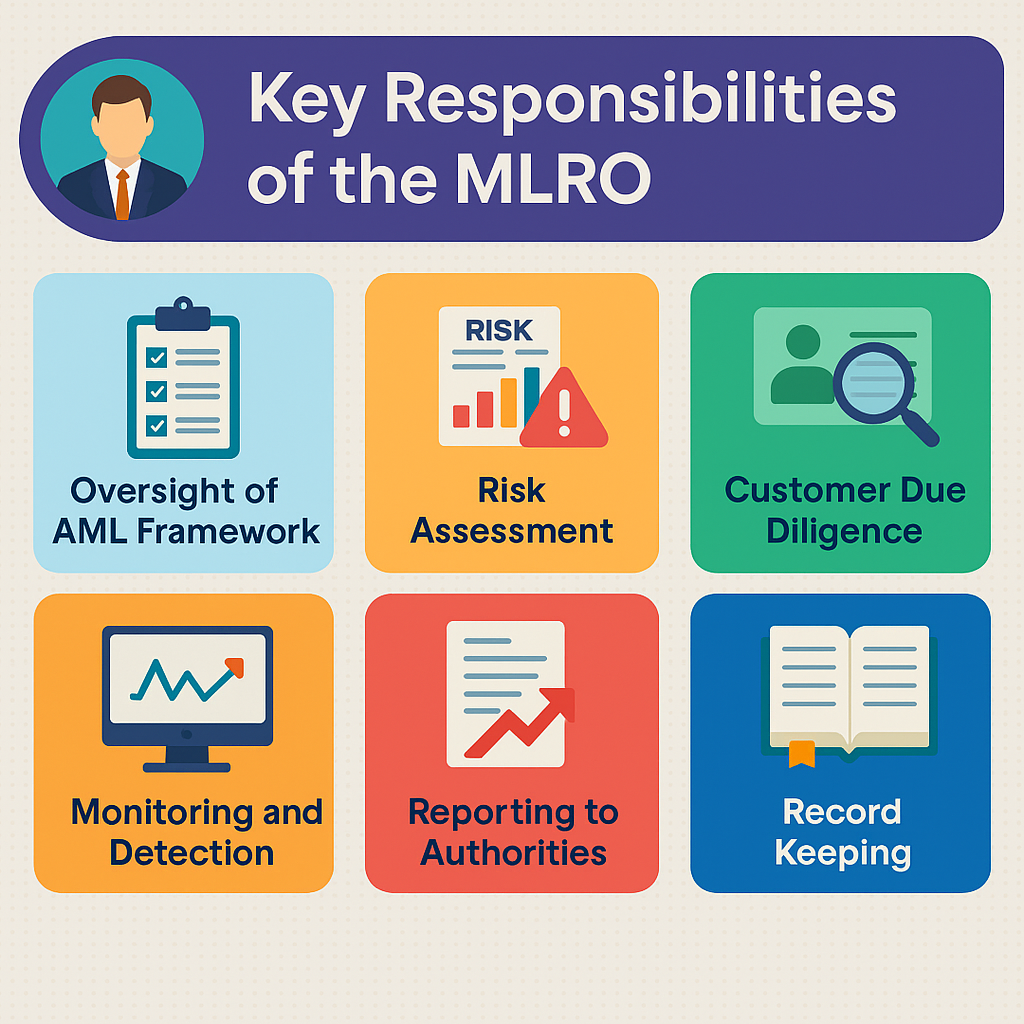
a) Oversight of AML Framework
The MLRO ensures the business has appropriate policies, controls, and procedures in place to detect and prevent money laundering and terrorist financing.
b) Risk Assessment
• Conducts enterprise-wide risk assessments.
• Identifies customer, product, geographic, and delivery channel risks.
• Advises management on risk mitigation strategies.
c) Customer Due Diligence (CDD)
• Ensures KYC processes are followed.
• Oversees UBO verification and application of Enhanced Due Diligence (EDD) for high-risk clients.
d) Monitoring and Detection
• Implements transaction monitoring systems to detect suspicious activity.
• Reviews unusual transactions flagged by staff or automated tools.
e) Reporting to Authorities
• Reviews and files Suspicious Transaction Reports (STRs), Large Cash Transaction Reports (LCTRs), and other mandatory reports via the goAML portal.
• Acts as the main point of contact with the UAE Financial Intelligence Unit (FIU).
f) Staff Training and Awareness
• Organizes regular AML training for employees.
• Ensures staff can identify red flags and know escalation procedures.
g) Internal and Regulatory Communication
• Reports regularly to senior management and the board on AML risks.
• Responds to requests from regulators during inspections or audits.
h) Record Keeping
• Ensures compliance with the requirement to retain records for at least five years.
________________________________________
3. Skills and Qualities of an Effective MLRO
• Strong regulatory knowledge of UAE AML/CTF laws and FATF standards.
• Analytical ability to assess complex transactions and ownership structures.
• Integrity and independence to act without bias.
• Communication skills to train staff, report to regulators, and advise management.
• Technological proficiency in AML/RegTech tools such as sanctions screening and transaction monitoring systems.
________________________________________
4. Challenges Faced by MLROs
The role of an MLRO is demanding and often carries personal accountability. Common challenges include:
• Balancing regulatory requirements with business growth.
• Managing the increasing complexity of cross-border transactions.
• Staying updated with constant changes in UAE AML laws and FATF guidelines.
• Handling large volumes of alerts and reports while ensuring quality and timeliness.
________________________________________
5. Importance of the MLRO Role in UAE DNFBPs
For DNFBPs in the UAE—such as gold and jewellery traders, real estate firms, lawyers, and accountants—the MLRO is particularly critical. These sectors are considered high risk for money laundering, making strong oversight a regulatory and reputational necessity.
________________________________________
Conclusion
The Money Laundering Reporting Officer is the cornerstone of AML compliance. By overseeing risk assessments, due diligence, monitoring, reporting, and staff training, the MLRO ensures that businesses remain compliant with UAE regulations and FATF standards.
More importantly, the MLRO helps safeguard the integrity of the business, preventing financial crime while fostering trust among clients, regulators, and international partners.
________________________________________
About Us
Sheikh Anwar Accounting and Auditing LLC is a leading auditing and compliance advisory firm in Dubai, specializing in AML frameworks, corporate tax, VAT, and transfer pricing. We assist businesses in appointing qualified MLROs, developing AML policies, and ensuring compliance with UAE regulations and FATF standards.
📍 Address: Dubai Creek Tower, M 35, Dubai, UAE
📞 Contact: info@sa-auditors.com | +971-XXX-XXXX
🌐 Website: www.sa-auditors.com