Role of Internal Audit in AML Compliance
Introduction
As regulatory expectations in the UAE continue to strengthen, businesses are under increasing pressure to ensure their Anti-Money Laundering (AML) frameworks are not only implemented but also tested for effectiveness. While Compliance Officers and MLROs are responsible for daily monitoring, the Internal Audit function plays a critical role in providing independent assurance that AML controls are working as intended.
________________________________________
1. Why Internal Audit Matters in AML
• Independent Oversight – Internal Audit provides an impartial evaluation of AML systems, independent from management.
• Regulatory Expectation – Federal Decree-Law No. 20 of 2018 and Cabinet Decision No. 10 of 2019 require businesses to demonstrate effectiveness of AML programs, not just have them documented.
• Risk-Based Assurance – Internal Audit ensures that high-risk areas (gold trading, real estate, cross-border payments, shell structures) receive the most scrutiny.
• Continuous Improvement – Audit findings drive policy updates, system enhancements, and training improvements.
________________________________________
2. Key Responsibilities of Internal Audit in AML
a) Review of AML Governance
• Verify that a Money Laundering Reporting Officer (MLRO) is appointed.
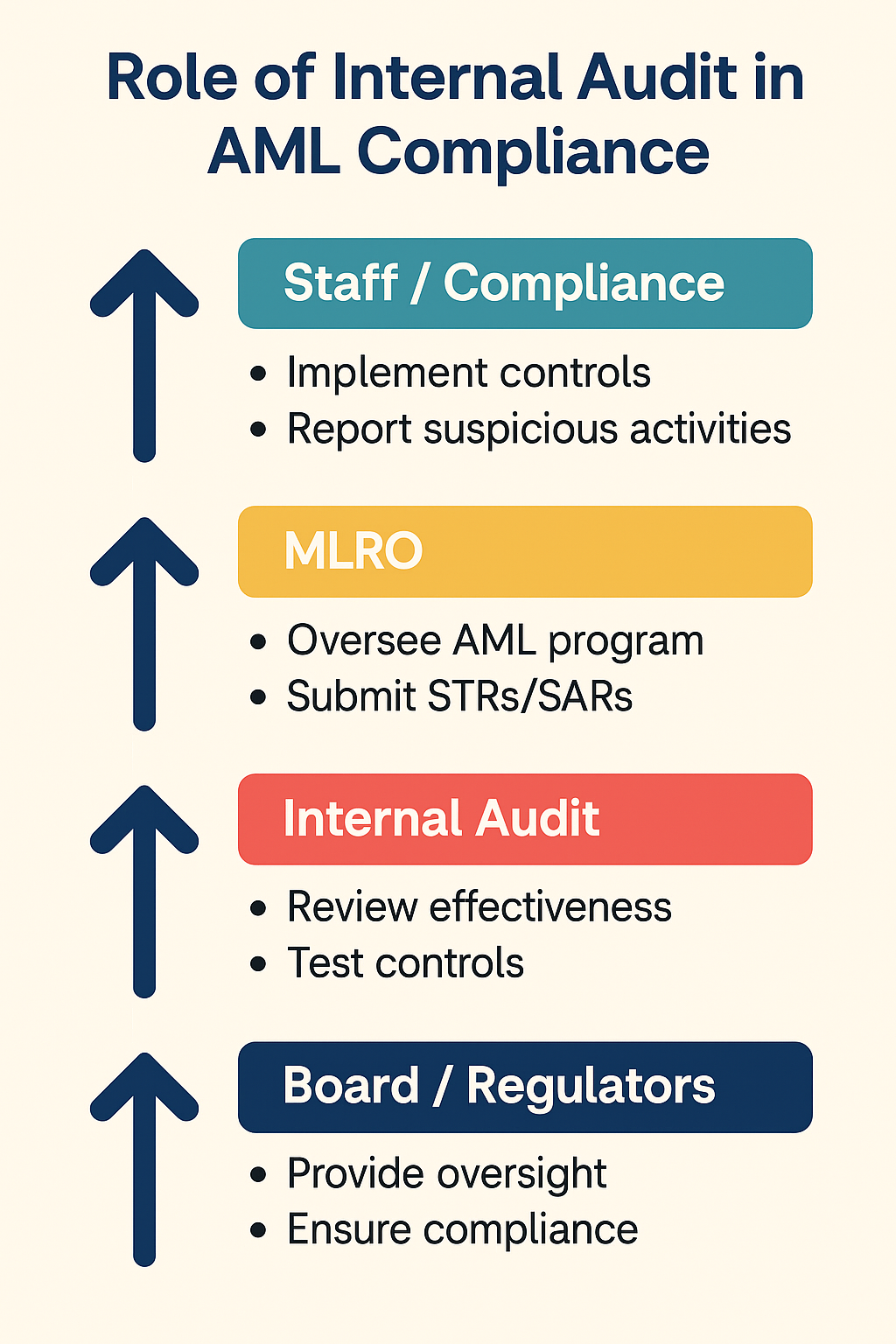
• Check reporting lines from staff → MLRO → senior management → Board.
• Confirm that AML responsibilities are clearly defined and resourced.
b) Evaluation of Policies & Procedures
• Ensure AML manuals and policies reflect UAE law and regulatory guidance (CBUAE, MoE, DFSA, FSRA).
• Confirm procedures for CDD, EDD, sanctions screening, and suspicious transaction reporting.
c) Testing Customer Due Diligence (CDD)
• Review sample customer files for proper KYC documentation (Emirates ID, trade license, UBO verification).
• Check that high-risk customers are subject to Enhanced Due Diligence (EDD).
d) Assessing Transaction Monitoring & Screening
• Test whether monitoring scenarios are effective in detecting suspicious patterns.
• Review sanctions/PEP screening for accuracy in both Arabic and English.
• Evaluate how false positives are managed.
e) Reviewing Suspicious Transaction Reporting
• Confirm internal escalation procedures are followed.
• Ensure STRs/SARs are filed on time via the goAML portal.
• Verify that DIFC/ADGM firms notify DFSA or FSRA after filing with the FIU.
f) Training & Awareness Checks
• Verify that staff receive periodic AML training.
• Assess whether training records are maintained and effectiveness measured.
g) Follow-Up & Remediation
• Track implementation of previous audit findings.
• Recommend corrective actions with deadlines.
________________________________________
3. Internal Audit vs. Compliance vs. MLRO
• Compliance/MLRO: Day-to-day responsibility for AML controls, reporting, and liaising with regulators.
• Internal Audit: Independent review of the compliance framework, ensuring it works effectively and aligns with UAE laws.
• Board & Senior Management: Ultimate accountability for AML, supported by assurance from Internal Audit.
________________________________________
4. Benefits of Internal Audit in AML Compliance
• Inspection Readiness – Firms with documented internal audit reviews are better prepared for MoE, CBUAE, DFSA, or FSRA inspections.
• Risk Mitigation – Early detection of control weaknesses prevents regulatory fines.
• Reputation Protection – Demonstrates a strong compliance culture to banks, investors, and regulators.
• Continuous Learning – Provides feedback loops for compliance officers and management.
________________________________________
5. UAE-Specific Expectations
• CBUAE-regulated entities: Must have independent audit functions that test AML frameworks.
• DNFBPs (under MoE): Increasingly required to show evidence of AML reviews or independent assurance.
• DIFC & ADGM entities: Required under DFSA and FSRA rulebooks to ensure independent review and board oversight of AML compliance.
________________________________________
Final Thoughts
The role of Internal Audit in AML compliance is more than a “check-the-box” exercise. It is about ensuring that compliance controls are effective, documented, and continuously improved. In the UAE’s tightening regulatory environment, businesses that integrate internal audit into their AML governance not only reduce risks but also strengthen their reputation and resilience.
________________________________________
📌 About Us
Sheikh Anwar Accounting and Auditing LLC – Registered Auditor (Ministry of Economy Entry No. 5817, Company Entry LC4695-01)
📍 Dubai Creek Tower, M 35, Dubai, UAE
🌐 Website: www.sa-auditors.com
📧 Email: info@sa-auditors.com
📞 Phone: +971-585621786