Role of Financial Statements in Tax Planning
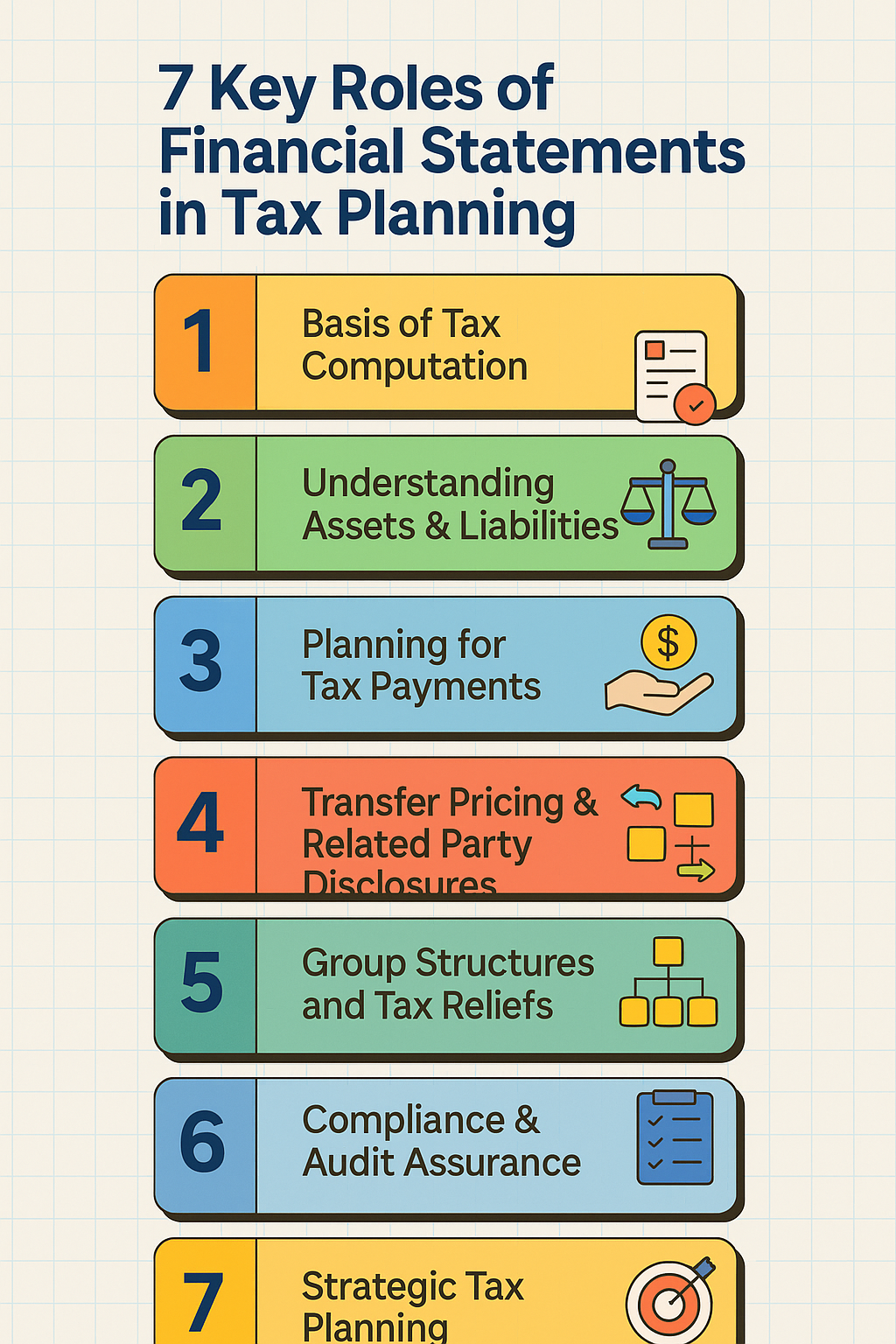
In today’s regulatory environment, financial statements are more than just compliance documents—they are the foundation of effective tax planning and corporate strategy. For businesses in the UAE, where Corporate Tax (CT) was introduced under Federal Decree-Law No. 47 of 2022, accurate financial reporting plays a critical role in determining tax liabilities, identifying opportunities for exemptions, and ensuring compliance with transfer pricing and group relief provisions.
Whether for mainland companies, free zone entities, or holding structures, financial statements directly influence tax outcomes and strategic decision-making.
________________________________________
1. Financial Statements as the Basis of Tax Computation
The Profit or Loss Statement (Income Statement) is the starting point for calculating Taxable Income under UAE CT law. However, adjustments are required to account for:
• Non-deductible expenses (e.g., fines, donations not meeting criteria).
• Exempt income (dividends from qualifying shareholdings, capital gains).
• Timing differences (depreciation vs. capital allowances).
Thus, accurate and compliant financial statements ensure that tax is calculated on the correct base.
________________________________________
2. Balance Sheet: Understanding Assets & Liabilities for Tax Purposes
The Balance Sheet provides vital data that shapes tax planning strategies:
• Depreciable Assets: Tax depreciation (capital allowances) can differ from accounting depreciation, impacting taxable profits.
• Provisions & Reserves: Some provisions (e.g., doubtful debts) may not be deductible unless conditions are met.
• Intercompany Balances: Loans and related-party payables are scrutinized under transfer pricing and thin capitalization rules.
• Equity Structure: Helps determine eligibility for dividend exemptions and capital gain relief.
________________________________________
3. Cash Flow Statement: Planning for Tax Payments
The Cash Flow Statement supports tax planning by:
• Highlighting operating cash inflows available to meet tax obligations.
• Identifying financing transactions (e.g., interest payments subject to limitation rules).
• Tracking investment flows, such as acquisitions or disposals of subsidiaries, which could trigger taxable or exempt gains.
Tax planning is not just about minimizing liability but also about ensuring liquidity for timely payments and avoiding penalties.
________________________________________
4. Transfer Pricing & Related Party Disclosures
Under UAE Corporate Tax Law, transfer pricing regulations require businesses to demonstrate that transactions with related parties are at arm’s length. Financial statements play a key role here because they:
• Provide visibility on intercompany sales, purchases, and loans.
• Disclose related party transactions and balances in the notes.
• Serve as the starting point for transfer pricing documentation (Local File, Master File).
Without proper disclosures, businesses risk adjustments, penalties, and disputes with the FTA.
________________________________________
5. Role in Group Structures and Tax Reliefs
For holding companies and corporate groups, consolidated or standalone financial statements determine:
• Eligibility for group relief (loss transfers, tax grouping).
• Verification of ownership thresholds (≥75% for group taxation).
• Tracking exempt income from subsidiaries.
Well-prepared financial statements make it easier to apply for intra-group exemptions and avoid unnecessary tax leakage.
________________________________________
6. Compliance & Audit Assurance
The FTA requires businesses exceeding certain thresholds to maintain audited financial statements. These not only ensure compliance but also provide:
• Credibility when claiming exemptions or reliefs.
• Assurance to stakeholders, including regulators, banks, and investors.
• Defensibility in the event of an audit or tax dispute.
________________________________________
7. Strategic Tax Planning through Financial Insights
Financial statements can reveal opportunities for proactive tax planning, such as:
• Optimizing expense structures to maximize deductions.
• Restructuring financing arrangements to comply with interest deduction caps.
• Identifying timing differences for better tax deferral.
• Assessing free zone eligibility by segregating qualifying vs non-qualifying income.
When used strategically, financial statements become a roadmap for tax efficiency rather than a year-end reporting exercise.
________________________________________
Conclusion
Financial statements are not just accounting outputs—they are the cornerstone of effective tax planning in the UAE. They influence every aspect of Corporate Tax, from calculating taxable income and claiming exemptions to planning cash flows and defending transfer pricing positions.
Businesses that maintain accurate, transparent, and well-structured financial statements will not only ensure compliance with the FTA but also gain a competitive advantage through tax-efficient strategies.
________________________________________
✍️ Sheikh Anwar Accounting & Auditing LLC
📍 Dubai, UAE | 🌐 www.sa-auditors.com
📧 info@sa-auditors.com