Role of Data Analytics in AML Risk Assessments
Introduction
Anti-Money Laundering (AML) compliance has become a central focus for regulators and businesses worldwide, particularly in the UAE where DNFBPs and financial institutions are under strict scrutiny. Traditional AML risk assessments—largely manual, checklist-driven, and static—are no longer sufficient in today’s complex financial ecosystem. Data analytics is transforming the way organizations identify, evaluate, and mitigate money laundering risks, bringing accuracy, efficiency, and actionable insights into compliance programs.
________________________________________
Why Data Analytics Matters in AML Risk Assessments
1. Volume and Complexity of Data
Businesses generate vast amounts of structured (transactions, customer data) and unstructured data (contracts, news articles). Manual methods cannot cope with this scale, while analytics can process and interpret it efficiently.
2. Dynamic Risk Environments
Risks change rapidly due to evolving typologies, cross-border trade, and digital assets. Data analytics allows businesses to update assessments continuously rather than relying on annual reviews.
3. Regulatory Expectations
Regulators expect risk-based approaches (RBA) supported by evidence. Data-driven assessments demonstrate to regulators that AML frameworks are robust and proactive.
________________________________________
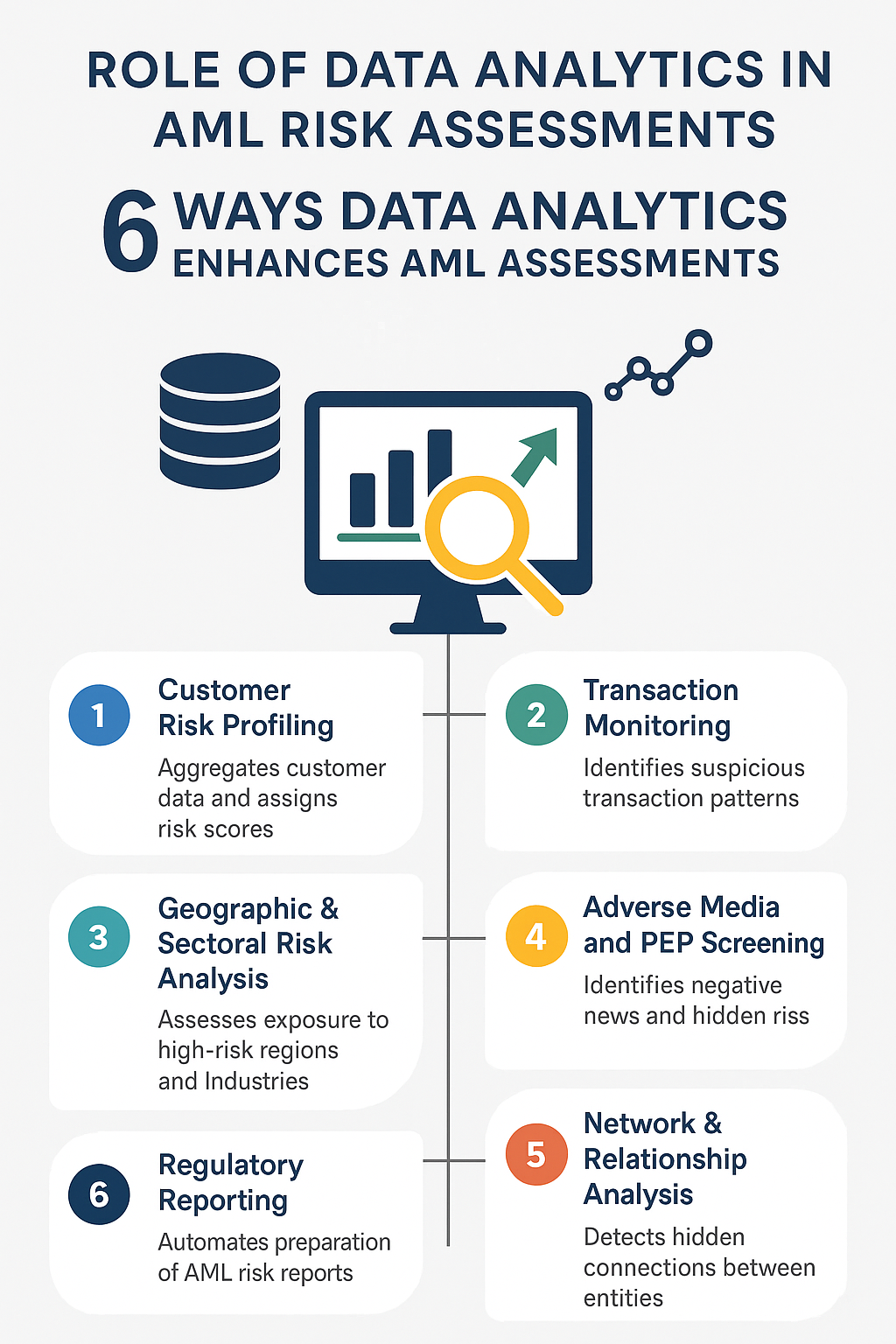
Applications of Data Analytics in AML Risk Assessments
1. Customer Risk Profiling
• Aggregates customer data (KYC, onboarding, transaction history).
• Assigns risk scores based on geography, industry, transaction volume, and behavior.
• Enables dynamic re-scoring when new information emerges.
2. Transaction Monitoring
• Identifies unusual or suspicious transaction patterns through predictive models.
• Detects anomalies such as structuring, rapid movement of funds, or deviations from peer group behavior.
• Prioritizes high-risk cases for compliance officers.
3. Geographic & Sectoral Risk Analysis
• Analytics tools integrate external data (FATF high-risk country lists, UAE FIU advisories).
• Helps assess exposure to high-risk jurisdictions or sectors such as real estate, gold, and virtual assets.
4. Adverse Media and PEP Screening
• Uses Natural Language Processing (NLP) to scan global news and identify negative associations with clients.
• Flags hidden risks that may not appear in sanctions lists.
5. Network & Relationship Analysis
• Visualizes connections between entities, accounts, and transactions.
• Detects hidden beneficial owners or collusion networks.
6. Regulatory Reporting
• Data analytics automates the preparation of AML risk reports.
• Provides dashboards that can be presented during regulatory inspections.
________________________________________
Benefits of Data Analytics in AML
• Accuracy – Reduces human error and subjectivity in assessments.
• Efficiency – Automates repetitive tasks, freeing staff for investigations.
• Proactive Risk Management – Identifies emerging risks before they escalate.
• Transparency – Clear audit trails and evidence for regulators.
• Cost-Effectiveness – Long-term savings through smarter resource allocation.
________________________________________
Challenges in Applying Data Analytics
1. Data Quality – Inaccurate or incomplete data limits effectiveness.
2. Integration Issues – Legacy systems may not integrate easily with analytics platforms.
3. Regulatory Concerns – Regulators demand transparency in analytics models.
4. Resource Needs – Requires skilled data analysts and compliance officers.
5. Over-Reliance on Technology – Must balance automation with human judgment.
________________________________________
Best Practices for UAE Businesses
• Centralize Data Sources – Consolidate KYC, transaction, and compliance data.
• Adopt Risk-Based Models – Tailor analytics to specific business risk profiles (e.g., gold traders vs. real estate firms).
• Ensure Explainability – Use models regulators can understand and validate.
• Regular Updates – Continuously refine models with new data and regulatory changes.
• Staff Training – Equip compliance officers with data literacy skills.
________________________________________
Future Outlook
• AI-Powered Predictive Analytics: Moving from detection to forecasting suspicious activities.
• Blockchain Integration: Using on-chain analytics to monitor cryptocurrency risks.
• RegTech Expansion: Integration of advanced data analytics into AML-specific software.
• Collaborative Intelligence: Shared data platforms across industries and regulators to enhance AML insights.
________________________________________
Conclusion
Data analytics is no longer a luxury in AML risk assessments—it is a necessity. By leveraging advanced analytics, UAE businesses can move beyond checklists to build dynamic, proactive, and regulator-approved compliance frameworks. Those who invest in data-driven AML risk assessments today will be better prepared for tomorrow’s regulatory and financial crime challenges.
________________________________________
About Us
Sheikh Anwar Accounting and Auditing LLC specializes in AML compliance, data-driven risk assessments, and outsourced MLRO services. We help UAE businesses integrate data analytics into AML programs, ensuring compliance with FIU, Central Bank, and international FATF standards.
📧 Email: info@sa-auditors.com
🌐 Website: www.sa-auditors.com
☎️ Contact: +971 4 123 4567