Role of Artificial Intelligence in AML Monitoring
Introduction
As financial crimes become increasingly complex, traditional Anti-Money Laundering (AML) systems often struggle to keep pace with evolving threats. Artificial Intelligence (AI) is transforming the way organizations detect and prevent money laundering by enhancing speed, accuracy, and efficiency. In jurisdictions like the UAE, where regulators emphasize proactive compliance, AI-driven monitoring solutions are becoming an essential part of the compliance ecosystem.
________________________________________
Why AI is Needed in AML Monitoring
1. Limitations of Traditional Rules-Based Systems
o High volumes of false positives drain compliance resources.
o Limited ability to detect new or evolving laundering techniques.
o Manual reviews slow down investigation and reporting.
2. Growing Data Complexity
o Businesses handle vast volumes of structured (transactions, KYC data) and unstructured data (emails, documents).
o AI provides the ability to analyze multiple data sources in real time.
3. Regulatory Expectations
o Regulators are encouraging adoption of technology-driven solutions for robust AML compliance.
o AI improves transparency and auditability of monitoring programs.
________________________________________
Key Applications of AI in AML Monitoring
1. Transaction Monitoring
AI models detect suspicious activity by analyzing customer behavior patterns instead of relying solely on fixed rules. For example:
• Identifying unusual fund transfers.
• Detecting structuring or “smurfing” activities.
• Cross-border movement anomalies.
2. Customer Risk Profiling
• Machine learning algorithms build dynamic customer risk scores.
• Profiles are updated in real time as new data (transactions, news, sanctions) becomes available.
3. Name Screening and KYC
• AI enhances screening against sanctions, PEP (Politically Exposed Person), and adverse media lists.
• Natural Language Processing (NLP) helps in understanding unstructured text like news reports for risk alerts.
4. Reducing False Positives
• AI refines alerts by learning from past investigation outcomes.
• Focuses compliance teams on genuine suspicious cases.
5. Predictive Analytics
• AI anticipates emerging risks by spotting unusual patterns before they escalate.
• Helps institutions act proactively, not reactively.
6. Case Management and Investigation Support
• AI assists compliance officers by prioritizing alerts, generating automated narratives, and suggesting next steps.
• Speeds up reporting of Suspicious Transaction Reports (STRs).
________________________________________
Benefits of Using AI in AML
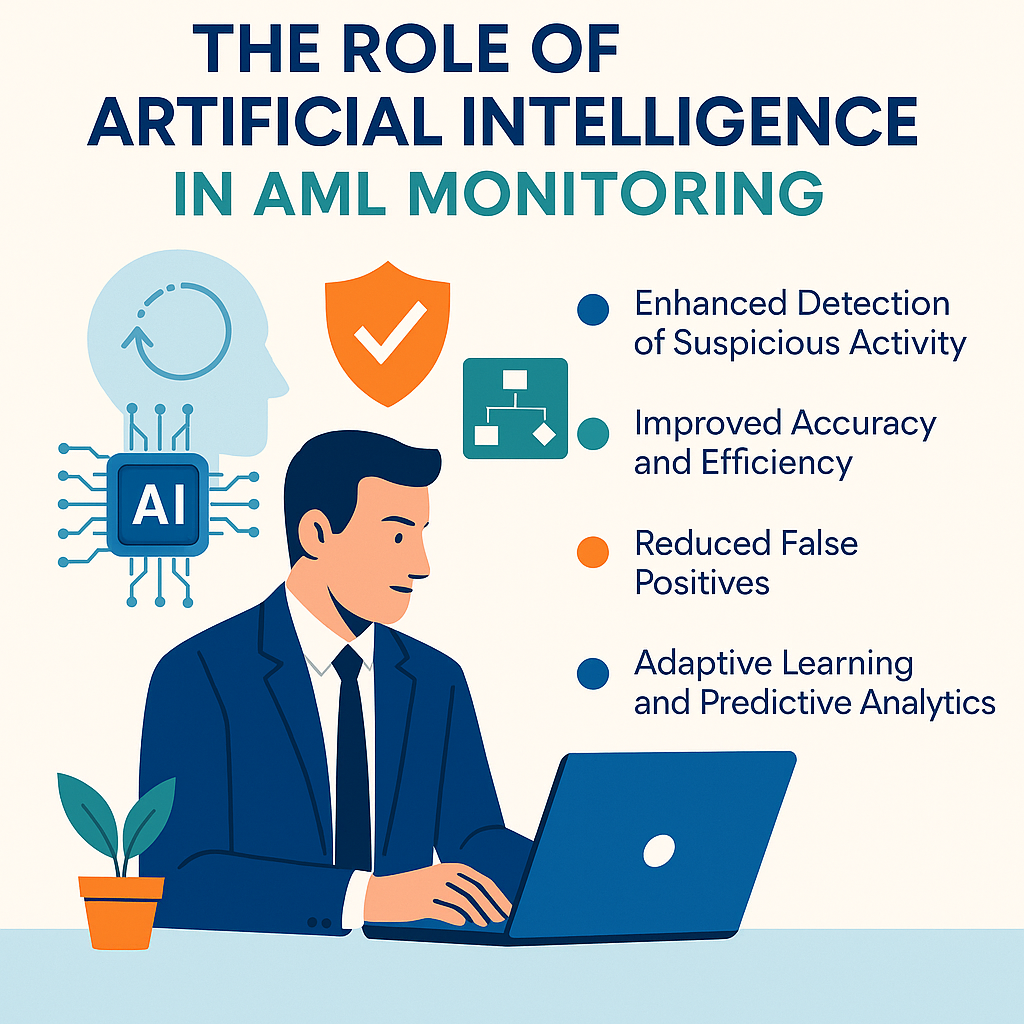
• Efficiency: Reduces time spent on manual reviews.
• Accuracy: Lowers false positives and improves detection rates.
• Scalability: Handles large data volumes effortlessly.
• Adaptability: Learns and evolves with new laundering techniques.
• Cost Savings: Optimizes compliance resources.
________________________________________
Challenges in Implementing AI for AML
1. Data Quality – AI systems are only as effective as the data they analyze.
2. Regulatory Acceptance – Regulators require transparency in how AI models work (“explainability”).
3. Integration Issues – Legacy systems may not align easily with AI solutions.
4. Cost of Implementation – High initial investment, especially for smaller firms.
________________________________________
Future of AI in AML Compliance
• Explainable AI (XAI): To meet regulatory transparency requirements.
• Integration with Blockchain Analytics: Enhancing monitoring of crypto transactions.
• Continuous Learning Systems: Adaptive models that evolve with new risks.
• Collaboration with Regulators: Shared AI tools for industry-wide AML improvements.
________________________________________
Conclusion
Artificial Intelligence is no longer a futuristic option — it is a necessity in the fight against money laundering and terrorist financing. By leveraging AI, compliance teams can shift from reactive investigations to proactive risk management, reducing both regulatory and reputational risks. While challenges remain, organizations that embrace AI-driven AML solutions will be better positioned to meet regulatory demands and protect the integrity of the financial system.
________________________________________
About Us
Sheikh Anwar Accounting and Auditing LLC specializes in AML compliance advisory, outsourced MLRO services, and implementation of technology-driven monitoring solutions. Our expertise helps businesses adopt AI-based AML monitoring frameworks tailored to UAE and international regulations.
📧 Email: info@sa-auditors.com
🌐 Website: www.sa-auditors.com
☎️ Contact: +971 4 123 4567