Reverse Charge vs Input VAT Recovery
Introduction
Freelancers, startups, and growing businesses often find UAE VAT compliance tricky—especially when dealing with cross-border transactions. Two commonly misunderstood concepts in this context are:
• The Reverse Charge Mechanism (RCM)
• Input VAT Recovery
While both deal with VAT accounting and reporting, they serve different purposes and apply under different circumstances. At Sheikh Anwar Accounting & Auditing LLC, we break down the distinction in simple yet technical terms to help you stay compliant and avoid costly errors.
________________________________________
🔁 What is Reverse Charge Mechanism (RCM)?
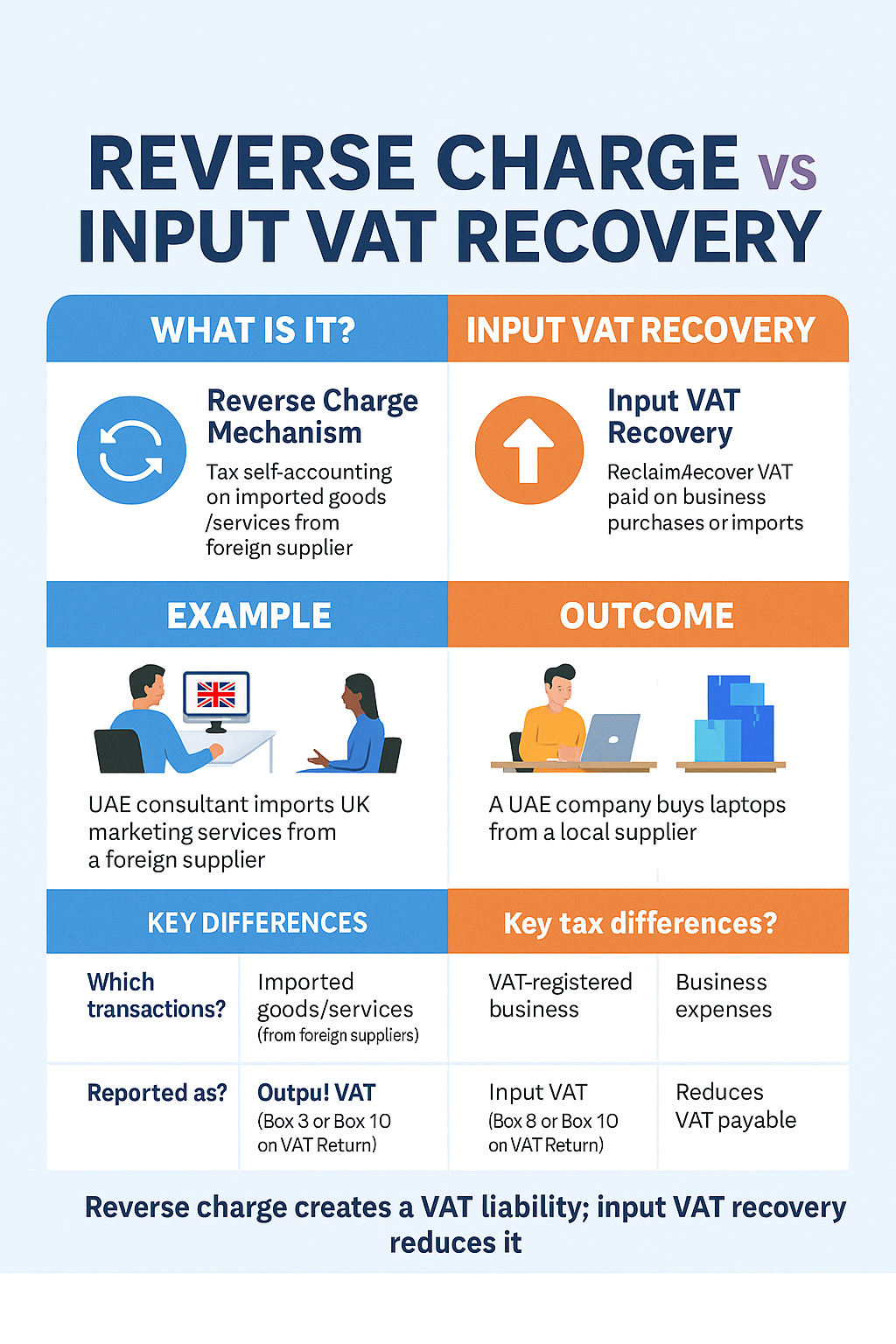
The Reverse Charge Mechanism is a VAT treatment where the recipient (importer) of a service or good is liable to account for VAT on behalf of the foreign supplier.
🧩 Why is it needed?
RCM is used when:
• The supplier is not registered for VAT in the UAE
• The recipient is VAT-registered in the UAE
• The transaction involves imported services or goods
This ensures VAT is collected even when the supplier is outside the UAE jurisdiction.
📜 Legal Reference:
Federal Decree-Law No. 8 of 2017, Article 48:
The recipient of a taxable supply shall be responsible for calculating and reporting the tax under RCM if the supplier is not UAE VAT-registered.
________________________________________
💼 Example 1: Reverse Charge in Action
A Dubai-based VAT-registered consultant purchases marketing services from a UK agency. The UK supplier is not VAT-registered in the UAE.
✅ The UAE consultant must:
• Self-account for 5% VAT on the value of the invoice
• Report it as output VAT under Box 3 in the VAT return
________________________________________
💰 What is Input VAT Recovery?
Input VAT Recovery refers to the mechanism through which a VAT-registered person can reclaim VAT paid on eligible business expenses or imports.
This is a separate process from RCM, and applies to both:
• VAT paid to UAE suppliers
• VAT accounted for under RCM (in some cases)
________________________________________
✅ Conditions for Input VAT Recovery:
According to Article 54 of the UAE VAT Law, the following must be satisfied:
• The purchased goods/services are used for taxable supplies
• The VAT invoice is properly documented
• The expense is not explicitly blocked (e.g., entertainment, motor vehicles for personal use)
________________________________________
📤 Example 2: Input VAT Recovery Scenario
A VAT-registered software company purchases laptops for developers and pays AED 5,000 in VAT to a local supplier.
✅ If the laptops are used for taxable activities:
• The AED 5,000 VAT is reported as Input VAT under Box 10 in the VAT return
• It reduces the net VAT payable
________________________________________
🔄 How RCM & Input VAT Recovery Interact
In many RCM transactions, the same person:
• Pays the output VAT via self-assessment (RCM)
• Recovers the input VAT in the same return (if eligible)
🔄 Example 3: RCM + Input VAT Recovery
• A UAE design firm buys online design software from the USA for AED 10,000
• It applies RCM (5% of AED 10,000 = AED 500 output VAT)
• Since it uses the software for its taxable services, it can recover the same AED 500 as input VAT
📊 The net effect on the VAT return = Zero, but reporting is mandatory.
________________________________________
🚫 Common Mistakes to Avoid
Mistake Why It's a Problem
Failing to apply RCM on imports Leads to underreporting and penalties
Trying to recover VAT on ineligible expenses Risk of rejection during audit
Confusing RCM as a recovery mechanism RCM creates a liability first; recovery is separate
________________________________________
🧠 Summary: Key Differences
Feature Reverse Charge Mechanism (RCM) Input VAT Recovery
Purpose Tax self-accounting for imports Reclaim tax paid on purchases
Applies to Imported goods/services from non-VAT suppliers Eligible business expenses
Requires VAT registration? Yes Yes
Reported as Output VAT (Box 3) Input VAT (Box 10)
Net tax effect Often neutral if recovered Reduces VAT payable
________________________________________
🧾 Final Thoughts from Sheikh Anwar Accounting & Auditing LLC
Understanding the distinction between RCM and Input VAT Recovery is essential for accurate VAT reporting and audit readiness. While they often appear together in cross-border transactions, they play different roles and must be accounted for correctly in the VAT return.
🔍 Need help reviewing your VAT return or understanding RCM implications?
📩 Contact us today at info@sa-auditors.com or visit www.sa-auditors.com