Restructuring to Minimize Tax Liability
Introduction
In today’s evolving business landscape, companies are under constant pressure to reduce costs, improve efficiency, and remain compliant with tax regulations. One of the most effective strategies to achieve this is corporate restructuring with a focus on tax optimization.
Restructuring is not merely about reorganization—it is a strategic move to align business operations with tax efficiency, compliance, and long-term growth objectives.
________________________________________
What is Tax-Focused Restructuring?
Tax-focused restructuring involves reorganizing a company’s structure, ownership, or operations to achieve lower tax liabilities while staying compliant with the law. It can range from mergers, acquisitions, and spin-offs to changing legal entity types, relocating business activities, or creating holding structures.
The key goal is to minimize the overall effective tax rate, ensure compliance with local and international regulations, and improve cash flow for reinvestment.
________________________________________
Why Businesses Opt for Restructuring to Reduce Tax Burden
1. Changing Tax Laws
With the introduction of UAE Corporate Tax (9%) and global measures like OECD BEPS rules, many businesses need to rethink their entity structures.
2. Cross-Border Operations
Companies with international presence often restructure to take advantage of double tax treaties, low-tax jurisdictions, and efficient repatriation of profits.
3. Mergers & Acquisitions (M&A)
During M&A, restructuring ensures that the deal is tax-neutral and does not result in unexpected liabilities.
4. Free Zone vs Mainland Strategy
Many UAE businesses restructure to qualify as a Qualifying Free Zone Person (QFZP) to enjoy 0% tax on eligible income.
5. Succession & Estate Planning
Ownership restructuring helps in smooth transition to heirs, while minimizing inheritance or capital gains tax exposure.
________________________________________
Key Methods of Restructuring for Tax Minimization
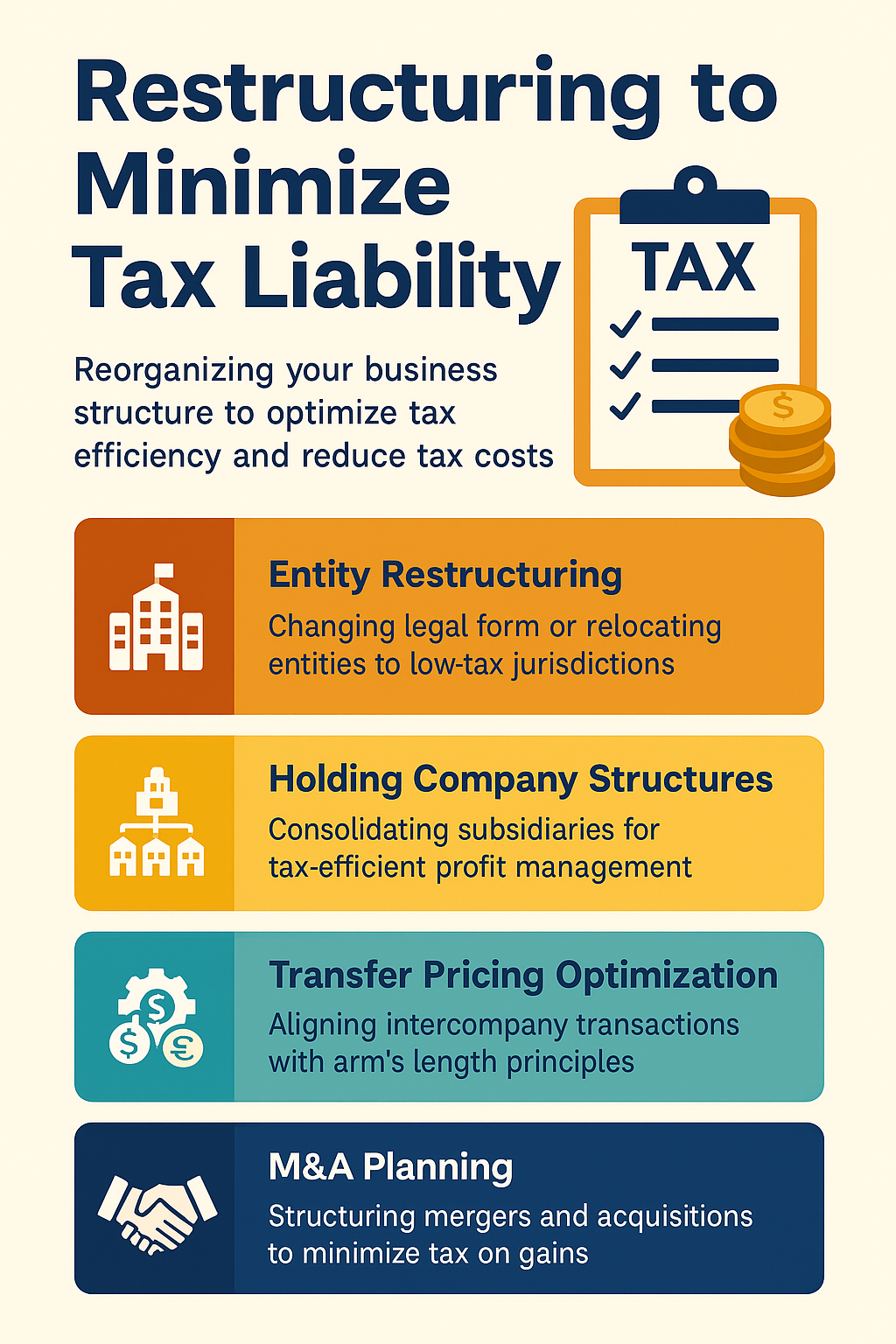
1. Entity Restructuring
• Converting from a sole proprietorship to an LLC for liability protection and better tax planning.
• Re-domiciling entities from high-tax to low-tax jurisdictions like UAE Free Zones.
2. Holding Company Structures
• Establishing a holding company to consolidate profits and manage subsidiaries.
• Facilitates tax-efficient dividend distribution and protection against double taxation.
3. Transfer Pricing Optimization
• Aligning intercompany transactions with arm’s length principles.
• Helps avoid penalties and ensures tax deductibility of expenses.
4. Mergers & Acquisitions (M&A) Planning
• Structuring M&A deals in a way that carries forward losses, optimizes goodwill, and avoids capital gains tax.
• Ensuring compliance with anti-avoidance rules during asset transfers.
5. Debt vs Equity Restructuring
• Optimizing the balance between loans and share capital to maximize interest deductibility under UAE tax rules.
• Avoiding thin capitalization issues and related-party transaction disallowances.
6. Cross-Border Restructuring
• Shifting intellectual property (IP) or headquarters to tax-efficient jurisdictions.
• Leveraging Double Tax Treaties to reduce withholding tax on dividends, royalties, and interest.
________________________________________
Tax Risks to Watch Out For
While restructuring can save significant tax, it must be carried out with caution:
• General Anti-Avoidance Rules (GAAR): Transactions must have a commercial purpose, not just tax reduction.
• Economic Substance Regulations (ESR): UAE entities must prove real activities in the jurisdiction.
• PoEM (Place of Effective Management): Tax residency rules can trigger taxation in unintended jurisdictions (e.g., India).
• Transfer Pricing Scrutiny: Authorities increasingly focus on related-party arrangements.
________________________________________
Best Practices for Successful Tax Restructuring
1. Conduct a Tax Impact Assessment – Review current and future tax exposures.
2. Seek Double Tax Treaty Benefits – But ensure compliance with substance requirements.
3. Document Everything – Maintain proper agreements, board resolutions, and transfer pricing reports.
4. Regularly Review Structures – Laws change frequently; a structure effective today may not be optimal tomorrow.
5. Engage Experts – Professional tax and legal advisors ensure compliance while achieving efficiency.
________________________________________
Conclusion
Tax restructuring is not a one-time fix but an ongoing strategy. By carefully selecting the right entity type, optimizing group structures, and aligning operations with tax laws, businesses can significantly reduce liabilities while staying compliant.
In the UAE, where corporate tax is still new, businesses that restructure early will gain a competitive edge—optimizing taxes today while preparing for global regulatory shifts tomorrow.
________________________________________
📌 Sheikh Anwar Accounting & Auditing LLC
📧 info@sa-auditors.com
🌐 www.sa-auditors.com