Reporting Lines in AML Governance
Introduction
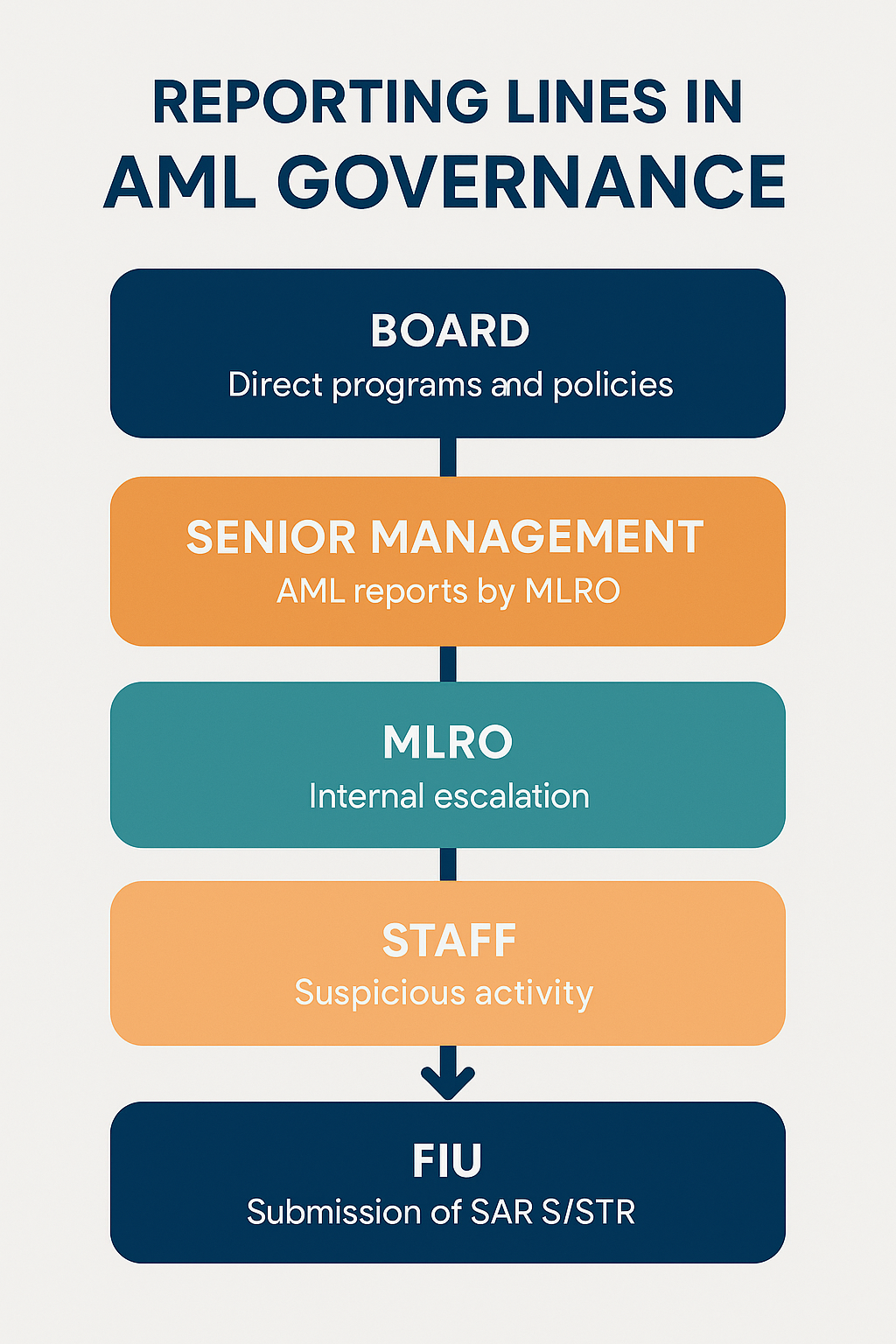
A strong Anti-Money Laundering (AML) program does not depend only on written policies or technical tools—it also relies heavily on clear governance and reporting lines. Regulators in the UAE, including the Central Bank, Ministry of Economy, DFSA (DIFC), and FSRA (ADGM), expect organizations to show how AML responsibilities are allocated, escalated, and overseen at every level.
This explains what AML reporting lines are, why they matter, and how UAE businesses—particularly Financial Institutions (FIs) and DNFBPs—can implement them effectively.
________________________________________
1. Why Reporting Lines Matter in AML
• Regulatory expectation – Federal Decree-Law No. 20 of 2018 and Cabinet Decision No. 10 of 2019 require businesses to have a designated Compliance Officer/MLRO with authority to report to senior management and regulators.
• Accountability – Clear reporting ensures responsibilities are not diluted across departments.
• Escalation – Suspicious activity must flow quickly from frontline staff to the MLRO and then to the UAE FIU through goAML.
• Governance assurance – Boards and senior management are ultimately responsible for AML, and regulators want evidence that they receive timely, accurate reports.
________________________________________
2. Typical AML Reporting Lines
a) Frontline / Business Units
• Customer-facing teams (trading desks, sales, operations, branch staff, real estate brokers, gold & jewellery traders) are the first line of defense.
• They must escalate unusual or suspicious activity to compliance/MLRO promptly.
b) Compliance Officer / MLRO
• The Money Laundering Reporting Officer (MLRO) or Compliance Officer is the focal point of AML governance.
• Responsibilities:
o Reviewing internal reports.
o Deciding whether to file Suspicious Transaction Reports (STRs) via goAML.
o Coordinating with regulators during inspections.
o Reporting to senior management and the board.
c) Senior Management
• Must receive regular compliance reports from the MLRO (monthly/quarterly).
• Approves AML policies, risk assessments, and training frameworks.
• Responsible for resourcing the compliance function.
d) Board of Directors
• The Board has ultimate oversight of AML governance.
• Required to approve AML policies, risk appetite statements, and ensure that the compliance function is independent and empowered.
• Boards in the UAE are expected to review AML testing results and remediation progress.
________________________________________
3. Escalation Path of a Suspicious Activity Report (SAR/STR)
1. Frontline detection (e.g., unusual transaction, inconsistent KYC documents).
2. Internal escalation to MLRO/Compliance Officer.
3. Assessment & documentation by MLRO.
4. Submission via goAML portal to the UAE FIU.
5. Board/senior management notification (without tipping-off the client).
6. If DIFC/ADGM entity – parallel notification to DFSA or FSRA as required.
________________________________________
4. Best Practices for Reporting Lines in AML
• Direct access to senior management – MLRO should not be buried under multiple managerial layers.
• Independence – Compliance officers must have authority to challenge business decisions without interference.
• Written documentation – Reporting structures must be clearly described in the AML Policy/Manual.
• Periodic board reporting – AML compliance should be a standing agenda item at board meetings.
• Alternate reporting officers – Appoint deputies to ensure continuity if the MLRO is unavailable.
________________________________________
5. UAE-Specific Expectations
• Financial Institutions (CBUAE-supervised): MLROs must be senior staff with sufficient authority and experience.
• DNFBPs (Ministry of Economy): Must appoint an AML Compliance Officer and maintain direct reporting lines to management.
• DIFC & ADGM entities: Obliged to notify both the FIU (via goAML) and their respective regulators (DFSA or FSRA) after filing a suspicious activity report.
• Multi-group structures: Group compliance functions may exist, but UAE-licensed entities must have their own local MLRO with direct reporting lines.
________________________________________
Final Thoughts
Clear reporting lines in AML governance are essential to demonstrate a culture of compliance. The UAE regulators want proof that compliance officers are not symbolic but have the authority, resources, and independence to escalate issues directly to top management and the FIU. Businesses that implement robust reporting structures will not only meet regulatory expectations but also strengthen trust with stakeholders and counterparties.
________________________________________
📌 About Us
Sheikh Anwar Accounting and Auditing LLC – Registered Auditor (Ministry of Economy Entry No. 5817, Company Entry LC4695-01)
📍 Dubai Creek Tower, M 35, Dubai, UAE
🌐 Website: www.sa-auditors.com
📧 Email: info@sa-auditors.com
📞 Phone: +971-585621786