Red Flags for Shell Companies in UAE
Introduction
The UAE has rapidly evolved into a global business hub, offering unmatched opportunities for entrepreneurs and investors. However, this same environment can be misused by shell companies—entities that exist only on paper, with no real commercial operations. These companies pose serious risks of money laundering, terrorist financing, tax evasion, and fraud.
Recognizing the red flags is essential for compliance officers, auditors, financial institutions, and regulators to safeguard against misuse.
________________________________________
1. Incorporation-Related Red Flags
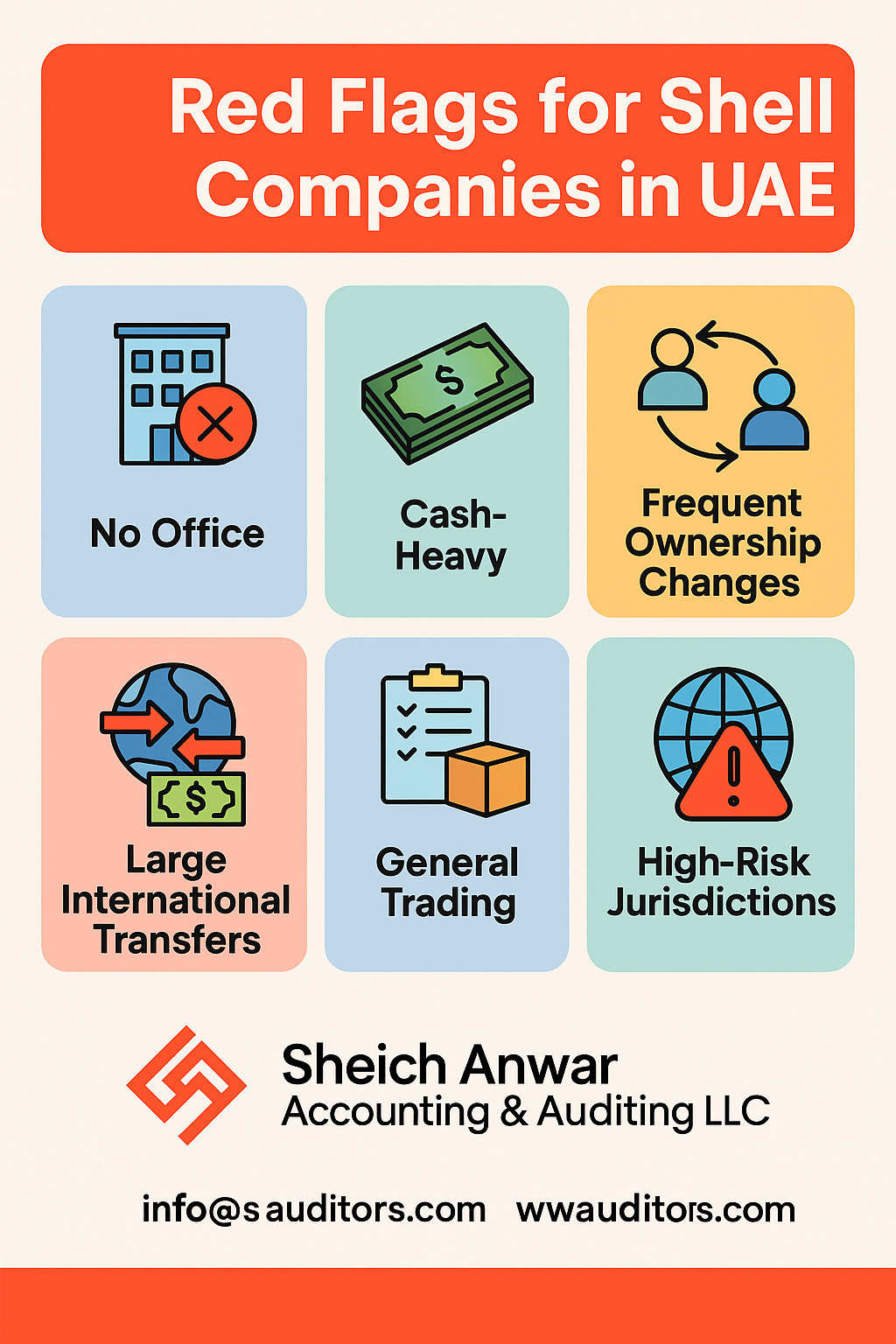
• Companies registered at the same address without genuine physical offices.
• Frequent changes in directors, shareholders, or authorized signatories.
• Ownership through nominees or complex layered structures to obscure the Ultimate Beneficial Owner (UBO).
• Registration in free zones with lighter oversight but no commercial justification.
________________________________________
2. Financial & Transactional Red Flags
• Minimal or no capital investment despite claiming large-scale operations.
• Large international fund transfers with little or no UAE-based revenue.
• Circular money movements (funds in and out without commercial rationale).
• Use of multiple bank accounts across different institutions with inconsistent activity.
________________________________________
3. Operational Red Flags
• No employees, staff, or physical presence.
• Websites that are incomplete, copied, or inactive.
• Outsourcing of all business functions with no internal control.
• Lack of valid contracts, invoices, or supporting trade documentation.
________________________________________
4. Trade & Customs Red Flags
• Trade volumes inconsistent with the company’s stated business profile.
• Import/export transactions at prices far above or below market rates.
• Continuous dealings with high-risk jurisdictions or FATF-listed countries.
• Involvement of unnecessary intermediaries or third parties.
________________________________________
5. Compliance & Governance Red Flags
• Delay or refusal to provide KYC or UBO documents.
• Non-compliance with UAE Economic Substance Regulations (ESR).
• Frequent late or missing tax/regulatory filings.
• Mismatch between audited financial statements and actual operations.
________________________________________
6. UAE-Specific Shell Company Indicators
• Entities incorporated in multiple free zones but without actual offices.
• Businesses registered as “general trading” with no defined products or markets.
• Heavy reliance on cash transactions in industries where digital payments are standard.
• Use of PO box or virtual addresses as the sole business location.
• Acting as conduits for moving funds between related parties without substance.
________________________________________
7. How to Mitigate These Risks
• Conduct Enhanced Due Diligence (EDD) and continuous AML monitoring.
• Verify UBOs in line with UAE AML laws (Federal Decree-Law No. 20 of 2018, Cabinet Decision No. 109 of 2023).
• Use AML screening and transaction monitoring tools (e.g., MyAML.io).
• Align operations with UAE ESR, AML/CFT frameworks, and Corporate Tax laws.
• Train staff to identify and escalate potential shell company activity.
________________________________________
✅ Conclusion
Shell companies are a major compliance challenge in the UAE. By proactively identifying these red flags, businesses, banks, and compliance teams can protect themselves against financial crime risks, regulatory penalties, and reputational damage.
________________________________________
📌 About Us
At Sheikh Anwar Accounting & Auditing LLC, we specialize in AML compliance, corporate tax advisory, audit, and risk assessment services across the UAE. With extensive experience in high-risk industries like gold, jewellery, and real estate, we help businesses stay compliant and resilient.
📧 Email: info@sa-auditors.com
🌐 Website: www.sa-auditors.com