Recovering VAT on Bad Debts: Procedure and Criteria in the UAE
Introduction
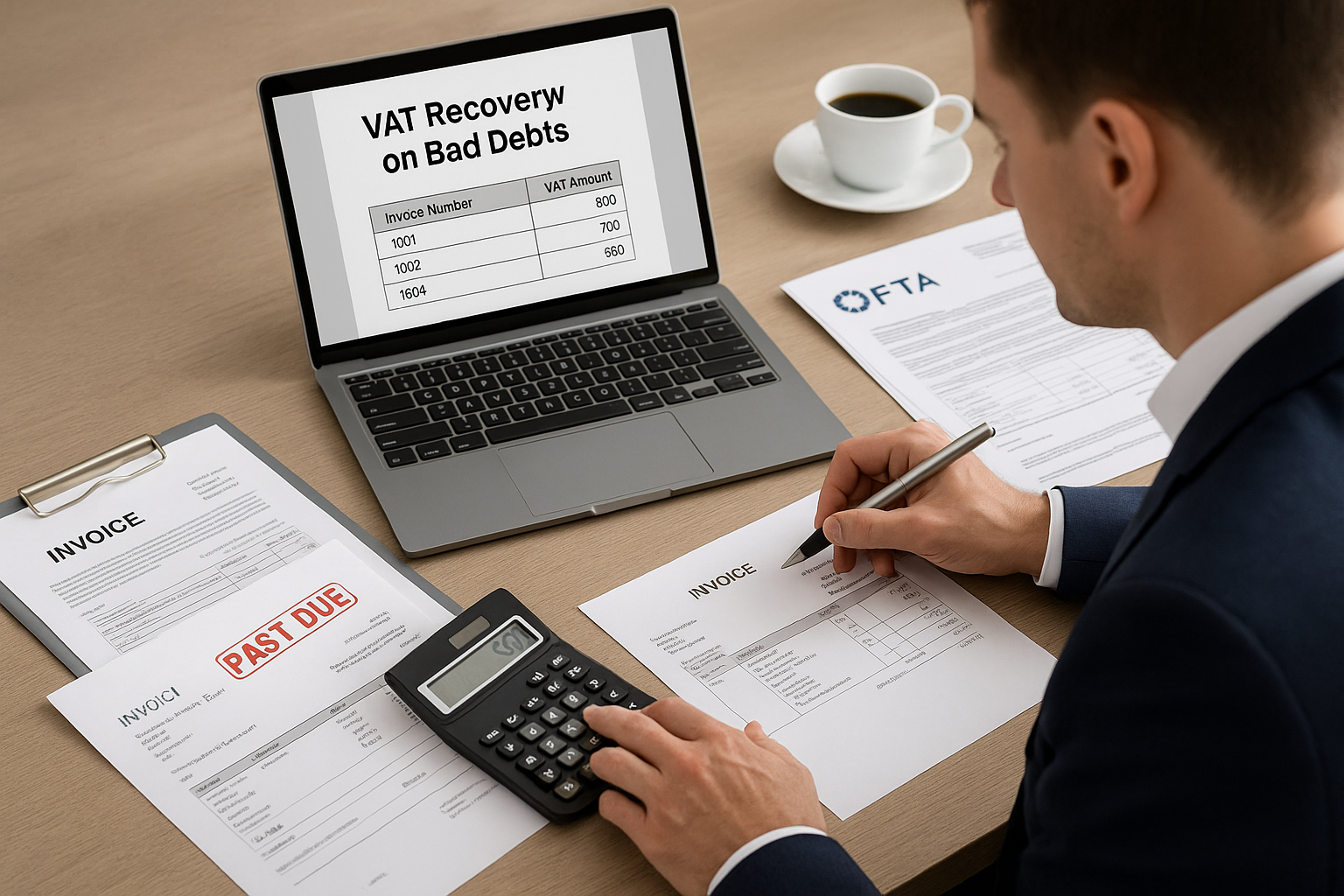
One of the challenges businesses face is dealing with customers who default on payments. The UAE VAT Law allows registered businesses to recover VAT on bad debts, provided certain conditions are met. This ensures that businesses aren't unfairly penalized for unpaid invoices on which VAT was already remitted to the Federal Tax Authority (FTA).
In this blog, we explain the criteria, documentation, and step-by-step procedure for recovering VAT on bad debts under UAE law.
________________________________________
✅ What Are Bad Debts Under VAT?
A bad debt refers to a situation where a supplier has issued a tax invoice, accounted for VAT, and paid it to the FTA — but the customer fails to pay the invoiced amount within a defined period.
Rather than losing out on both the income and VAT, businesses can claim back the VAT portion through a subsequent VAT return.
________________________________________
🧾 Legal Reference
• Federal Decree-Law No. 8 of 2017 (Article 64)
• Cabinet Decision No. 52 of 2017 on the Executive Regulations
________________________________________
📋 Criteria to Recover VAT on Bad Debts
To claim VAT recovery on a bad debt, all of the following must apply:
Condition Explanation
VAT has been paid to the FTA The VAT was declared and paid in a previous return.
6 months have passed At least 6 months must pass from the date of the supply.
Amount remains unpaid The customer has not paid the full amount (partially or entirely).
Reasonable steps taken to recover the debt You’ve sent reminders, follow-ups, or even legal notices.
Recorded in accounting books as bad debt It must be written off as a bad debt in the supplier’s accounts.
________________________________________
🔄 Step-by-Step Procedure to Recover VAT on Bad Debts
1. Identify Unpaid Invoices Older Than 6 Months
• Filter out invoices that remain unpaid 180+ days after the supply date.
2. Ensure VAT Was Declared and Paid
• You must have included these invoices in the relevant VAT return and paid the output VAT.
3. Take Reasonable Recovery Steps
• Send payment reminders, follow-up emails, or debt collection notices.
• Keep proof of all recovery efforts.
4. Write Off the Debt in Your Books
• The invoice amount must be recorded as a bad debt expense in your accounting records.
5. Adjust in Your VAT Return
• In the “Adjustments to Output Tax” section of your next VAT Return (Form 201), reduce the output VAT by the amount related to the bad debt.
⚠️ Note: You cannot recover input VAT if you’re the buyer with unpaid supplier invoices.
________________________________________
📊 Example
You invoiced a client AED 10,500 (including AED 500 VAT) in January 2024. The client didn’t pay, and you followed up multiple times. After 6 months, you write it off as bad debt.
In your July–September 2024 VAT Return, you can:
• Adjust AED 500 in the Output Tax section
• Attach documentation proving non-payment and collection attempts
________________________________________
🗂️ Documentation to Maintain
• Original invoice
• Proof of VAT payment to FTA
• Correspondence with the customer (emails, reminders)
• Ledger entries for bad debt write-off
• Any legal notices or debt collection evidence
________________________________________
⚠️ FTA Audit Tip
If you claim VAT recovery on bad debts, be ready to present clear evidence if the FTA audits you. Without proper documentation, your claim may be rejected, and penalties could apply.
________________________________________
💼 Conclusion
Recovering VAT on bad debts provides relief to suppliers impacted by non-paying customers. However, you must strictly follow the conditions and maintain detailed documentation to remain compliant.
________________________________________
💡 Need Help Filing Bad Debt Adjustments?
At Sheikh Anwar Accounting & Auditing LLC, we help UAE businesses:
• Identify eligible bad debts
• Prepare documentation
• File VAT adjustments properly
📞 Contact us today for VAT support and audit-ready compliance.
📧 info@sa-auditors.com
🌐 www.sa-auditors.com